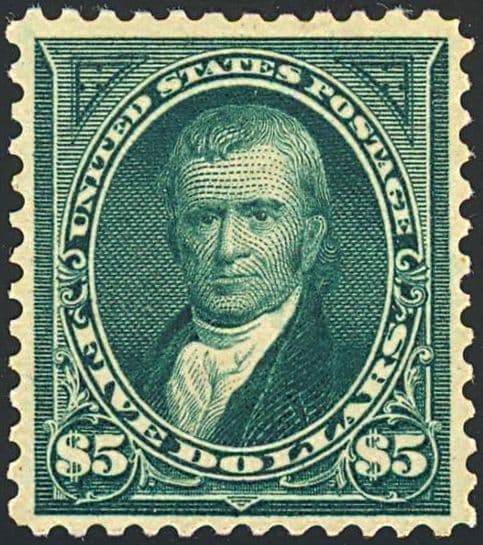
FLOAT 100 · Stamps · No. 36
US 1894 $5 John Marshall
The government's own printers made just over six thousand of them, almost nobody could afford one, and the stamp that crowns America's first Bureau-printed series has been the hardest square in the album ever since.
- Year
- 1894
- Maker
- United States (USPOD), Bureau of Engraving and Printing
- By price in stamps
- 74 of 100
Create a free account to see every recorded price and every grade.
Create a free account- Catalog number
- Scott 263, $5 dark green, unwatermarked, perforated 12
- Issued
- December 10, 1894
- Printer
- Bureau of Engraving and Printing, Washington, the first government-printed U.S. postage stamps
- Subject
- John Marshall (1755-1835), fourth chief justice of the United States
- Quantity issued
- 6,251 on unwatermarked paper; a later watermarked printing ran to under 27,000
- Plate
- Plate No. 85; the certified plate proof is dated November 7, 1894
- Size
- About 1 x 7/8 inch (2.54 x 2.22 cm)
- Role
- Top value of the 1894 First Bureau Issue, the stamp that completes the unwatermarked set
- Highest single sale found
- $11,500 at auction, October 2012, for a never-hinged copy
The government takes over the presses
Until 1894, every United States postage stamp had been printed by a private company working under contract to the Post Office Department. That year the Bureau of Engraving and Printing, a Treasury agency founded during the Civil War to print paper money and later revenue stamps, bid for the stamp contract with the approval of the Secretary of the Treasury. Its bid came in almost $7,000 below the lowest of three private firms competing for the work, and despite loud protests that the Bureau could not do the job, it won.
The result was the Series of 1894, which generations of collectors have called the First Bureau Issue. For speed, the Bureau inherited the American Bank Note Company's dies and simply added small triangles in the upper corners to tell its printings apart. The first value to appear was the 6-cent Garfield in July 1894; most of the rest followed that fall. The series ran to thirteen denominations, from one cent to five dollars.
The top two values were different. The $2 Madison and the $5 Marshall were new designs created specifically for the issue, and the $5 reached the post office on December 10, 1894. The Smithsonian's National Postal Museum holds the certified plate proof of its Plate No. 85, dated November 7, 1894.
The Bureau's first stamps are notoriously hard to find well centered. One auction description of the only copy graded Gem 100 attributed this to the problems of a new printer gearing up under time pressure, and singled out the $1 Type II and the $5 as perhaps the two most difficult denominations to find in superb condition.
The chief justice on the five-dollar stamp
John Marshall was the eldest of fifteen children, born in a log cabin near Germantown, Virginia. He joined the Continental Army in 1776, wintered at Valley Forge with George Washington's troops in 1777-78, and was promoted to captain in 1778. With little formal schooling, he studied law at the College of William and Mary and was admitted to the Virginia bar in 1780.
After serving in the Virginia House of Delegates, the U.S. House of Representatives and as Secretary of State under John Adams, Marshall was confirmed as chief justice on January 27, 1801, and took office on February 4. He served for thirty-four years, the longest tenure of any chief justice. His court established the Supreme Court's power of judicial review, the right to strike down laws that violate the Constitution, and he took part in more than 1,000 decisions while writing more than 500 opinions.
Marshall was also close to Washington. He announced Washington's death in 1799, led the commission that planned the Washington Monument, and at the family's request wrote a five-volume Life of George Washington. One collector reference states that the stamp portrait was modeled on Henry Inman's 1831 painting of Marshall, made a few years before his death in 1835.
Why so few were sold
Five dollars was a week's pay or more for many Americans in 1894, and the stamp paid no ordinary rate. The National Postal Museum's account is that, like the $2, its most likely uses were on large overseas packages or for internal Post Office Department accounting. One dealer reference adds that no envelopes bearing it are recorded.
Collectors and dealers were in no mood to stock up. A year earlier the Post Office had issued the $5 Columbian commemorative, and dealers who had bought those high values hoping for a quick rise had been disappointed. The museum gives the unwatermarked $5 Marshall's issue quantity as just over 6,000, against an estimated 21,000 for the $5 Columbian. Dealer references give the exact figure as 6,251.
In 1895 the Bureau switched to paper watermarked with a double-line USPS, the first U.S. postage stamps on watermarked paper, and the $5 was printed again on the new paper in a quantity of under 27,000. The unwatermarked first printing is the one collectors mean by the 1894 $5. The museum's verdict is blunt: by any comparison, used or unused, the $5 Marshall is a rare stamp. Auction descriptions have called it the rarest regularly issued U.S. stamp.
How to tell an 1894 $5 Marshall
The stamp is printed in dark green by line engraving on soft, porous paper, perforated 12, with a portrait of Marshall framed by the corner triangles that mark every First Bureau stamp. It measures about one inch tall and seven-eighths of an inch wide.
The single most important test is the watermark. The 1894 printing is on unwatermarked paper; the 1895 printing of the same design (Scott 278) carries the double-line USPS watermark, and the museum notes that on watermarked stamps at least part of a U, S or P can be found on every copy. Both printings exist in the same general color, so a stamp must be checked rather than judged by eye.
Condition drives everything. Many surviving copies are regummed, thinned, creased or reperforated, and auction descriptions repeatedly stress how hard the stamp is to find sound with original gum. Original-gum blocks of four are rare, because most have been broken up to supply collectors with singles. Copies are routinely sold with expert certificates, and a few have been numerically graded: a lightly hinged copy graded Gem 100 was described in 2012 as the only example to reach that grade, while the highest grade then awarded to a never-hinged copy was 80.
In the salesroom
Ordinary copies trade far below the stamp's reputation. In 2015 sound original-gum singles sold at auction for roughly $1,050 to $2,500, and used singles from about $400 to $2,100, depending on centering and faults. A no-gum copy brought $675 and a regummed one $500.
Exceptional copies are another matter. In October 2012 a never-hinged single with wide margin at left, once in the Whitman collection, sold for $11,500; the catalog said it was unlikely that more than three or four Extremely Fine never-hinged examples exist. A month later the lightly hinged copy graded Gem 100 sold for $10,500. In May 2013 an Extremely Fine original-gum copy brought $4,750.
Multiples appear rarely. Original-gum blocks of four sold for $3,750 and $6,250 in 2015; the second came with a note that the firm had offered only two others in more than a decade. In October 2025 an unused copy graded Extra Fine 90, from the collection of nuclear-waste expert Daniel Metlay, was offered with an estimate of $5,000 to $7,000.
Marshall stays on the high value
Marshall kept his place at the top of the Bureau's definitive sets. When the Second Bureau Issue arrived, a new $5 dark green Marshall was issued on June 5, 1903, designed by R. Ostrander Smith from a painting by William James Hubard. The museum notes that the 1903 stamp was frequently used for intra-Post Office Department funds transfers, and that in 1917 it was reprinted in light green with perforation 10 to meet wartime demand for high-value postage on parcels of machine parts bound for Russia and shipments of Liberty Bonds.
The 1894 stamp, though, remains the one collectors chase. As the last stamp needed to complete the first Bureau-printed series, it marks the moment the federal government began making its own postage stamps.
The numbers
- Issue date
- December 10, 1894
- Quantity issued
- 6,251 (unwatermarked); watermarked 1895 printing under 27,000
- Paper
- Unwatermarked, soft porous paper
- Perforation
- 12
- Printing
- Line-engraved intaglio, flat plate; Plate No. 85
- Color
- Dark green
- Face value
- $5
Timeline
John Marshall is born near Germantown, Virginia.
Marshall takes office as chief justice; he serves 34 years.
Marshall dies, ending the longest tenure of any chief justice.
The Bureau of Engraving and Printing begins work in the Treasury building.
The Bureau underbids three private printers by almost $7,000 and wins the postage stamp contract.
The first Bureau-printed postage stamp, the 6-cent Garfield, is issued.
Earliest known use of any First Bureau stamp.
The certified plate proof of $5 Plate No. 85 is approved.
The $5 Marshall is issued on unwatermarked paper; 6,251 are issued.
The Bureau moves to double-line USPS watermarked paper; the $5 is reprinted in a quantity under 27,000.
A new $5 Marshall design is issued in the Second Bureau Issue.
A never-hinged 1894 $5, ex Whitman, sells at auction for $11,500.
The only copy graded Gem 100 sells at auction for $10,500.
An original-gum block of four, ex Frelinghuysen, sells for $6,250.
An Extra Fine 90 copy from the Daniel Metlay collection is offered at auction with a $5,000 to $7,000 estimate.
The world in 1894
Coca-Cola is sold in bottles for the first time.
Coxey's Army, the first significant protest march in the United States, sets out from Massillon, Ohio, for Washington.
The Pullman Strike begins as 3,000 Pullman Palace Car Company workers walk out in Illinois.
The International Olympic Committee is founded in Paris at the initiative of Pierre de Coubertin.
Tower Bridge in London opens to traffic.
Sanford B. Dole proclaims the short-lived Republic of Hawaii.
The First Sino-Japanese War begins.
French Army officer Alfred Dreyfus is arrested for spying, beginning the Dreyfus affair.
Price record
| Date | Price | Kind |
|---|---|---|
| Oct 2012 | $11,500 | Sold at auctionNever hinged, wide selvage at left, ex Whitman; described as Very Fine and choice. |
| Oct 2012 | $2,500 | Sold at auctionUsed, jumbo margins, registry oval cancel; graded VF 80 Jumbo. |
| Nov 2012 | $10,500 | Sold at auctionOriginal gum, lightly hinged; graded Gem 100, described as the only example at that grade. |
| Dec 2012 | $1,300 | Sold at auctionUsed, unobtrusive cancel, Fine, with certificate. |
| Dec 2012 | $550 | Sold at auctionDisturbed original gum, hinge remnant, Fine. |
| Dec 2012 | $450 | Sold at auctionRegummed, tiny thin speck, Fine. |
| Feb 2013 | $850 | Sold at auctionDisturbed original gum, hinge thin, Fine. |
| Mar 2013 | $3,250 | Sold at auctionOriginal gum, Very Fine, with certificate. |
| Apr 2013 | $2,800 | Sold at auctionOriginal gum, previously hinged, Very Fine. |
| May 2013 | $4,750 | Sold at auctionOriginal gum, lightly hinged, Extremely Fine, with 1979 and 2013 certificates. |
| Jul 2013 | $2,200 | Sold at auctionUsed, wide margins, oval registry cancel, Very Fine. |
| Jul 2013 | $1,100 | Sold at auctionOriginal gum, barely hinged, Fine. |
| Jul 2013 | $800 | Sold at auctionUsed, crease and filled thin, appears Fine. |
| Jul 2013 | $700 | Sold at auctionOriginal gum, gum creases and corner crease. |
| Apr 2015 | $2,500 | Sold at auctionOriginal gum, lightly hinged, Very Fine and choice. |
| Apr 2015 | $2,100 | Sold at auctionUsed, New York registry oval cancels, Very Fine and choice. |
| May 2015 | $1,500 | Sold at auctionOriginal gum, previously hinged, Very Fine, with 1973 and 2015 certificates. |
| Jun 2015 | $1,400 | Sold at auctionSlightly disturbed original gum, Very Fine. |
| Jul 2015 | $1,250 | Sold at auctionOriginal gum, lightly hinged, nearly Very Fine; a single from a former block of four. |
| Jul 2015 | $1,050 | Sold at auctionOriginal gum, lightly hinged, large margins, Fine; a single from a former block of four. |
| Jul 2015 | $625 | Sold at auctionOriginal gum disturbed from hinge removal, Fine. |
| Jul 2015 | $500 | Sold at auctionRegummed over thins, Fine appearance. |
| Aug 2015 | $1,600 | Sold at auctionLarge part original gum, Very Fine. |
| Aug 2015 | $1,500 | Sold at auctionOriginal gum, previously hinged, Fine to Very Fine. |
| Aug 2015 | $900 | Sold at auctionUsed, light New York oval cancel, Fine to Very Fine. |
| Aug 2015 | $675 | Sold at auctionUnused, no gum, tiny corner creases. |
| Aug 2015 | $400 | Sold at auctionUsed, registry cancel, several small thin spots. |
| Oct 1, 2026 | $5,000 | Asking price, not a saleDealer asking price for a mint copy. |
| Oct 1, 2026 | $7,000 | Asking price, not a saleDealer asking price for a mint copy described as Fine centering. |
| Oct 1, 2026 | $2,900 | Asking price, not a saleDealer asking price for a used single. |
A price-guide value is an editorial estimate, not a transaction and not an asking price. Guides lag the market and smooth over grade and condition. It is neither a floor nor a ceiling: a sale can land above or below it, and it should be checked against a realized sale before anything rests on it.
By reference price, US 1894 $5 John Marshall is number 74 of 100 in the stamps entries of the FLOAT 100. 82 of those 100 rest on a realized sale; the rest carry an asking price or a guide value, and each page says which. Rank within the FLOAT 100 itself (36 here) is editorial: how much an object defines its field, not price alone.
Did you know
- The Bureau of Engraving and Printing won the 1894 stamp contract by underbidding three private printers by almost $7,000, over loud protests that it could not do the job.
- The $5 Marshall and $2 Madison were the only new designs in the series; the lower values largely repeated the old private-company designs with small triangles added to the corners.
- The National Postal Museum thinks the $5 was mostly used on heavy overseas packages or for the Post Office Department's internal accounting.
- Only about 6,000 unwatermarked copies were issued, against an estimated 21,000 of the more famous $5 Columbian.
- Most original-gum blocks of four have been broken up to give collectors singles, so intact blocks are now rare in their own right.
- Marshall returned on the 1903 $5, and a 1917 reprint helped mail machine parts to Russia and Liberty Bonds during World War I.
How this page is made
- The figure
- One reference price, shown with its own kind. FLOAT does not average it with anything or adjust it for time.
- Realized or not
- A realized price is a completed sale. An asking price, an estimate and a price-guide value are not sales, and are labeled as such wherever they appear.
- The story
- Researched from published records and checked fact by fact. Updated Oct 1, 2026.
- Archive
- Oct 5, 2026