FLOAT 100 · Stamps · No. 37
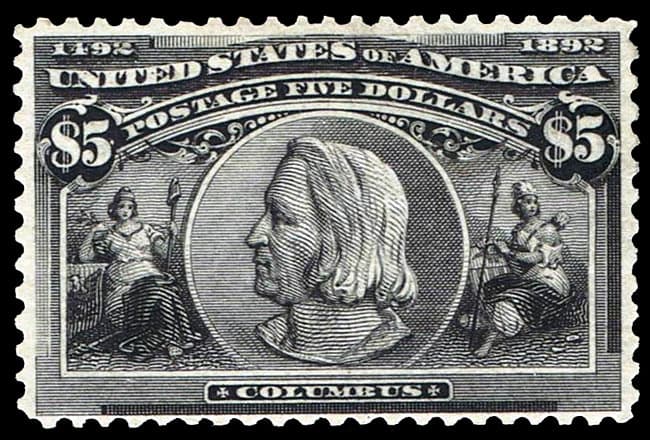
US 1893 Columbian $5 'Columbus'
A Chicago newspaper sneered that it was good for nothing except mailing sixty pounds of books, yet the five-dollar Columbus became the stamp that tells American collectors their set is finally complete.
- Year
- 1893
- Maker
- United States (USPOD)
- By price in stamps
- 72 of 100
Create a free account to see every recorded price and every grade.
Create a free account- Catalog number
- Scott 245, $5 black, Columbian Exposition Issue
- Issued
- January 1893; the first fifteen Columbian values went on sale January 1 in New York and Boston and nationwide on January 2
- Printer
- American Bank Note Company, New York
- Engravers
- Alfred Jones (Columbus portrait) and Charles Skinner (the two flanking figures)
- Printed / sold
- 27,350 printed; 21,844 sold, the rest destroyed
- On sale
- January 1893 to April 12, 1894
- Size
- About 1 x 1 1/2 inches, the large horizontal Columbian format
- Firsts
- The first U.S. stamp of $5, in America's first commemorative set
- Condition rarity
- Only 10 copies were certified never hinged by one leading expert committee between August 1993 and February 2004
- Highest single sale found
- $65,000 at auction, December 2010, for a never-hinged copy graded XF-Superb 95
A stamp for a world's fair
In the late 1880s American cities competed to host a world's fair. On February 24, 1890, Congress chose Chicago, and within months the event became the World's Columbian Exposition, marking the 400th anniversary of Christopher Columbus's first voyage. Postmaster General John Wanamaker took up the idea of honoring the event with special stamps, and the result was the Columbian Exposition Issue of 1893, the first commemorative stamps the United States ever issued.
The set was enormous by the standards of the day. Fifteen values went on sale at the start of January 1893: a dealer account says the stamps were placed on sale January 1 in New York and Boston, while most post offices, closed for the holiday, opened sales on January 2. An 8-cent value was added in March to pay a newly lowered registration fee. For the first time, the series included stamps of $1, $2, $3, $4 and $5; no U.S. postage stamp before had cost more than 90 cents. The full set cost $16.34, of which the five dollar-denominated values made up $15.
None of the dollar values was meant to pay a specific rate. The Smithsonian's National Postal Museum concludes that their function seems to have been to publicize the fair and raise revenue: printing cost about the same for any denomination, so the high values carried a large profit. In practice, collectors and dealers used them to overpay ordinary domestic postage on souvenir covers, and in a few cases they paid heavy foreign parcel rates.
The engravers and the portrait
The American Bank Note Company held the stamp contract, but the Columbians' large size required a special agreement. Wanamaker signed it without competitive bidding, letting the company charge 17 cents per thousand stamps against the 7.45 cents it charged for the regular 1890 stamps. The arrangement drew public criticism, and Wilson Bissell, who became Postmaster General when Grover Cleveland returned to office in March 1893, tried to renegotiate it.
Alfred Jones, an English-born engraver then past seventy, engraved the Columbus portrait, and Charles Skinner engraved the two figures that flank it. Jones had finished his apprenticeship in 1841, and his own firm became part of American Bank Note in 1859. He also engraved the portrait for the Columbian half dollar that the U.S. Mint struck for the fair. On the coin Columbus faces left; on the stamp he faces right.
Neither image is a portrait from life. Collector accounts trace the profile to a Columbus medal or metal cast associated with the New York sculptor Olin L. Warner, made in Madrid. One auction description summarized the chain: the half dollar was based on the original medal, and the stamp's design was taken from that, leaving it twice removed from the source.
A craze, and a backlash
The Columbians caused a sensation. Collectors lined up to buy them, some postal clerks refused to sell them because demand outran supply, and the craze ran even hotter in Europe, where a corner of the Hamburg stock exchange was given over to trading them. On August 11, 1893, The New York Times reported that the stamps were handled there "as carefully as they handled the highest gilt-edged securities."
Not everyone approved. An organization called the Society for the Suppression of Speculative Stamps was formed in protest, arguing that the fair did not deserve commemorative postage, and some collectors objected to the Post Office profiting from their hobby. The Chicago Tribune mocked the $5 stamp, saying it could be used for only one purpose: mailing a 62.5-pound package of books at the book rate.
The fair itself, the "White City," opened on Chicago's lakefront on May 1, 1893, and drew twenty-seven million visitors over the next seven months. It opened days before the Panic of 1893 plunged the country into depression. The set's $16.34 face was a substantial sum in 1893, and only a small number of the most expensive values were sold.
How many, and what survives
The American Bank Note Company printed 27,350 copies of the $5. The Post Office sold 21,844. The Columbians came off sale on April 12, 1894, and the unsold stock was destroyed; one history gives the remaining 5,506 copies of the $5 as destroyed by the Post Office Department in June 1899. The museum, for comparison, estimates that only about 6,000 of the unwatermarked 1894 $5 Marshall that followed were issued.
Because the stamp was expensive and famous from the day it appeared, collectors saved a large share of it. A 2004 study by a leading New York expert committee counted 1,413 unused $5 Columbians it had certified as of March 2004. Time has taken its toll, though. Of 1,818 submissions from 1945 to February 2004, only 870 were genuine with no defects; 222 were regummed and 225 had reperforated edges. Only 48 percent of all submissions were free of faults.
Never-hinged copies are the true rarity. For more than a century collectors proudly hinged the top value of the set into their albums, and most never-hinged survivors come from broken blocks. The committee certified only 10 never-hinged copies between August 1993 and February 2004. It has never received an unused copy with a straight edge for certification, even though every original pane included five straight-edge stamps.
Multiples and covers are rarer still. The largest reported multiple is a block of 14 without gum; the largest numbered plate multiple is an imprint plate number block of eight; 17 blocks of four were recorded. Only sixteen covers bearing the stamp had been certified. The largest recorded usage of Columbian stamps is $49.34 in postage on a piece of a registered package wrapper mailed from Bangor, Maine, on February 19, 1897, with a strip of three $5 stamps and a single.
Identifying a genuine $5 Columbian
The stamp is printed in black in the wide horizontal format shared by the whole Columbian set, about 1 inch tall by 1 1/2 inches wide. The center shows Columbus in profile facing right inside a circle, with a standing figure engraved by Skinner on each side.
Because it is valuable, it has been heavily doctored. The committee's records show the common problems: regumming, reperforation on any of the four sides (most often the top), thins and tears, and altered items such as fake cancels and perforated proofs. Used blocks bearing bull's-eye target cancels are believed to carry non-contemporary markings. The committee's advice is plain: get a certificate before buying or selling one.
The yardstick of a collection
The National Postal Museum calls the $5 the issue's most famous stamp and says it has "an almost mystical aura in the United States philatelic community." The philatelic historian Lester Brookman described it as "the very peak of desire for a great many collectors," and the 2008 book 100 Greatest American Stamps ranked it fourth. The stamp author Max Johl wrote that the degree of completion of the Columbian set is often the yardstick by which a U.S. collection is measured.
In the salesroom, ordinary hinged copies sold in 2015 for roughly $600 to $1,000, and used copies for about $375 to $800. The very best bring far more. In December 2010 a never-hinged copy graded XF-Superb 95, one of only three at that grade, sold for $65,000. In March 2011 a lightly hinged corner-margin copy graded Superb 98, from the collection known as Beverly Hills, sold for $13,000, and a never-hinged Very Fine copy brought $6,250.
The Columbians were also the last U.S. postage stamps made by a private printer for decades. In 1894 the Bureau of Engraving and Printing underbid American Bank Note for the contract, and the $5 Columbian's slow sales shaped what came next: dealers who had been disappointed by it bought few of the Bureau's $5 Marshall when it appeared in December 1894.
The numbers
- Issue date
- January 1, 1893 (New York and Boston); January 2 elsewhere
- Quantity printed
- 27,350
- Quantity sold
- 21,844
- Unused copies certified
- 1,413 by one expert committee as of March 2004; 10 never hinged, August 1993 to February 2004
- Covers certified
- 16
- Printing
- Engraved, printed in black by the American Bank Note Company
- Face value
- $5, top value of a 16-stamp set totaling $16.34
Timeline
Congress selects Chicago to host the world's fair, soon renamed the World's Columbian Exposition.
President Benjamin Harrison invites all nations to take part in the commemoration.
Alfred Jones, past seventy, begins engraving the Columbian Exposition Issue.
The first fifteen Columbian values go on sale in New York and Boston; most other post offices begin on January 2.
Grover Cleveland returns to office; the 8-cent Columbian is added to the set.
The World's Columbian Exposition opens in Chicago.
The New York Times reports Columbian stamps being traded on the Hamburg stock exchange.
The exposition closes after drawing some twenty-seven million visitors.
The Columbians are withdrawn from sale; 21,844 of the 27,350 $5 stamps printed have been sold.
A registered package mailed from Bangor, Maine, carries $49.34 in Columbians, including four $5 stamps, the largest recorded Columbian usage.
According to one history, the 5,506 unsold $5 stamps are destroyed by the Post Office Department.
A New York expert committee certifies the largest reported multiple, a block of 14 without gum.
The committee begins certifying stamps as never hinged; by 2004 it has certified only 10 $5 Columbians that way.
100 Greatest American Stamps ranks the $5 Columbus fourth.
A never-hinged copy graded XF-Superb 95 sells at auction for $65,000.
A hinged corner-margin copy graded Superb 98 sells at auction for $13,000.
The world in 1893
Queen Liliuokalani's government in Hawaii is overthrown with the intervention of U.S. Marines.
A crash on the New York Stock Exchange begins the Panic of 1893 and a depression.
Lizzie Borden is acquitted of the axe murders of her parents in Fall River, Massachusetts.
Frederick Jackson Turner presents "The Significance of the Frontier in American History" in Chicago.
The World Parliament of Religions opens in Chicago alongside the fair; Swami Vivekananda receives a standing ovation.
New Zealand becomes the first country to grant women the vote.
Charles and Frank Duryea drive the first gasoline-powered motorcar in America on public roads in Springfield, Massachusetts.
Antonin Dvorak's Symphony No. 9, "From the New World," premieres at Carnegie Hall.
Price record
| Date | Price | Kind |
|---|---|---|
| Oct 2010 | $1,200 | Sold at auctionOriginal gum, slight gum disturbance, Very Fine. |
| Oct 2010 | $800 | Sold at auctionOriginal gum, light corner crease, Very Fine otherwise. |
| Oct 2010 | $750 | Sold at auctionUnused, no gum, almost perfectly centered. |
| Oct 2010 | $500 | Sold at auctionDisturbed original gum, pinhole, Fine. |
| Nov 2010 | $1,300 | Sold at auctionLightly hinged, wide margins, Very Fine. |
| Nov 2010 | $700 | Sold at auctionUsed, registry cancel, Very Fine. |
| Dec 2010 | $65,000 | Sold at auctionNever hinged, graded XF-Superb 95, described as the highest grade then awarded and one of three at that grade. |
| Dec 2010 | $4,400 | Sold at auctionUsed with circular datestamp, graded XF 95. |
| Feb 2011 | $1,200 | Sold at auctionLightly hinged, well centered, Fine. |
| Mar 2011 | $13,000 | Sold at auctionLightly hinged lower right corner-margin single, graded Superb 98; ex Beverly Hills collection. |
| Mar 2011 | $6,250 | Sold at auctionNever hinged, Very Fine; ex Odeneal. |
| Mar 2011 | $3,750 | Sold at auctionUsed, graded XF-Superb 95. |
| Mar 2011 | $2,300 | Sold at auctionOriginal gum, Extremely Fine. |
| Mar 2011 | $1,900 | Sold at auctionUsed, New York registry cancel, graded XF 90. |
| Aug 2015 | $978 | Sold at auctionOriginal gum, Very Fine. |
| Aug 2015 | $863 | Sold at auctionOriginal gum, Fine, with certificate. |
| Aug 2015 | $863 | Sold at auctionOriginal gum, hinge remnant, Fine to Very Fine. |
| Aug 2015 | $850 | Sold at auctionRegummed, tiny repair, Very Fine to Extremely Fine appearance. |
| Aug 2015 | $800 | Sold at auctionOriginal gum, hinge remnant, Fine to Very Fine. |
| Aug 2015 | $800 | Sold at auctionUsed, large margins, Extremely Fine. |
| Aug 2015 | $700 | Sold at auctionOriginal gum, disturbed, light corner creases. |
| Aug 2015 | $690 | Sold at auctionRegummed, Fine to Very Fine. |
| Aug 2015 | $625 | Sold at auctionLightly disturbed original gum, hinge remnant, with certificate. |
| Aug 2015 | $604 | Sold at auctionUsed, target cancel, crease and filled thin. |
| Aug 2015 | $546 | Sold at auctionRegummed, small corner repair. |
| Aug 2015 | $425 | Sold at auctionUsed, light cancel, nibbed perf. |
| Aug 2015 | $374 | Sold at auctionUsed, pressed crease. |
| Aug 2015 | $350 | Sold at auctionUnused, internal tear. |
| Aug 2015 | $325 | Sold at auctionOriginal gum, hinge thins, pulled perf, Very Good to Fine. |
| Oct 1, 2026 | $3,750 | Asking price, not a saleDealer asking price for a mint copy. |
| Oct 1, 2026 | $5,250 | Asking price, not a saleDealer asking price for a mint copy described as Fine centering. |
| Oct 1, 2026 | $2,100 | Asking price, not a saleDealer asking price for an unused copy with small flaws. |
| Oct 1, 2026 | $1,800 | Asking price, not a saleDealer asking price for a used single. |
| Oct 1, 2026 | $2,520 | Asking price, not a saleDealer asking price for a used single described as Fine centering. |
A realized auction price is what a buyer actually paid on the date shown, including the buyer's premium where the sale reported it. It is the strongest kind of reference price, and it is a record of one sale of one object on one day, not a promise of what the next example will bring.
By reference price, US 1893 Columbian $5 'Columbus' is number 72 of 100 in the stamps entries of the FLOAT 100. 82 of those 100 rest on a realized sale; the rest carry an asking price or a guide value, and each page says which. Rank within the FLOAT 100 itself (37 here) is editorial: how much an object defines its field, not price alone.
Did you know
- The Chicago Tribune joked that the $5 Columbian could be used for only one thing: mailing a 62.5-pound package of books.
- Columbus faces right on the stamp but left on the Columbian half dollar, though the same engraver, Alfred Jones, cut both portraits.
- In 1893 a corner of the Hamburg stock exchange was devoted to trading Columbian stamps.
- A group called the Society for the Suppression of Speculative Stamps was formed to protest the set.
- Every original pane included five straight-edge stamps, yet the leading expert committee has never been sent an unused straight-edge copy to certify.
- The biggest recorded use of Columbians is $49.34 in postage on a registered package from Bangor, Maine, in 1897, including four $5 stamps.
- Of the 27,350 printed, only 21,844 were sold; the rest were destroyed.
How this page is made
- The figure
- One reference price, shown with its own kind. FLOAT does not average it with anything or adjust it for time.
- Realized or not
- A realized price is a completed sale. An asking price, an estimate and a price-guide value are not sales, and are labeled as such wherever they appear.
- The story
- Researched from published records and checked fact by fact. Updated Oct 1, 2026.
- Archive
- Oct 5, 2026