FLOAT 100 · Coins · No. 21
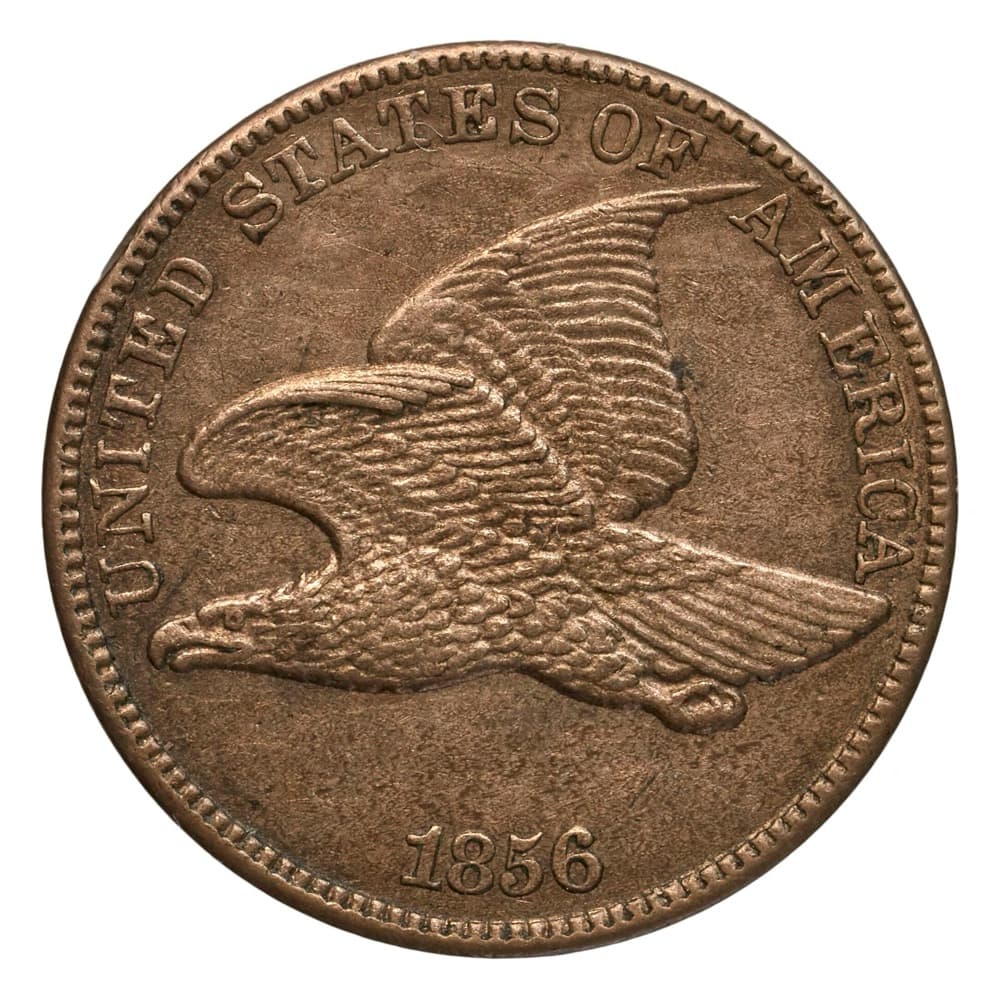
1856 Flying Eagle Cent
Before Congress had approved a small cent, the Mint struck hundreds of them to win votes, handed them to lawmakers and the president, and accidentally created the coin that set off America's first collecting boom.
- Year
- 1856
- Maker
- U.S. Mint (Philadelphia)
- By price in coins
- 49 of 100
Create a free account to see every recorded price and every grade.
Create a free account- Struck
- Late 1856 and early 1857 as a pattern, with more 1856-dated pieces made later in the 1850s for collectors
- Status
- A pattern and presentation piece; Congress did not authorize the small cent until February 21, 1857
- Designer
- Chief Engraver James B. Longacre, after Christian Gobrecht's flying eagle
- Metal
- 88% copper, 12% nickel, about 72 grains
- How many
- Never officially reported; estimates run from about 800 to 1,500, with at least 634 given to officials
- Key variety
- Snow-3, identified by repunching on the 5 of the date and tied to the original 1856 distribution
- This entry
- Snow-3, PCGS PR67+ CAC, ex Bob R. Simpson; described as the finest PCGS had seen
- This coin's sales
- $240,000 in September 2020; $312,000 in November 2024, a record for the issue
The big copper problem
Since 1793 the American cent had been a pure-copper coin about the size of a half dollar. By the 1840s it was disliked: it was not legal tender, so banks and merchants could and often did refuse it, and it was bulky. When copper prices jumped in 1849, the Treasury began looking for an alternative. By 1851, one account says, it cost the Mint $1.06 to make a dollar's worth of cents.
The search took years. In 1850 New York Senator Daniel S. Dickinson proposed a cent of copper with a little silver, with a hole in the middle; the Mint found the holed pieces hard to eject from the presses and the silver costly to recover. In his 1854 annual report, Mint Director James Ross Snowden called for small cents and for abolishing the half cent, which he called useless. Patterns came in 1854 and 1855, some adapting the late Christian Gobrecht's flying eagle, itself based on a sketch by Titian Peale.
In early 1856 Snowden asked Congress for a small cent, with the size and metal left to him and Treasury Secretary James Guthrie. The bill was introduced in the Senate on March 25, 1856. In July, Snowden proposed an alloy of 88 percent copper and 12 percent nickel, backed by the Mint's melter and refiner, James Curtis Booth, at a weight of 72 grains, convenient because 80 of them made a troy pound. One account says Snowden was also being lobbied by Joseph Wharton, whose nickel interests stood to gain.
Longacre's borrowed eagle
James Barton Longacre, born in Delaware County, Pennsylvania, in 1794, ran away to Philadelphia at 12, became a bookstore apprentice, and trained as an engraver in the firm that grew out of the business of the Mint's first chief engraver, Robert Scot. He made his name with portraits of leading Americans and became the Mint's fourth chief engraver in 1844, after Gobrecht's death.
Longacre started with Liberty heads, but Snowden asked for a flying eagle. In early November 1856 Longacre prepared dies in the final design: an eagle in flight on the obverse with UNITED STATES OF AMERICA above and the date below, and on the reverse ONE CENT inside a wreath of corn, wheat, cotton and tobacco, crops of both North and South. The eagle came from Gobrecht's dollars of 1836 to 1839, and the wreath from Longacre's own 1854 gold dollar and three-dollar piece. Some sources say Gobrecht's bird was modeled on Peter, a tame eagle that lived at the Mint until it was killed in the machinery; it was stuffed and is still displayed at the Philadelphia Mint.
The design was admired then and later. In 1905, Augustus Saint-Gaudens wrote to President Theodore Roosevelt that the flying eagle of the 1857 cent was 'by all odds the best design on any American coin.' It was also hard to strike. The hard alloy and the eagle's position opposite the wreath left many coins weak at the eagle's head, breast and tail, and the design was replaced by Longacre's Indian Head cent in 1859.
A coin made to win a vote
To sell the idea, the Mint struck at least several hundred cents in the new design and alloy and began handing them out in November 1856. Two hundred went to the House Committee on Coinage, Weights and Measures, and four to President Franklin Pierce. At least 634 were distributed, possibly more, and extras were available on request. Snowden wrote in December that he was 'pressed on all hands, and from every quarter, for the new cent.'
The bill still had to survive the House, where members fought over making the cent legal tender and over letting the Mint strike medals for the public. Both provisions were dropped. The Senate added a two-year window for redeeming worn Spanish silver, the House agreed on February 18, and Pierce signed the act on February 21, 1857. It abolished the half cent and set the new cent at 72 grains of 88 percent copper and 12 percent nickel.
Strictly speaking, Snowden had struck the 1856 coins without authorization from Congress. One numismatic writer has argued that, like the 1804 dollar and the 1913 Liberty nickel, they could in principle be considered illegally struck. Collectors have never treated them that way.
The coin that started a hobby
The new cents went out on May 25, 1857. The Mint built a temporary wooden booth in its courtyard with two windows, signed 'cents for cents' and 'cents for silver,' and crowds, by one account more than a thousand people, lined up with old coppers and worn Spanish coins wrapped in newspaper and handkerchiefs. Snowden reported $30,000 worth on hand that morning, three million coins, and expected nearly all of it to go out that day. The 17,450,000 Flying Eagle cents struck in 1857 were the largest production of a single coin in a year at a U.S. mint to that time.
The public soon learned that an 1856-dated cent existed, and started checking change. By 1859, 1856 cents sold for as much as $2 each. At the same time, people began trying to assemble old large cents back to 1793. Writers on the series credit the 1856 cent with sparking the nation's first coin-collecting boom.
The Mint fed the demand. Later strikings from 1856-dated dies, first for officials and then, by 1859 if not late 1858, expressly for collectors, ran into 1860, and the extra supply drove prices down to as little as 25 cents. Specialists divide the coins into originals of 1856 and early 1857, the first restrikes of 1858, and questionable second restrikes of 1860. Collector George W. Rice once owned 756 pieces and John Beck 531.
Proof or not, Snow-3 or Snow-9
Specialist Rick Snow's die-pair numbers organize the issue. Snow-9 is the most common and accounts for most of the Proofs struck for collectors around 1859. Snow-3 is the one specialists tie to the original distribution: Snow has suggested it may include most or all of the 634 coins given to Congress. It is identified by repunching on the 5 of the date, on its left side or upright.
Whether a given coin is a Proof is an old argument. The grading services generally certify many 1856 cents as Proofs. Walter Breen in 1977 described coins from the Snow-3 dies as 'usually non-proofs, proofs rare,' and grading experts consulted for a 1996 guide to Flying Eagle and Indian cents could not agree. Snow-3 coins often show non-Proof traits, such as softly struck breast feathers, rounded leaves and satiny surfaces, even when early impressions have flashy, prooflike fields.
The coin in this entry shows both sides of that argument. Graded PR67+ by PCGS and approved by CAC, it was cataloged with flashy, prooflike fields, moderately frosted devices and bronze-gold surfaces with copper-orange, magenta, powder-blue and mint-green accents, yet with the slight rounding of the breast feathers associated with original Snow-3 strikes. As of August 2024, PCGS reported two 1856 cents in PR67, one of them PR67+, with none finer.
Counterfeits are common in the series, made by altering dates, with false dies and with spark-erosion dies, so expert authentication matters for any 1856 cent.
From $240,000 to $312,000
This coin, from the collection of Bob R. Simpson, sold at auction on September 17, 2020, for $240,000. It returned on November 21, 2024, in a sale in Dallas, and brought $312,000, a record for the issue. An executive of the auction firm called it 'the finest example seen by PCGS.' The same sale set a Mint State record when a Snow-3 MS66 from the Greensboro Collection brought $192,000, passing the $172,500 paid for another Snow-3 MS66 in January 2004.
Sources disagree on the auction record. A grading-service price page still lists the issue's record as $70,500 for a PR66 in 2019, while the sale reports give $312,000 for this coin. FLOAT treats $312,000 as the highest reported price.
The numbers
- Mintage
- Not officially reported; estimates of about 800 to 1,500, including later restrikes. At least 634 went to officials.
- Known survivors
- No firm count; one 19th-century collector alone owned 756
- Weight
- 72 grains, about 4.67 to 4.70 grams
- Diameter
- 19 millimeters
- Composition
- 88% copper, 12% nickel
- Designer
- James B. Longacre, after Christian Gobrecht and Titian Peale
- Top population
- Two PCGS PR67 coins, one PR67+, none finer (August 2024)
Timeline
A sharp rise in copper prices sends the Treasury looking for an alternative to the large cent.
Senator Daniel S. Dickinson introduces a bill for a holed billon cent.
Mint Director James Ross Snowden calls for small cents and the end of the half cent.
Snowden's small-cent bill is introduced in the Senate.
Snowden proposes an alloy of 88% copper and 12% nickel.
Longacre prepares the final dies; the Mint begins giving 1856 Flying Eagle cents to Congress and officials.
President Pierce signs the act authorizing the small cent and abolishing the half cent.
Striking of Flying Eagle cents for circulation begins.
The new cents are released at a booth in the Philadelphia Mint's courtyard.
The first restrikes from 1856-dated dies are made for sale to collectors.
The Indian Head cent replaces the Flying Eagle; 1856 cents sell for as much as $2.
A questionable second round of 1856 restrikes is made.
Walter Breen describes Snow-3 coins as usually non-Proofs.
A Snow-3 MS66 sells at auction for $172,500.
This coin sells at auction for $240,000.
This coin, PCGS PR67+ CAC, sells at auction in Dallas for a record $312,000.
The world in 1856
President Franklin Pierce declares the Free-State government in Topeka, Kansas, to be in rebellion.
Dallas, Texas, is incorporated as a city.
Pro-slavery forces sack Lawrence, Kansas.
Congressman Preston Brooks beats Senator Charles Sumner with a cane in the Senate chamber.
Followers of John Brown kill five pro-slavery settlers at Pottawatomie, Kansas.
The Great Train Wreck of 1856 near Philadelphia kills at least 59.
James Buchanan wins the presidency over Millard Fillmore and John C. Fremont.
Price record
| Date | Price | Kind |
|---|---|---|
| Jun 2000 | $83,375 | Sold at auctionPaul R. Gougelman example, Snow-5, PCGS MS66. |
| Jan 7, 2004 | $172,500 | Sold at auctionSnow-3, PCGS MS66. |
| Aug 2018 | $52,800 | Sold at auctionSnow-3, PCGS MS65, sold at auction in August 2018. |
| Sep 26, 2019 | $70,500 | Sold at auctionPCGS PR66. |
| Sep 17, 2020 | $240,000 | Sold at auctionThis coin, Snow-3, PCGS PR67+, Bob R. Simpson collection. |
| Nov 21, 2024 | $192,000 | Sold at auctionSnow-3, PCGS MS66, Greensboro Collection; Mint State record. |
| Nov 21, 2024 | $312,000 | Sold at auctionThis coin, Snow-3, PCGS PR67+ CAC. Sold at auction in Dallas; record for the issue. |
A realized auction price is what a buyer actually paid on the date shown, including the buyer's premium where the sale reported it. It is the strongest kind of reference price, and it is a record of one sale of one object on one day, not a promise of what the next example will bring.
By reference price, 1856 Flying Eagle Cent is number 49 of 100 in the coins entries of the FLOAT 100. 96 of those 100 rest on a realized sale; the rest carry an asking price or a guide value, and each page says which. Rank within the FLOAT 100 itself (21 here) is editorial: how much an object defines its field, not price alone.
Did you know
- President Franklin Pierce was given four 1856 Flying Eagle cents before Congress had authorized the coin.
- Augustus Saint-Gaudens called the flying eagle 'by all odds the best design on any American coin' and later put a flying eagle on his double eagle.
- The eagle may trace back to Peter, a pet eagle at the Philadelphia Mint whose stuffed body is still on display there.
- To show off the new alloy, the Mint struck 50 half cents in copper-nickel and sent them to Washington.
- Snowden once suggested replacing the eagle with Christopher Columbus; Longacre warned it would draw objections.
- In anticipation of the new law, most of the 333,456 large cents struck in 1857 never left the Mint and were melted.
- By 1859 an 1856 cent could sell for $2, two hundred times its face value.
How this page is made
- The figure
- One reference price, shown with its own kind. FLOAT does not average it with anything or adjust it for time.
- Realized or not
- A realized price is a completed sale. An asking price, an estimate and a price-guide value are not sales, and are labeled as such wherever they appear.
- The story
- Researched from published records and checked fact by fact. Updated Oct 1, 2026.
- Archive
- Oct 5, 2026