FLOAT 100 · Coins · No. 47
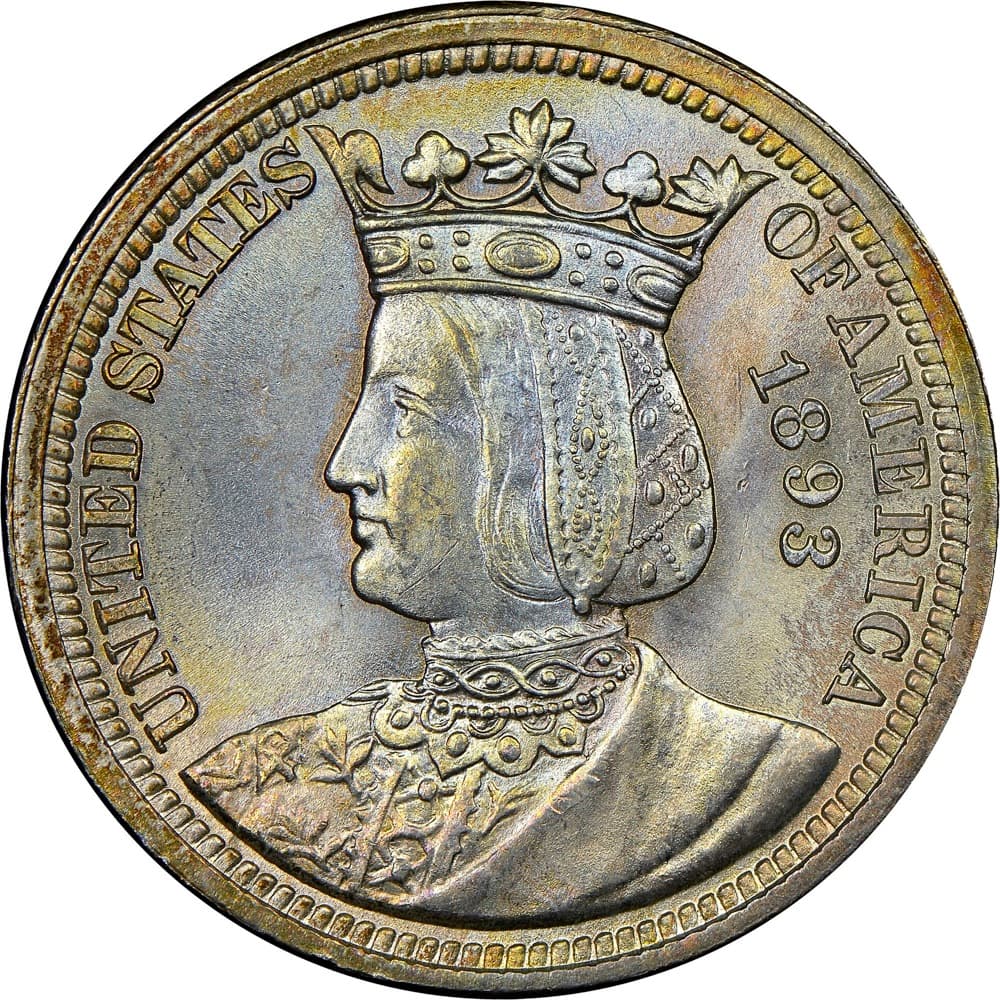
1893 Isabella Quarter
The women running the 1893 World's Fair wanted the first truly beautiful American coin, designed by a woman; the Mint pushed their sculptor out, and the result became the only commemorative quarter of the classic era and the first U.S. coin to show a foreign monarch.
- Year
- 1893
- Maker
- U.S. Mint (Philadelphia)
- By price in coins
- 93 of 100
Create a free account to see every recorded price and every grade.
Create a free account- Struck
- From June 13, 1893, Philadelphia Mint (no mintmark)
- Ordered by
- The Board of Lady Managers of the World's Columbian Exposition, led by Bertha Palmer
- Designer
- Charles E. Barber; reverse after a sketch by George T. Morgan
- Subject
- Queen Isabella I of Castile, Columbus's royal patron; reverse, a kneeling woman with distaff and spindle
- Mintage
- 40,023 struck; 15,809 melted; 24,214 distributed
- Specifications
- 6.25 grams, 24.3 mm, 90% silver and 10% copper, reeded edge
- Issue price
- $1, the same as the Columbian half dollar
- This entry
- The type as graded MS65 Prooflike: a business strike with mirrored fields, likely from proof dies
- Top verified sale
- $64,625 for an NGC MS68 from the Eric P. Newman collection, November 15, 2013
A coin for the Lady Managers
The 1890 law that created the World's Columbian Exposition in Chicago also created a Board of Lady Managers, included at the insistence of Susan B. Anthony to prove that women could help run the fair. Its president was Bertha Palmer, Chicago socialite and wife of Potter Palmer, owner of the Palmer House hotel. The Lady Managers were often overruled by the men's board; when Palmer tried to shut the fair's 'Egyptian Girls' dancing show as obscene, the men kept it open because it made money.
In August 1892 Congress authorized the first U.S. commemorative coin, a half dollar for the fair. When it appeared in November, the Lady Managers thought it inartistic. Palmer wanted her board to have 'credit of being the authors of the first really beautiful and artistic coin that has ever been issued by the government of the United States.'
In January 1893 she asked the House Appropriations Committee to pay $10,000 of the money already owed the Lady Managers in souvenir quarters they could sell at a premium. Congress agreed on March 3, 1893, capping the issue at 40,000 coins struck to the standard quarter's specifications.
The sculptor who walked away
Palmer was determined that a woman design the coin. Through Sara Hallowell, Augustus Saint-Gaudens recommended his former student Caroline Peddle, and Palmer hired her by letter in late March 1893, asking for Isabella on the obverse and a long inscription on the reverse. Treasury Secretary John G. Carlisle had no objection to a woman designer or to Isabella, but he thought the inscription would make the coin look like a business token; on March 28 Palmer was told there was not room for it.
Chief Engraver Charles E. Barber and Philadelphia Mint Superintendent Oliver Bosbyshell had already urged Mint Director Edward O. Leech to keep the work in house. Peddle's sketch of a seated Isabella was rejected on the grounds that the legs would look distorted, and she was told Barber would do the reverse. She wrote that she 'could not consent to do half of a piece of work.' Two letters dated April 7 finished it: Leech asserted his right to prescribe the design, and Bosbyshell ruled that Isabella should not wear a crown. Peddle withdrew on April 8, 1893.
Barber turned down Palmer's idea of putting the fair's Woman's Building on the reverse, saying it would be 'a mere streak' in low relief, and favored a sketch by Assistant Engraver George T. Morgan of a kneeling woman spinning flax. Leech worried the pairing was 'too much woman,' but chose it, writing that 'the distaff is used in art to symbolize patient industry, and especially the industry of women.' On April 24 he sent Palmer two plaster obverse models, a young queen and an older one. The Lady Managers chose the young queen on May 5. The finished bust wears a crown after all.
Critics were unkind. The American Journal of Numismatics compared the reverse to an anti-slavery token captioned 'Am I not a woman and a sister,' and wrote that if these coins were the best the nation's medalists could do, 'we might as well despair' of its future. Historian Don Taxay called the design 'commonplace.' Writing in 1971, art historian Cornelius Vermeule found it charming 'for its quaintness and its Victorian flavor.'
Chicago, 1893
The fair opened May 1, 1893, and the first U.S. commemorative stamps and coins were issued for it. Four days later a crash on the New York Stock Exchange began the Panic of 1893. Barber's 'showy quarters' were not struck until June 13, six weeks into the fair's May-to-October run, which had been exactly Palmer's fear.
Philadelphia struck 40,023 pieces, 23 of them held back for the 1894 Assay Commission. The coins were handled carefully and show fewer contact marks than the Columbian half dollar. Sources disagree on proofs: one account says the first coin and numbers 400, 1,492 and 1,892 were struck as proofs and sent to the Lady Managers with certificates; another says 103 proofs, the first 100 plus those three, though researchers point out that no Mint record supports that number.
The quarter was sold only at the Woman's Building or by mail, at $1, the same as the half dollar sold at many outlets. Buyers saw the bigger coin as the better deal. About 15,000 quarters were sold to collectors, dealers and fairgoers, including several thousand to a stamp and coin firm. Palmer and other Lady Managers bought about 10,000 at face value, and 15,809 went back to the Mint to be melted, leaving 24,214 in public hands.
From the Lady Managers' drawer to the condition census
The Lady Managers' hoard leaked into the market slowly. New York dealer Thomas Elder said he bought 1,000 from the board at 40 cents each and more at 45 cents, and Chicago dealer Silas Curtis Stevens reportedly sold them in lots of 100 at 50 to 60 cents a coin into the mid-1920s. By 1896 the coin traded at $1.50; by 1930 it had climbed back to its issue price; by 1955 uncirculated pieces sold for $20.
Dealer advertisements trace the rise: $9 each in December 1947, $90 for a Brilliant Uncirculated coin in July 1964, $245 for a Gem in October 1976. In 1973 dealer David Hall spent six months buying every Gem he could find, paying about $150 a coin and ending up with about 80. A coin sold as a proof and the fourth struck, with two affidavits, was offered in 1937 and again in 1964 for $750.
Today the finest coins are toned. A coin then graded NGC MS69 sold for $46,000 in 2002 and, regraded PCGS MS68, for $51,750 in 2004, and an NGC MS68 from the Eric P. Newman collection, sold in its envelope noting Newman had paid $10, brought $64,625 on November 15, 2013. A PCGS MS68+ with cobalt and gold toning failed to meet its reserve at $82,500 in 2019. Proofs are rarer still: an NGC PF67 brought $31,200 in 2022.
Reading a prooflike Isabella
The coin weighs 6.25 grams, measures 24.3 millimeters and is 90% silver with a reeded edge. It carries none of the usual mottoes. Its reverse legend reads 'Board of Lady Managers,' wording Carlisle hesitated over because it drew a distinction by sex.
Most Isabellas grade MS62 to MS64, with some lightly circulated AU coins. David Hall calls MS65 rare, MS66 very rare and MS67 a handful. Many are fully toned, from dull to vivid, and the most colorful mark-free coins fill the top of the census.
This entry is the prooflike version, which a grading service tracks separately. A cataloger described one MS65 Prooflike as 'probably struck from the proof dies,' with a full strike and mirrored fields that still lack the crispness of a true proof. An NGC MS65 Deep Prooflike brought $7,200 in December 2021, and the highest auction price a grading service records for a prooflike coin is $8,400, for a PCGS MS66 Prooflike on December 9, 2025.
One of a kind
The Isabella is the only U.S. quarter struck strictly as a commemorative and not for circulation, and the second U.S. commemorative after the Columbian half dollar. Isabella was the first historical woman on a U.S. coin, as opposed to an allegorical Liberty, and the first foreign monarch. Only two have followed: William the Silent on the 1924 Huguenot-Walloon half dollar and King Kamehameha I on the 2008 Hawaii quarter.
Its distribution of 24,214 was about 0.29% of Philadelphia's quarter output for the year. For a commemorative dealer, Hall wrote, 'it just doesn't seem like you're a commemorative dealer if you don't have an Isabella quarter.'
The numbers
- Mintage
- 40,023 struck (23 for assay); 15,809 melted; 24,214 distributed (one guide gives 24,191)
- Proofs
- Disputed: four numbered coins per one account, 103 per another, with no Mint record
- Known survivors
- No verified census figure; typical grades MS62 to MS64, MS65 rare, MS67 a handful
- Weight
- 6.25 grams
- Diameter
- 24.3 mm
- Composition
- 90% silver, 10% copper (0.18084 troy oz silver)
- Designer
- Charles E. Barber; reverse after a sketch by George T. Morgan
- Mint
- Philadelphia, no mintmark
Timeline
The law authorizing the Columbian Exposition creates the Board of Lady Managers.
Congress authorizes the Columbian half dollar, the first U.S. commemorative coin.
The half dollar appears; the Lady Managers find it inartistic.
Bertha Palmer asks the House Appropriations Committee for $10,000 in souvenir quarters.
Congress authorizes up to 40,000 souvenir quarters.
Mint Director Edward O. Leech writes to Palmer about the design.
Palmer is told the long reverse inscription will not fit.
Sculptor Caroline Peddle withdraws from the project.
Leech sends Palmer two plaster obverse models of Isabella.
The World's Columbian Exposition opens in Chicago.
The Lady Managers choose the young queen.
Striking begins at the Philadelphia Mint; 40,023 are made.
The quarter trades at $1.50.
Market prices return to the $1 issue price as the Lady Managers' coins filter out.
Uncirculated examples sell for $20.
Dealer David Hall buys about 80 Gems at about $150 each.
The Eric P. Newman NGC MS68 sells for $64,625.
An MS66 Prooflike sells for $8,400, the prooflike record.
The world in 1893
U.S. Marines land in Hawaii as Queen Liliuokalani's government is overthrown.
Grover Cleveland is sworn in as the 24th president.
The World's Columbian Exposition opens in Chicago.
A stock market crash starts the Panic of 1893.
Lizzie Borden is found not guilty.
Frederick Jackson Turner presents his frontier thesis in Chicago.
Katharine Lee Bates writes 'America the Beautiful' after seeing the view from Pikes Peak.
The Duryea brothers drive the first gasoline-powered car on American public roads.
Price record
| Date | Price | Kind |
|---|---|---|
| 1893 | $1 | Asking price, not a saleIssue price at the Woman's Building and by mail. |
| Dec 1947 | $9 | Asking price, not a saleDealer advertisement in The Numismatist. |
| Apr 1964 | $750 | Asking price, not a saleCoin offered as a proof and the fourth struck, with two affidavits. |
| Jul 1964 | $90 | Asking price, not a saleBrilliant Uncirculated, dealer advertisement. |
| Mar 1965 | $450 | Asking price, not a saleProof, dealer advertisement in The Numismatist. |
| Oct 1976 | $245 | Asking price, not a saleGem Brilliant Uncirculated, dealer advertisement. |
| May 31, 2001 | $16,100 | Sold at auctionProof, NGC PF66, golden-red toning. |
| Jul 27, 2002 | $46,000 | Sold at auctionThen NGC MS69; later PCGS MS68 and MS68+. |
| Aug 18, 2004 | $51,750 | Sold at auctionSame coin as the 2002 sale, then PCGS MS68, JFS Collection. |
| Aug 21, 2004 | $12,650 | Sold at auctionProof, NGC PF65. |
| Apr 17, 2008 | $21,850 | Sold at auctionNGC MS68, multicolor toning. |
| Nov 15, 2013 | $64,625 | Sold at auctionNGC MS68 CAC, Eric P. Newman collection; auction record for the type. |
| Jan 9, 2014 | $47,000 | Sold at auctionPCGS MS68 CAC, aqua and rose toning. |
| Jan 9, 2014 | $15,275 | Sold at auctionProof, NGC PF66. |
| Jan 10, 2014 | $15,275 | Sold at auctionProof, NGC PF65. |
| Mar 21, 2014 | $47,000 | Sold at auctionSame PCGS MS68 CAC coin as January 2014. |
| Jun 16, 2021 | $840 | Sold at auctionNGC MS65. |
| Dec 2021 | $7,200 | Sold at auctionNGC MS65 Deep Prooflike, the grade and variety of this entry. |
| Feb 24, 2022 | $31,200 | Sold at auctionProof, NGC PF67, finest proof graded by that service. |
| Jun 12, 2022 | $12,938 | Sold at auctionProof, NGC PF65, Greg Bingham collection; $12,937.50. |
| Jun 26, 2022 | $13,219 | Sold at auctionProof, NGC PF65, Greg Bingham collection; $13,218.75. |
| Sep 25, 2022 | $27,174 | Sold at auctionPCGS MS68, Pavonini collection of toned commemoratives; $27,174.38. |
| Mar 26, 2024 | $12,000 | Sold at auctionPCGS MS67+ CAC, toned. |
| Mar 26, 2024 | $16,800 | Sold at auctionPCGS MS67+, blue, purple and orange toning. |
| Dec 9, 2025 | $8,400 | Sold at auctionPCGS MS66 Prooflike; the auction record a grading service lists for the prooflike variety. |
A price-guide value is an editorial estimate, not a transaction and not an asking price. Guides lag the market and smooth over grade and condition. It is neither a floor nor a ceiling: a sale can land above or below it, and it should be checked against a realized sale before anything rests on it.
By reference price, 1893 Isabella Quarter is number 93 of 100 in the coins entries of the FLOAT 100. 96 of those 100 rest on a realized sale; the rest carry an asking price or a guide value, and each page says which. Rank within the FLOAT 100 itself (47 here) is editorial: how much an object defines its field, not price alone.
Did you know
- The Mint's sculptor was pushed out partly because the superintendent thought a crown was inappropriate on an American coin. The finished Isabella wears one anyway.
- Mint Director Leech worried that Isabella on one side and a spinning woman on the other was 'too much woman.'
- When the Lady Managers pushed back with new reverse ideas, even asking whether a living person could appear on the coin, Leech replied that the secretary had chosen the distaff design and his decision was binding.
- Eric P. Newman's Isabella came with his envelope showing he paid $10; it sold for $64,625 in 2013.
- The coin carries none of the usual mottoes, which Vermeule counted among its joys.
- Isabella was the first historical woman, and the first foreign monarch, on a U.S. coin.
How this page is made
- The figure
- One reference price, shown with its own kind. FLOAT does not average it with anything or adjust it for time.
- Realized or not
- A realized price is a completed sale. An asking price, an estimate and a price-guide value are not sales, and are labeled as such wherever they appear.
- The story
- Researched from published records and checked fact by fact. Updated Oct 1, 2026.
- Archive
- Oct 5, 2026