FLOAT 100 · Coins · No. 48
1900 Lafayette Dollar
American schoolchildren gave their pennies for a statue of Lafayette in Paris, and the Mint struck every one of the coins meant to pay for it in a single day, the 100th anniversary of George Washington's death, dated a year it had not yet reached.
- Year
- 1900
- Maker
- U.S. Mint (Philadelphia)
- By price in coins
- 98 of 100
Create a free account to see every recorded price and every grade.
Create a free account- Struck
- December 14, 1899, all at the Philadelphia Mint (no mintmark), though the coin reads 'Paris 1900'
- Purpose
- Fundraiser for the Lafayette Memorial Commission's statue in Paris, unveiled July 4, 1900
- Designer
- Charles E. Barber; reverse after Paul Wayland Bartlett's early sketch of the statue
- Mintage
- 50,026 struck (26 for assay); 14,000 melted; 36,026 net
- Specifications
- 26.73 grams, 38.1 mm, 90% silver and 10% copper, reeded edge
- Issue price
- $2
- Firsts
- First U.S. coin to depict a U.S. citizen and the first U.S. coin with George Washington; the only commemorative silver dollar before 1983
- This entry
- The type as graded PCGS MS65, a grade specialists call rare for this coin
- Record sale
- $165,937.50 for a toned PCGS MS67 CAC at an online auction, September 13, 2026
A statue paid for by schoolchildren
In March 1898 a resolution was introduced in Congress for a commission to put up a monument to the Marquis de Lafayette in Paris. Chicago businessman Ferdinand Peck testified for it, but the House set it aside during the Spanish-American War. Later that year President William McKinley named Peck commissioner-general to the 1900 Paris Exposition, and Peck revived the idea as part of the American program, aiming to unveil the monument on July 4, 1900, both Independence Day and United States Day at the fair.
On September 1, 1898, Peck appointed a Lafayette Memorial Commission that included Senator William B. Allison, Secretary of State William R. Day, Archbishop John Ireland and Edward Everett Hale; Comptroller of the Currency and future Vice President Charles G. Dawes was treasurer. October 19, 1898, the 117th anniversary of Cornwallis's surrender at Yorktown, was proclaimed the first 'Lafayette Day' by 42 governors or education commissioners. Schoolchildren were asked to donate pennies, and the schools raised $45,858.30.
The commission asked Congress for $50,000 in the form of 100,000 commemorative half dollars to sell at a premium. Instead, an appropriations bill signed March 3, 1899, gave it 50,000 silver dollars. The silver had to be bought on the open market, at no more than $25,000; the Treasury paid $23,032.80 for 38,675.875 troy ounces.
Barber, Bartlett and a borrowed design
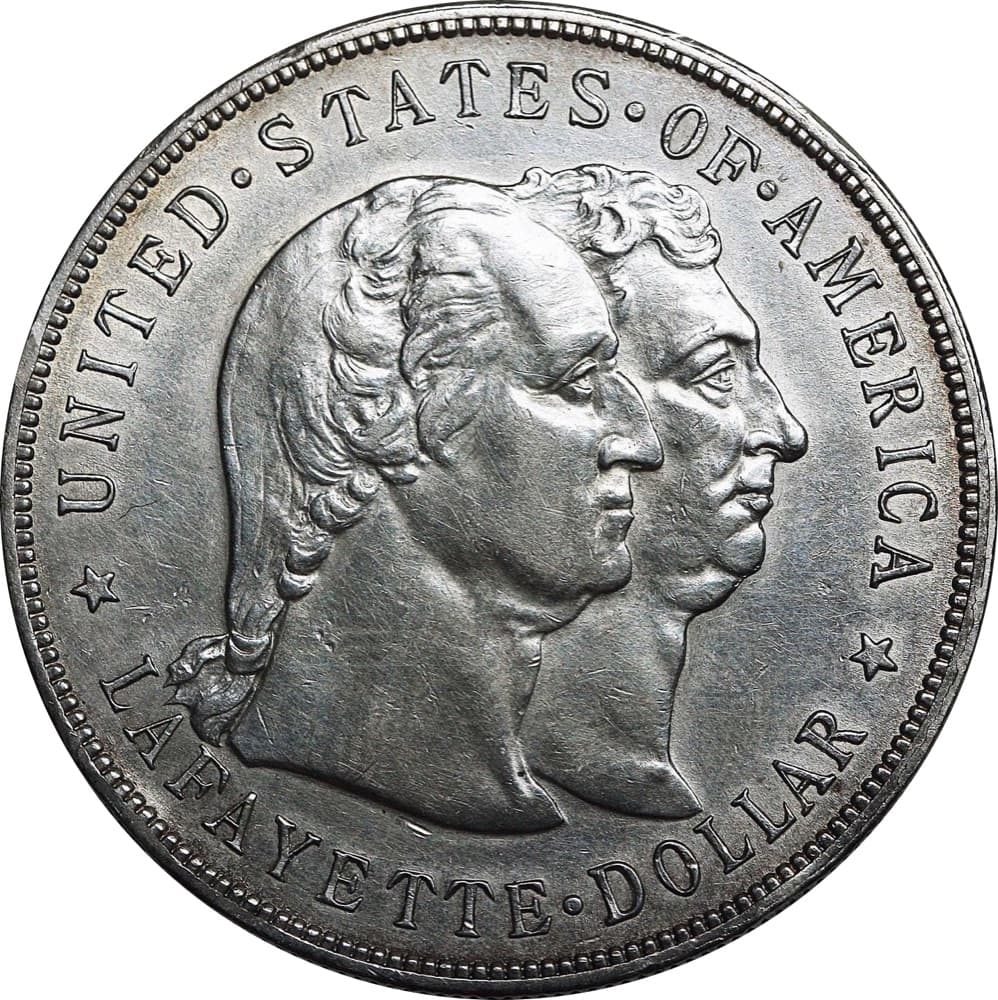
Chief Engraver Charles E. Barber took personal charge, hoping to avoid the fights that had marked the Columbian half dollar and the Isabella quarter. By April 12, 1899, he had a preliminary sketch of sculptor Paul Wayland Bartlett's equestrian statue. Mint Director George E. Roberts approved Barber's idea of jugate heads of Washington and Lafayette and leaked it to the American Journal of Numismatics before telling the commission.
Peck wanted only the faces shown. Barber scoffed that the two men should not be seen 'peeping out of a half moon,' met Peck in New York on June 14 and 15, and reported, 'I think we will hear no more of the Lafayette prayer,' the commission's wish to put Lafayette's 1784 words on the coin. He submitted final designs on June 20, and Roberts approved them July 1.
Barber said he based Washington on Jean-Antoine Houdon's 1785 bust and Lafayette on an 1824 medal by Francois-Augustin Caunois. Numismatic writers have long doubted him: Arlie Slabaugh and later Swiatek and Breen saw the real source in Peter L. Krider's 1881 Yorktown Centennial Medal, which places the two busts the same way. Q. David Bowers called Barber's version 'but a travesty of Krider's extremely detailed high-relief artistry.'
The reverse shows Lafayette on horseback, sword raised, with 'Bartlett' on the base, a palm branch, and the legend 'Erected by the youth of the United States in honor of Gen Lafayette / Paris 1900.' Barber's own monogram is not on the coin.
One day in December
The commission wanted coins dated 1900 but on sale in 1899. Treasury Secretary Lyman Gage held to the Coinage Act of 1873, which required the year of striking on a coin. The compromise was to strike the coins in December 1899, release them the next month, and use 'Paris 1900' as part of the legend. Swiatek and Breen pointed out that this technically left the coins undated, 'and therefore illegal!'
The whole run was struck on December 14, 1899, the centennial of Washington's death. After a press operator removed the first coin, it passed from the Philadelphia superintendent to Barber, to commission secretary Robert J. Thompson, and to Roberts, who carried it to Washington for McKinley. An offer of $5,000 for that first coin was refused. Production then continued on an older press making about 80 coins a minute. The coins were ejected into a hopper with no care for their surfaces.
Thompson carried the first coin to France in an elaborate case said to have cost $1,000 and presented it to President Emile Loubet on March 3, 1900. Coin and casket are now in the Louvre.
The statue was not ready either. A one-third model was finished only in May 1900, so the commission had it sawed into pieces, enlarged in plaster at several workshops and reassembled. The full-size plaster was dedicated in the Place du Carrousel on July 4, 1900. Bartlett then reworked it; the bronze installed in 1908 dropped Lafayette's three-cornered hat and changed his arm and sword, so it differs from the statue on the coin. Moved in the 1980s for the Louvre pyramid, it now stands on the Cours-la-Reine by the Seine.
From $1.10 to six figures
The commission sold the dollars at $2, handing sales to a Chicago bank after it moved its office to Paris in February 1900. Few collectors bought them. Only about 1,800 sold in Paris, and by 1903 the coins could be had for $1.10; thousands were probably spent. Fourteen thousand unsold coins went back to the Treasury in $1,000 sacks. In 1945 an Omaha dealer, Aubrey Beebe, found them in government records and asked about them, only to learn they had just been melted.
Prices recovered slowly: past issue price by 1920, $3.50 by 1930, $13 by 1950, $55 by 1960 and $650 by 1975. Dealers asked $135 for a Brilliant Uncirculated coin in 1964 and $900 for a Gem in 1976.
At the top of the market, one toned PCGS MS67 has sold again and again: $66,700 in January 2004, $69,000 and then $86,250 in 2008, $77,625 in 2009 and $73,437.50 in 2015. The coin from the D. Brent Pogue collection brought $60,000 in 2020 and $76,375 in 2023, and another PCGS MS67 CAC brought $90,000 in September 2022. On September 13, 2026, a toned PCGS MS67 CAC sold for $165,937.50 at an online auction. By 2025 a grading service had certified a single toned coin as MS68, the first at that grade.
Provenance matters too. On August 13, 2024, a Lafayette dollar graded MS65 by NGC sold with a letter signed by McKinley saying he had given the coin to a Masonic fair in Canton, Ohio, for a benefit raffle; the winner's family kept it for two generations before it was sold at a coin show in 1988.
Reading a Lafayette dollar
The coin weighs 26.73 grams, measures 38.1 millimeters and is 90% silver with a reeded edge. There is no mintmark. Wear shows first on Washington's cheekbone and on Lafayette's face on the reverse. A sharp strike shows the engraved line between Lafayette's boot and his uniform.
The typical survivor grades AU50 to MS62 or MS63. MS64 is scarce, MS65 rare and anything finer very rare, because the large, flat fields pick up marks and high-point rub. Gems have a mix of satiny and soft frosty luster. One comparison makes the point: more 1900 Morgan dollars are graded PCGS MS67 than Lafayettes are graded MS65+ or better.
Several die pairs exist. George H. Clapp noticed a difference in 1925, Howland Wood catalogued 1-A, 1-B, 2-C and 3-D, Anthony Swiatek reported 1-C in 1980, and Frank DuVall found 4-E in 1988. 1-B is the most common. Diagnostics include a repunched second 'S' in STATES on obverse 2 and a repunched 'C' in AMERICA on obverse 4, but the varieties rarely carry much premium. The coin has been counterfeited, and polished coins are a known trap.
Two men, one coin
Lafayette sailed to America at his own expense in 1777, served without pay, was wounded at Brandywine and helped lead the Yorktown campaign. He and Washington, a quarter century apart in age, became close friends. When he returned in 1824 as the nation's guest, he visited all 24 states.
The coin that honors them holds a list of firsts: the first U.S. coin to depict a U.S. citizen, the first with Washington, the first to show the same man on both sides, and the only commemorative silver dollar until the 1983 Olympic dollars. Art historian Cornelius Vermeule judged that it 'lacks the quaint, dated appeal of the Isabella quarter,' but collectors have never treated it as a minor coin.
The numbers
- Mintage
- 50,026 struck (26 for assay); 14,000 melted; 36,026 net
- Known survivors
- No verified census figure; typical grades AU50 to MS63, MS65 rare, one coin at MS68
- Weight
- 26.73 grams
- Diameter
- 38.1 mm
- Composition
- 90% silver, 10% copper (0.77344 troy oz silver)
- Designer
- Charles E. Barber; reverse after Paul Wayland Bartlett's statue
- Mint
- Philadelphia, no mintmark
- Die varieties
- DuVall 1-A, 1-B, 1-C, 2-C, 3-D and 4-E; 1-B most common
Timeline
Gilbert du Motier, Marquis de Lafayette, is born.
Congress commissions Lafayette a major general.
Lafayette returns to the United States as the nation's guest and visits all 24 states.
Lafayette dies.
Peter L. Krider's Yorktown Centennial Medal, later seen as the model for the obverse.
A resolution for a Lafayette monument in Paris is introduced in Congress.
Ferdinand Peck appoints the Lafayette Memorial Commission.
The first Lafayette Day; schoolchildren eventually give $45,858.30.
McKinley signs the law granting the commission 50,000 silver dollars.
Barber submits final designs; Roberts approves them July 1.
All 50,026 coins are struck at Philadelphia on the centennial of Washington's death.
The coins go on sale at $2.
The first coin struck is presented to French President Emile Loubet.
The full-size plaster statue is dedicated in the Place du Carrousel.
The dollars can be bought for $1.10.
Bartlett's revised bronze statue is installed.
George H. Clapp notices the first die variety.
The 14,000 unsold coins held by the Treasury are reported melted.
The Los Angeles Olympic dollars become the next U.S. commemorative silver dollars.
A toned PCGS MS67 CAC sells for $165,937.50.
The world in 1899
Queens and Staten Island merge into New York City.
The Philippine-American War begins in Manila.
Gold is found at Nome, Alaska, starting the Nome Gold Rush.
Henry H. Bliss becomes the first person killed by a motor vehicle in the United States.
Scott Joplin's Maple Leaf Rag is registered for copyright.
The Bronx Zoo opens.
Vice President Garret Hobart dies.
The San Jacinto earthquake shakes Southern California.
Price record
| Date | Price | Kind |
|---|---|---|
| Jan 1900 | $2 | Asking price, not a saleIssue price set by the Lafayette Memorial Commission. |
| Jul 1964 | $135 | Asking price, not a saleBrilliant Uncirculated, dealer advertisement. |
| Dec 1974 | $575 | Asking price, not a saleBrilliant Uncirculated, dealer advertisement. |
| Oct 1976 | $900 | Asking price, not a saleGem Brilliant Uncirculated, dealer advertisement. |
| Jul 27, 2002 | $59,800 | Sold at auctionPCGS MS67, darkly toned; later sold in 2005. |
| Jan 7, 2004 | $66,700 | Sold at auctionPCGS MS67, DuVall 1-B, toned; the coin that resold in 2008, 2009 and 2015. |
| Feb 24, 2005 | $71,875 | Sold at auctionPCGS MS67, Bruce Scher collection; same coin as 2002. |
| May 10, 2007 | $51,750 | Sold at auctionNGC MS67, DuVall 2-C, Cary and Cheryl Porter collection. |
| Jan 10, 2008 | $69,000 | Sold at auctionPCGS MS67, same coin as 2004. |
| Apr 17, 2008 | $86,250 | Sold at auctionPCGS MS67 CAC, same coin; long the auction record for the type. |
| Jan 8, 2009 | $34,500 | Sold at auctionNGC MS67, DuVall 2-C. |
| Jul 31, 2009 | $77,625 | Sold at auctionPCGS MS67 CAC, Louis Bassano collection; same coin as 2004. |
| Aug 3, 2012 | $35,250 | Sold at auctionNGC MS67, same coin as January 2009. |
| Apr 24, 2014 | $36,719 | Sold at auctionNGC MS67, same coin; $36,718.75. |
| Jan 7, 2015 | $73,438 | Sold at auctionPCGS MS67 CAC, Empire collection; $73,437.50; same coin as 2004. |
| Apr 27, 2017 | $25,850 | Sold at auctionNGC MS67, DuVall 2-C; same coin as 2007. |
| Mar 20, 2020 | $60,000 | Sold at auctionPCGS MS67 CAC, D. Brent Pogue collection. |
| Aug 31, 2022 | $1,440 | Sold at auctionPCGS MS63. |
| Sep 25, 2022 | $90,000 | Sold at auctionPCGS MS67 CAC, Pavonini collection of toned commemoratives. |
| May 25, 2023 | $76,375 | Sold at auctionPCGS MS67 CAC, the Pogue coin, Coronet collection. |
| Sep 13, 2026 | $165,938 | Sold at auctionPCGS MS67 CAC, toned; $165,937.50 at an online auction. |
A realized auction price is what a buyer actually paid on the date shown, including the buyer's premium where the sale reported it. It is the strongest kind of reference price, and it is a record of one sale of one object on one day, not a promise of what the next example will bring.
By reference price, 1900 Lafayette Dollar is number 98 of 100 in the coins entries of the FLOAT 100. 96 of those 100 rest on a realized sale; the rest carry an asking price or a guide value, and each page says which. Rank within the FLOAT 100 itself (48 here) is editorial: how much an object defines its field, not price alone.
Did you know
- Every Lafayette dollar was struck on one day, December 14, 1899, the 100th anniversary of George Washington's death.
- Because the law required the year of striking on a coin, the 'Paris 1900' legend technically leaves the coin undated.
- Lafayette appears twice: in the portrait on one side and on horseback on the other.
- Someone offered $5,000 for the first coin struck. It went instead to the president of France and is now in the Louvre.
- The statue on the coin was never cast in bronze as shown: Bartlett dropped the hat and changed the arm and sword before the 1908 bronze.
- A dealer tracked the 14,000 unsold coins through government records in 1945, only to learn they had just been melted.
How this page is made
- The figure
- One reference price, shown with its own kind. FLOAT does not average it with anything or adjust it for time.
- Realized or not
- A realized price is a completed sale. An asking price, an estimate and a price-guide value are not sales, and are labeled as such wherever they appear.
- The story
- Researched from published records and checked fact by fact. Updated Oct 1, 2026.
- Archive
- Oct 5, 2026