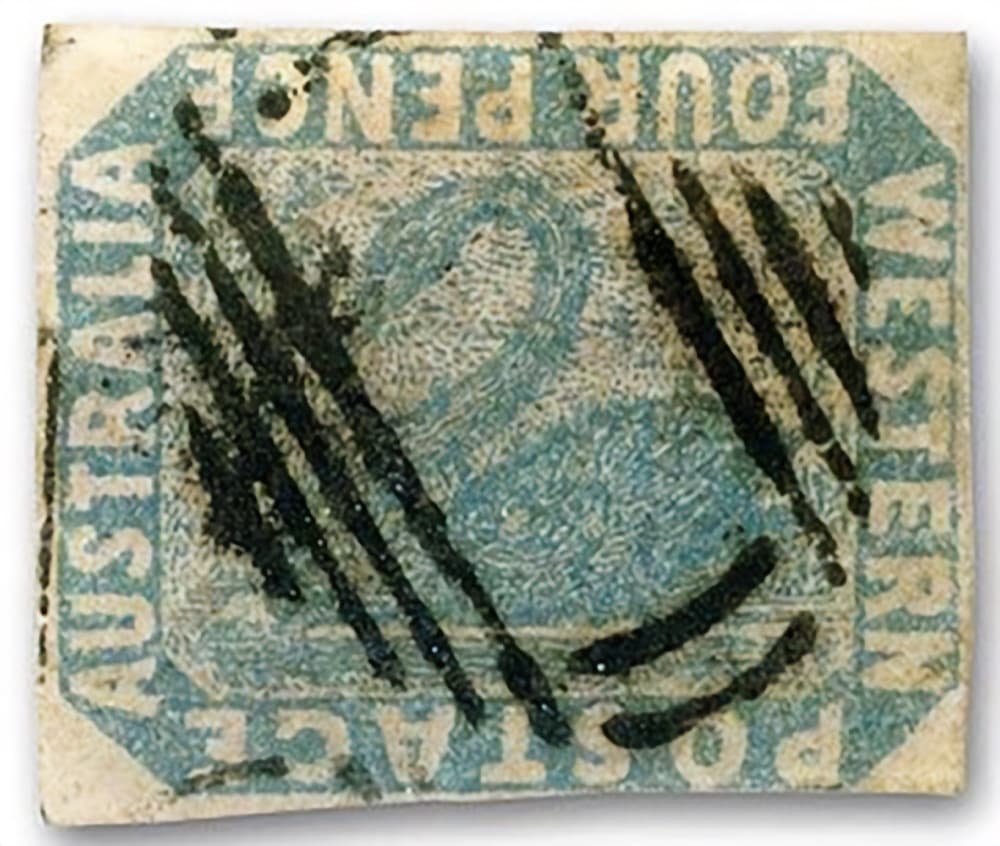
FLOAT 100 · Stamps · No. 13
Inverted Swan
A lithographer in Perth patched a damaged stone in January 1855 and set one tiny frame upside down; fourteen survivors later, the mistake is the most famous error stamp in the South Pacific.
- Year
- 1855
- Maker
- Colony of Western Australia
- By price in stamps
- 37 of 100
Create a free account to see every recorded price and every grade.
Create a free account- Issued
- Western Australia's 4d blue Swan, first printed in Perth in July 1854; the error comes from a printing of January 1855
- What is inverted
- The octagonal frame, not the swan. The name "Inverted Swan" stuck before collectors understood the error
- Who made the mistake
- Alfred Hillman, appointed the colony's lithographer in August 1854
- How many printed
- Reported as 388: four errors on each of 97 sheets
- How many survive
- Fourteen accepted as genuine in recent counts; older counts give 15, plus a damaged strip on piece showing part of an inverted frame
- Condition
- No unused examples are known; every survivor is used
- In institutions
- The Royal Collection, the British Library's Tapling Collection, the National Museum of Ireland, the State Library of New South Wales, the Australian Museum in Sydney and the Western Australian Museum in Perth
- Record
- $189,500 including buyer's premium, at auction in London on May 19, 2015, for a used three-margin example
A swan, a stone and a colony short of stamps
Western Australia issued its first postage stamp on August 1, 1854: a one-penny black stamp showing the black swan, the colony's emblem, engraved and printed in London. According to the dealer and author Gary Watson, that stamp should never have been needed. In June 1852 the governor had decreed only two postal rates, 2d for letters within the colonies and 4d for foreign letters, yet only a penny value was ordered, and a million of them arrived in September 1853.
When a 4d stamp was wanted, the colony did not send to London. The engraved steel plate for the penny stamp had arrived with the first consignment, but the government printing office in Perth was not equipped to print from it. Instead, the printers adapted the penny design for lithography, printing from a flat slab of stone.
The process, as reconstructed by the historian Brian Pope and summarized by Watson, was painstaking. Two blocks of 60 impressions were transferred from the steel plate onto an "intermediate stone," one block for the 4d and one for a shilling value. The penny frames were removed with an acid brush, a new octagonal 4d frame was drawn by hand, and 60 copies of that frame were placed one at a time around each swan. The block of 60 was then transferred four times onto a printing stone, giving 240 stamps to a sheet. The first printing, of 100 sheets in a slate-blue shade, came off the press in July 1854.
Two days in January 1855
In August 1854 Alfred Hillman was appointed lithographer. On January 2, 1855, he printed just three sheets of 4d stamps; three days later he printed 97 more. A fault had appeared on the printing stone, which had to be replaced. Going back to the intermediate stone to make a new one, Hillman found damage on the last stamp in the eighth row and repaired it by replacing only the frame. He put the new frame on upside down. A second damaged frame, repaired at the same time, came out tilted.
Because the block of 60 was transferred four times to make the printing stone, the inverted frame appeared four times on every sheet. Pope concluded that the 97-sheet printing produced 388 errors before the mistake was corrected for the next printing. Watson notes that 14 survivors would mean a survival rate of about 3.6 percent.
The error was not noticed for years. Watson writes that the first example was recorded in 1863, but that it was only in 1892 that the error was correctly identified as an inverted frame rather than an inverted center. Other accounts give a later date for the proof: one Australian dealer writes that a damaged strip on piece, found by a London dealer in 1937 in a box of mixed stamps, was the discovery that showed it was the frame that was upside down. The National Museum of Ireland's own register entry for its copy still reads "Inverted centre."
Nearly every surviving copy was found abroad, mostly in England. Watson points out why: a 4d stamp in Western Australia paid for foreign letters, so the errors left the colony on mail.
From a schoolmaster's album to the great collections
The copy now in Dublin has the best origin story. According to the National Museum of Ireland, a schoolboy named Vance learned that a schoolmaster, Mr. Morris, would part with the stamp for £3. Introduced in a local shop to Gerald FitzGerald, the fifth Duke of Leinster, Vance mentioned it, and the Duke wrote him a check on the spot. Vance bargained Morris down to £2, kept the extra pound, and was rewarded by the delighted Duke with several pounds' worth of stamps. The Duke showed it at the Royal Philatelic Society London's first exhibition in 1890 but never mounted it in his album; he cared more about completing regular issues than about errors. He had arranged to trade it away, but died before the exchange, and it passed to the museum with his collection. The museum gives the year of the bequest as 1893; Wikipedia gives 1897. It is in the museum's reserve collection, not on display.
Watson's list of past owners reads like a roll call of philately: Tapling, Crawford, Hausberg, Duveen, Ferrary, Colonel Green, Hind, Lichtenstein, King George V, King Carol of Romania, Lilly and Boker. Miss A. Vickery, whom he calls Australia's first prominent woman collector, owned two, acquired in the mid-1930s; both passed by bequest in 1942 to the Australian Museum in Sydney. A 1927 Brisbane newspaper listed the nine copies then known, starting with the royal family's.
The highest prices before 2015 were set in Switzerland. In 1979 the example from John Gartner's Western Australia collection sold at auction in Zurich for 242,000 Swiss francs; two years later the former Ferrary copy brought 236,250 Swiss francs. Watson tells of a Sydney collector, Mogens Juhl, a retired Danish consul who knew he had terminal cancer but was set on owning an inverted frame as the centerpiece of his collection; he bought the former King Carol copy privately in October 1992 and died less than a year later.
Lord Vestey bought his copy privately in December 1942 for £850. When his Western Australia collection was sold at auction in London on May 19, 2015, it was hammered at £102,000, or $189,500 with the 20 percent buyer's premium: more than double the top estimate of £50,000 to £60,000. One dealer called it the highest price ever paid for any single stamp from Australasia. A copy with small faults sold at auction in Switzerland on May 31, 2018, for 314,600 Swiss francs.
One collector has dominated the market for decades. Dr. Arthur Woo, a retired physician in Hong Kong, made his first purchase in 1993 and by 2018 was reported to own at least four genuine copies, the damaged strip and a much-debated forgery, which is to say nearly every example outside institutions.
Fakes, a count that keeps changing, and how to tell
The census of survivors has moved. For decades collectors accepted fifteen examples, numbered I to XV. Watson counted 14 genuine stamps plus a "convincing fake that fooled everyone for more than 60 years," a stamp whose frame had been painted in by hand. That copy, once credited to the New York collector "Colonel" Green, was knocked down at a 1986 auction in New York for the equivalent of £31,000, but it was judged a fake and the auctioneer bought it back. In 2018, collectors comparing high-resolution scans online concluded that two of the numbered copies were crude forgeries, leaving fourteen widely accepted as genuine. Sources writing in 2015 still described about 15 recorded examples, six of them in institutions.
Identification turns on position. Every genuine inverted frame comes from the same spot on the printing stone, and because each of the 60 frames was hand-drawn, the shapes of the outer letters and design details differ from one position to the next. A true error must match the other true errors exactly, which is why side-by-side scans expose fakes quickly.
Condition matters too. The stamps are imperforate, and the crude local printing made both a clean impression and good margins hard to come by. The finest copy, with four margins and no faults, passed through the Avery, Worthington, Liechtenstein, Meinertzhagen, Lilly and Boker collections before the Western Australian Museum bought it for 135,000 Australian dollars. The 2015 record copy had three margins.
In 1978 the Perth dealer Wim Smits was offered two old lithographic stones. One was the intermediate stone for the 4d and shilling values, inverted frame and all; one account says the family that owned it had used it as a doorstop. It was offered at an international stamp show auction in Chicago in 1986, withdrawn after an objection from the floor, failed to sell at a later auction in Switzerland, and was finally bought by the Western Australian Museum, where it is displayed.
Why it matters
Most famous inverts, such as the American 1869 pictorials or the Tongan 7½d of 1892, are two-color stamps whose sheets were turned around between two passes through the press. Watson notes the Western Australia 4d is different: it is a one-color stamp printed in a single operation, and only the frame of one subject is upside down relative to its neighbors. It is one of the earliest printing errors of any kind.
Half of the survivors will probably never be sold. Watson counted seven in institutions or the Royal Collection, and a dealer writing in 2018 called the 4d inverted frame the most famous and expensive printing error from the entire South Pacific.
The numbers
- Issue
- 4d blue, first printed July 1854; error printing January 5, 1855
- Printing
- Lithographed in Perth from a stone of 240 subjects (four blocks of 60, each 5 x 12)
- Errors printed
- About 388 (four per sheet on 97 sheets)
- Known
- 14 accepted as genuine, plus a damaged strip on piece; older counts give 15
- Perforation
- Imperforate
Timeline
The governor of Western Australia decrees postal rates of 2d for letters within the colonies and 4d for foreign letters.
A million one-penny stamps are sent out from London; the engraved steel plate comes with the consignment.
The first 100 sheets of the lithographed 4d blue are printed in Perth.
Western Australia's first stamp, the 1d black Swan, is issued.
Alfred Hillman is appointed lithographer.
Hillman prints three sheets of 4d stamps before the printing stone fails.
Hillman prints 97 sheets from a new stone carrying four inverted frames per sheet, about 388 errors in all.
The first example of the error is recorded.
The Duke of Leinster's copy is shown at the Royal Philatelic Society London's first exhibition.
The error is correctly identified as an inverted frame rather than an inverted center, according to one account.
The Duke of Leinster dies and his copy passes to the National Museum of Ireland (another source gives 1897).
A Brisbane newspaper lists the locations of the nine copies then known.
A damaged strip on piece with part of an inverted frame is found by a London dealer in mixed stamps.
Miss A. Vickery's two copies pass by bequest to the Australian Museum in Sydney; in December Lord Vestey buys a copy for £850.
The intermediate lithographic stone, showing the inverted frame, turns up in Perth.
The Gartner copy sells at auction in Zurich for 242,000 Swiss francs.
A copy once credited to Colonel Green is knocked down at auction in New York, then judged a fake and bought back by the auctioneer; the printing stone is withdrawn from a Chicago auction.
A copy sells at auction in New York for $14,500 plus a 10 percent buyer's fee.
Lord Vestey's copy sells at auction in London for £102,000 hammer, $189,500 with premium, a record for the error.
A copy with small faults sells at auction in Switzerland for 314,600 Swiss francs.
The world in 1855
The Panama Railway opens, the first railroad to connect the Atlantic and Pacific Oceans.
Alexander II becomes Tsar of Russia on the death of Nicholas I, in the middle of the Crimean War.
The Exposition Universelle opens in Paris.
Britain abolishes the stamp duty on newspapers.
Walt Whitman publishes Leaves of Grass in Brooklyn.
Sevastopol falls to French and British troops.
Henry Bessemer files his British patent for the Bessemer steelmaking process.
David Livingstone becomes the first European to see Victoria Falls.
Price record
| Date | Price | Kind |
|---|---|---|
| 1989 | $14,500 | Sold at auctionHammer price at auction in New York, plus a 10 percent buyer's fee, as reported by an Australian dealer who had hoped to buy it. |
| May 19, 2015 | $189,500 | Sold at auctionLord Vestey's used three-margin copy, sold at auction in London. Hammer £102,000; £122,400 (about $189,500) with the 20 percent buyer's premium. Estimate was £50,000 to £60,000. Record for the error. |
| May 31, 2018 | $319,586 | Sold at auctionAt auction in Switzerland: CHF 314,600 (including buyer's premium), shown in USD at the Federal Reserve rate on the sale date (1 CHF = 1.0158 USD). |
A realized auction price is what a buyer actually paid on the date shown, including the buyer's premium where the sale reported it. It is the strongest kind of reference price, and it is a record of one sale of one object on one day, not a promise of what the next example will bring.
By reference price, Inverted Swan is number 37 of 100 in the stamps entries of the FLOAT 100. 82 of those 100 rest on a realized sale; the rest carry an asking price or a guide value, and each page says which. Rank within the FLOAT 100 itself (13 here) is editorial: how much an object defines its field, not price alone.
Did you know
- The swan is not upside down. The frame is, but the name "Inverted Swan" stuck before collectors worked that out.
- A schoolboy bought the Duke of Leinster's copy for £2 from his schoolmaster, after the Duke had given him £3, and pocketed the difference.
- The original printing stone survived. One account says a Perth family had used it as a doorstop before a dealer bought it in 1978.
- Lord Vestey paid £850 for his copy in 1942; 73 years later it sold for £122,400 with premium.
- One forgery fooled the stamp world for more than 60 years; its frame had been painted in by hand.
- A single collector in Hong Kong has owned more copies than anyone else in history.
How this page is made
- The figure
- One reference price, shown with its own kind. FLOAT does not average it with anything or adjust it for time.
- Realized or not
- A realized price is a completed sale. An asking price, an estimate and a price-guide value are not sales, and are labeled as such wherever they appear.
- The story
- Researched from published records and checked fact by fact. Updated Oct 1, 2026.
- Archive
- Oct 5, 2026