FLOAT 100 · Stamps · No. 47
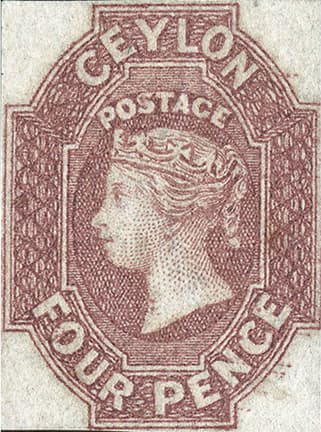
Ceylon 1857-59 'Pence Issue' 4d Dull Rose
About 7,000 were issued, only about ten unused copies survive, and the finest of them has passed from a baron to Ceylon's greatest native collector and on to a New York sale with a quarter-million-dollar estimate.
- Year
- 1857
- Maker
- British Ceylon
- By price in stamps
- 50 of 100
Create a free account to see every recorded price and every grade.
Create a free account- Issued
- April 23, 1859, Ceylon (now Sri Lanka); some accounts date it to 1857
- Face value
- Four pence
- Design
- Left-facing portrait of the young Queen Victoria in an octagonal frame
- Printed by
- Perkins, Bacon & Co. of London, printers of Britain's Penny Black
- Format
- Imperforate; large star watermark
- Quantity
- About 7,000 issued (one source says 7,400)
- Unused survivors
- About 10
- Finest known
- An unused copy with large part original gum, ex de Worms, de Silva, Amundsen and Hackmey
- Standing
- Widely described as the rarest and most valuable stamp of Ceylon
A colony's first stamps
Ceylon, the British crown colony that became Sri Lanka, began using adhesive postage stamps in 1857, seventeen years after Britain's Penny Black. The first, a sixpence value, went on sale on April 1, 1857. It was printed by Perkins Bacon & Co., the same London firm that printed the world's first postage stamp, recess-printed on blue paper with a star watermark and no perforations, in sheets of 250.
More values followed quickly: a 5d chestnut, 6d brown, 10d orange-vermilion and 1s dull violet on July 2, 1857, and a ½d lilac in October 1857 for printed matter. One Sri Lankan account says that between July 1857 and April 1859 eleven denominations from ½d to 2s were issued, all with Queen Victoria's portrait. The same account calls these early stamps the most expensive and the most difficult to obtain of all Ceylon stamps.
Perforated stamps followed in 1861, and their perforations were reported to vary greatly in consistency and quality.
The four pence in dull rose
According to several Sri Lankan accounts, the four pence was issued on April 23, 1859, with a face value of four pence and a color described as dark pink, which collectors know as dull rose. It shows a left-facing young Queen Victoria inside an octagonal frame. The Ceylon historian Hugh Karunanayake instead dates the stamp to 1857, the year the imperforate series began.
Sources also disagree on which stamps came out the same day. Wikipedia lists the 8d chocolate brown, 1s 9d green and 2s 9d; a 2018 Sri Lankan newspaper article lists 8d, 9d, 1s 9d and 2s values. The quantity is reported as about 7,000 by most accounts and 7,400 by the Ceylon historian Hugh Karunanayake.
One stamp writer noted that the backgrounds of many early Ceylon stamps were ones Perkins Bacon had previously used for the first issues of Chile.
Used copies, typically cancelled with grid obliterators, sell for a small fraction of the price of unused ones. Unused copies are the great rarity: only about 10 are known. Forgeries exist; collectors point to missing lines and dots in the name and value tablets, a background with too little detail, and a color too bright to be called dull. One forger produced high-quality Ceylon imitations in the 1980s.
A baron, a Ceylonese collector and the crown jewel
The finest unused four pence has one of the best-documented histories of any British colonial stamp. It belonged first, as far as the record shows, to Baron Anthony de Worms (1869-1938), whose Ceylon collection was regarded at his death as the finest in the world. His collection included nine copies of the imperforate four pence, among them a pair, plus a mint copy said to be the finest known. It was sold over four days in London, June 20-23, 1938, in 880 lots.
The great buyer at that sale was Sir Ernest de Silva (1887-1957), described as the only Sri Lankan to own a collection of Ceylon stamps of international renown. He acquired the finest four pence. After his death his collection was sold over two days in London, January 12-13, 1959, where the stamp was estimated at £900. It received a Royal Philatelic Society London certificate that year.
From there the stamp passed to Lars Amundsen in December 1967, and then through a stamp dealership into the collection of Joseph Hackmey. On February 18, 2009, it was offered at auction in New York as the crown jewel of Hackmey's classic Ceylon collection, described as having large part original gum, deep color, margins all round showing part of the adjoining stamp at right, and "undoubtedly the finest mint example in existence." Its estimate was $200,000 to $250,000. The published results page lists the lot as closed without a sale price.
A second unused copy in that sale, without gum and with a pressed crease, also ex de Worms and de Silva and later P.C. Pearson, sold for $20,000 against a $30,000 to $40,000 estimate. At a second Hackmey sale on October 29, 2010, an unused copy without gum, its outer frame line cut into at the foot, sold for $12,500.
What the record says about value
The best-known public sale of an unused copy took place in January 2008, when an example with full original gum and a Royal Philatelic Society certificate sold at auction for $71,875.
Published values vary by date and source. Wikipedia gives an estimated value of £70,000 to £100,000 for a mint copy and about £4,500 for a used one. A 2017 Sri Lankan article valued unused copies at £50,000. A 2005 Sri Lankan children's paper reported that an unused copy had fetched about £50,000 some twenty years earlier. Hugh Karunanayake's 2022 article gave $20,000 for an unused copy. These are catalog and press figures, not sales, and they are not included in the price history.
Condition drives the gap. In the 2009 New York sale, a used copy with a frame line cut into at one side brought $2,200, while the two unused copies were estimated at $30,000 and $200,000 or more.
The numbers
- Issue date
- April 23, 1859 (some sources: 1857)
- Quantity issued
- About 7,000 (one source: 7,400)
- Unused known
- About 10
- Perforation
- None (imperforate)
- Paper and watermark
- Large star watermark
- Printer
- Perkins, Bacon & Co., London
Timeline
Ceylon issues its first adhesive stamp, a sixpence printed by Perkins Bacon, imperforate on blue paper with a star watermark.
The 5d, 6d, 10d and 1s values follow.
A ½d lilac is issued for printed matter.
The four pence dull rose is issued, with other high values; about 7,000 are reported issued.
Perforated stamps replace the imperforate issues.
Baron Anthony de Worms, owner of the finest Ceylon collection, dies.
His collection is sold in London over four days; it includes nine imperforate four pence and the finest mint copy.
Sir Ernest de Silva, who bought the finest copy at the de Worms sale, dies.
De Silva's collection is sold in London; the finest four pence is estimated at £900 and receives a Royal Philatelic Society certificate.
The finest copy passes to Lars Amundsen.
A second ex-de Worms unused copy appears in the P.C. Pearson sale and receives a 1983 certificate.
An unused copy with full original gum sells at auction for $71,875.
Joseph Hackmey's Ceylon collection is offered in New York; the finest copy is estimated at $200,000-250,000 and a second unused copy sells for $20,000.
At the second Hackmey sale an unused copy without gum sells for $12,500.
Sri Lankan press marks the stamp's 159th anniversary.
The world in 1857
The Indian Rebellion of 1857 begins as a cavalry regiment of the East India Company's army turns on its British officers.
The Panic of 1857 begins in the United States and spreads to Europe.
Ground is broken for the Suez Canal in Egypt, two days after the four pence is issued.
Charles Dickens publishes A Tale of Two Cities.
French and Sardinian forces defeat the Austrians at the Battle of Magenta.
The chimes of Big Ben ring for the first time in London.
Edwin Drake drills the first U.S. oil well near Titusville, Pennsylvania.
Charles Darwin publishes On the Origin of Species.
Price record
| Date | Price | Kind |
|---|---|---|
| Jan 2008 | $71,875 | Sold at auctionUnused with full original gum and a Royal Philatelic Society certificate; sold at auction. |
| Feb 18, 2009 | $200,000 | Estimate, not a salePresale estimate of $200,000-250,000 (low end shown) at auction in New York for the finest known mint copy, ex de Worms, de Silva and Amundsen. No realized price is published. |
| Feb 18, 2009 | $30,000 | Estimate, not a salePresale estimate of $30,000-40,000 (low end shown) for an unused copy without gum, ex de Worms, de Silva and Pearson. |
| Feb 18, 2009 | $20,000 | Sold at auctionUnused without gum, pressed crease, 1983 certificate; sold at auction in New York. |
| Oct 29, 2010 | $7,500 | Estimate, not a salePresale estimate of $7,500-10,000 (low end shown) for an unused copy without gum. |
| Oct 29, 2010 | $12,500 | Sold at auctionUnused without gum, outer frame line touched at top and cut into at foot; Hackmey collection, part II. |
A realized auction price is what a buyer actually paid on the date shown, including the buyer's premium where the sale reported it. It is the strongest kind of reference price, and it is a record of one sale of one object on one day, not a promise of what the next example will bring.
By reference price, Ceylon 1857-59 'Pence Issue' 4d Dull Rose is number 50 of 100 in the stamps entries of the FLOAT 100. 82 of those 100 rest on a realized sale; the rest carry an asking price or a guide value, and each page says which. Rank within the FLOAT 100 itself (47 here) is editorial: how much an object defines its field, not price alone.
Did you know
- The printer of Ceylon's first stamps, Perkins Bacon, also printed the world's first postage stamp, the Penny Black.
- Baron de Worms owned nine copies of the imperforate four pence, including a pair.
- The finest copy was estimated at £900 in 1959; fifty years later its estimate was $200,000 to $250,000.
- The finest copy still shows part of the neighboring stamp along its right margin.
- Ceylon's first stamps were issued in 1857, the year the Indian Rebellion broke out in British India.
- Some backgrounds on early Ceylon stamps were reused from Perkins Bacon's first stamps for Chile.
How this page is made
- The figure
- One reference price, shown with its own kind. FLOAT does not average it with anything or adjust it for time.
- Realized or not
- A realized price is a completed sale. An asking price, an estimate and a price-guide value are not sales, and are labeled as such wherever they appear.
- The story
- Researched from published records and checked fact by fact. Updated Oct 1, 2026.
- Archive
- Oct 5, 2026