FLOAT 100 · Stamps · No. 46
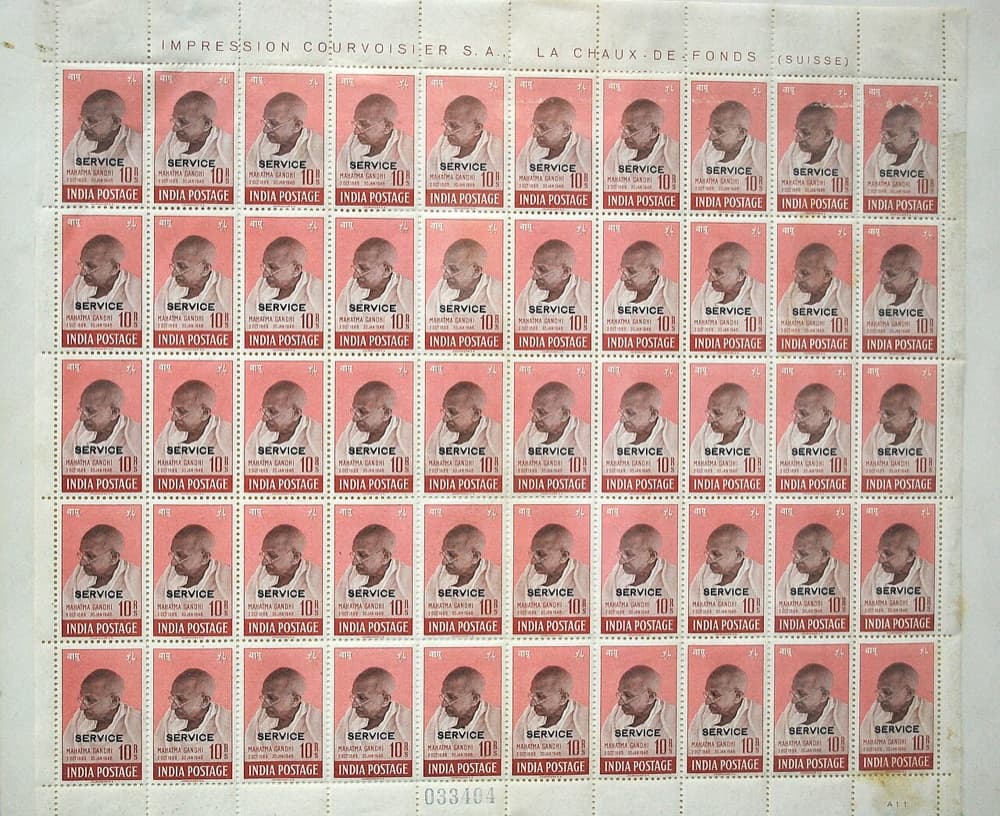
India 1948 Gandhi 10 Rupees 'Service' Overprint
India planned to put Gandhi on a stamp while he was alive, issued it as a memorial after his assassination, and overprinted just 100 of the top value for the Governor-General's own letters. Those 100 became the most valuable stamps of independent India.
- Year
- 1948
- Maker
- Government of India (Posts & Telegraphs)
- By price in stamps
- 34 of 100
Create a free account to see every recorded price and every grade.
Create a free account- Issued
- August 15, 1948, the first anniversary of Indian independence
- Set
- Four values: 1½ annas, 3½ annas, 12 annas and 10 rupees, each showing Gandhi with the word "Bapu" in Hindi and Urdu
- Printed by
- Hélio Courvoisier of Switzerland, in photogravure, because the India Security Press in Nasik could not reach the required quality
- Ordinary 10 rupees printed
- 250,000, in sheets of 50 (5 rows of 10)
- "SERVICE" overprint
- 100 stamps (two sheets of 50), overprinted by typography at the India Security Press, Nasik
- For the use of
- The office of C. Rajagopalachari, Governor-General of India
- In institutions
- A full sheet of 50 plus a strip of five in India's National Philatelic Museum, New Delhi; a block of four in the Royal Collection (per a 2014 census)
- In private hands
- Counts differ: fewer than 8, 11, 13, 17 and 18 have all been published
- Highest single-stamp result found
- EUR 168,000 at auction in September 2013 for an unmounted mint example
A tribute that became a memorial
Independent India's postal administration originally planned to honor Mahatma Gandhi, whom the nation called "Bapu," or father, with a set of four stamps in January 1948. The India Security Press at Nasik was given the job. Before the stamps could be issued, Gandhi was shot dead in New Delhi on January 30, 1948.
The government decided to issue the set anyway, now as a memorial. It wanted the portrait printed in photogravure, a process the Nasik press could not handle to the standard required, so the work went to the Swiss printer Hélio Courvoisier. Sources differ on where the firm was based: the same reference article places it in Geneva in one spot and in La Chaux-de-Fonds in another.
The four stamps, 1½ annas, 3½ annas, 12 annas and 10 rupees, were issued on August 15, 1948, the first anniversary of India's independence. Gandhi became the first Indian to be pictured on the stamps of India. The word "Bapu" was printed in both Hindi and Urdu as a symbol of communal harmony in the year after Partition.
The 10 rupee value shows Gandhi in gray against a reddish-brown background; in the trade its colors are described as purple-brown and lake. At 10 rupees it was a very high denomination, priced beyond the reach of most people in India. A total of 250,000 were printed, in sheets of 50 stamps, five rows of ten, perforated 11½.
One hundred stamps for the Governor-General
Government offices in India used stamps overprinted "SERVICE" for official mail. For the Gandhi set, the overprint was applied for the exclusive use of the office of C. Rajagopalachari, the Governor-General of India. Rajagopalachari, one of Gandhi's earliest political lieutenants, served as Governor-General from 1948 to 1950, was the last person to hold the office, and was the only Indian-born Governor-General or Viceroy of India.
The quantities were tiny and fell sharply with the face value. One published account gives 15,950 stamps (319 sheets) of the 1½ annas, 1,350 of the 3½ annas, 250 of the 12 annas and just 100 of the 10 rupees, two sheets of 50. The overprints were applied by typography at the India Security Press in Nasik.
Of the 100 overprinted 10 rupee stamps, a few were given to dignitaries, while most stayed in official hands. A full sheet of 50 was exhibited at the Indipex 2011 international stamp exhibition in New Delhi.
How many exist? Nobody agrees
The number of 10 rupee SERVICE stamps in private hands is one of the most argued figures in Indian philately. A 2006 book by Dr. Reuben Ramkissoon and Dr. Rajagopalan put it at fewer than eight. In 2011 the Swiss auction firm that sold one example said 18 were known. In 2013 the same firm wrote that only 11 examples were recorded in total. In 2017 a London dealer said 13 single examples were authoritatively recorded.
The most detailed count comes from Pradip Jain's 2014 book, as summarized by a philatelic literature site: 76 copies exist in all. India's National Philatelic Museum in New Delhi holds a full sheet of 50 plus a strip of five; the Royal Collection holds a block of four; and private collectors hold 13 singles and one horizontal strip of four, all certified. That accounts for 76 of the 100 printed; the sources reviewed here do not say what became of the rest.
Mint condition is another dividing line. The example sold in 2013 was described as one of only two unmounted mint examples known to the seller, the other being the stamp it had sold in 2011.
From official mail to record prices
A complete overprinted set of four sold at auction for EUR 38,000 on October 5, 2007. Because that was a set rather than a single 10 rupee stamp, it is not counted in the price history below.
On May 19, 2011, a single 10 rupee SERVICE stamp sold at auction in Geneva for EUR 120,000 hammer, or EUR 144,000 (about $205,000) with buyer's premium. The seller called it the highest price ever paid for any modern stamp.
In September 2013 an unmounted mint example from the bottom margin of its sheet brought EUR 168,000 at auction. It carried certificates from the Royal Philatelic Society London (1988) and the British Philatelic Association (2011). In 2016 a London dealer sold another single to a collector in Uruguay for £160,000. Neither source gave a dollar figure.
On April 19, 2017, the same London dealer sold a horizontal strip of four to a private Australian collector for £500,000, described as the highest price ever paid for Indian stamps. In May 2019 that strip was offered for £550,000 at the Stockholmia 2019 exhibition in Stockholm. Because these are multiples, they appear here as context, not as single-stamp prices.
Telling a real one from a fake
Forgeries of the SERVICE overprint are well known, and forgeries of the ordinary stamps and of first-day covers bearing them also exist.
One specialist guide describes the genuine typographed overprint as showing a slight shadow effect and rounded letterforms, notably a rounded spine on the "S", while forged overprints tend to have sharp, crisp edges and straighter letters. The same guide recommends recent certificates (after 2018) from the British Philatelic Association or the Royal Philatelic Society London, and treats older certificates with caution.
Position and gum matter to collectors too. The 2013 example was a lower marginal copy, still carrying part of the sheet margin, and was described as unmounted mint, meaning its gum had never been disturbed by a hinge.
The numbers
- Issue date
- August 15, 1948
- Ordinary 10 rupees printed
- 250,000
- Overprinted "SERVICE"
- 100 (two sheets of 50)
- Surviving (2014 census)
- 76: 55 in New Delhi's National Philatelic Museum, 4 in the Royal Collection, 17 in private hands
- Printing
- Photogravure (stamp); typography (overprint)
- Sheet
- 50 stamps, 5 rows of 10
- Perforation
- 11½
Timeline
Original planned issue date for a set of four Gandhi stamps, to be printed at the India Security Press, Nasik.
Gandhi is assassinated in New Delhi before the stamps are issued; the set becomes a memorial issue.
The four Gandhi stamps, including the 10 rupees, are issued on the first anniversary of independence, printed in photogravure in Switzerland.
100 of the 10 rupee stamps, two sheets of 50, are overprinted "SERVICE" at Nasik for the use of Governor-General C. Rajagopalachari's office.
The Royal Philatelic Society London certifies the unmounted mint example later sold in 2013.
A book by Dr. Reuben Ramkissoon and Dr. Rajagopalan reports fewer than eight 10 rupee SERVICE stamps in private hands.
A complete SERVICE-overprinted set of four sells at auction for EUR 38,000.
A single 10 rupee SERVICE sells at auction in Geneva for EUR 144,000 (about $205,000) with premium, billed as a world record for a modern stamp.
A full sheet of 50 overprinted 10 rupee stamps is shown at Indipex 2011 in New Delhi.
An unmounted mint lower-marginal example sells at auction for EUR 168,000.
Pradip Jain's book counts 76 surviving copies, 17 of them in private hands.
A London dealer sells a single example to a collector in Uruguay for £160,000.
A strip of four sells privately to an Australian collector for £500,000, a record for Indian stamps.
The same strip of four is offered for £550,000 at Stockholmia 2019.
The world in 1948
Burma gains independence from the United Kingdom.
Mahatma Gandhi is shot by Nathuram Godse in New Delhi.
Ceylon, later Sri Lanka, becomes independent within the British Commonwealth.
The Israeli Declaration of Independence is made.
The Berlin Blockade begins, followed by the Berlin Airlift.
The Summer Olympics open in London, the first since 1936.
Muhammad Ali Jinnah, founder and first Governor-General of Pakistan, dies.
The UN General Assembly adopts the Universal Declaration of Human Rights.
Price record
| Date | Price | Kind |
|---|---|---|
| May 19, 2011 | $205,000 | Sold at auctionSingle stamp sold at auction in Geneva for EUR 144,000 including premium (EUR 120,000 hammer); USD figure as reported at the time. |
| Sep 2013 | $224,515 | Sold at auctionAt auction in Geneva: EUR 168,000 (including buyer's premium), shown in USD at the Federal Reserve monthly average (1 EUR = 1.3364 USD). |
A realized auction price is what a buyer actually paid on the date shown, including the buyer's premium where the sale reported it. It is the strongest kind of reference price, and it is a record of one sale of one object on one day, not a promise of what the next example will bring.
By reference price, India 1948 Gandhi 10 Rupees 'Service' Overprint is number 34 of 100 in the stamps entries of the FLOAT 100. 82 of those 100 rest on a realized sale; the rest carry an asking price or a guide value, and each page says which. Rank within the FLOAT 100 itself (46 here) is editorial: how much an object defines its field, not price alone.
Did you know
- The Gandhi stamps were planned while he was alive; his assassination at the end of January 1948 turned them into a memorial issue.
- "Bapu" appears on the stamp in both Hindi and Urdu script as a gesture of communal harmony after Partition.
- Only 100 of the 10 rupee stamps were overprinted, against nearly 16,000 of the lowest value.
- Rajagopalachari, whose office used the stamps, was the only Indian-born person ever to serve as Governor-General or Viceroy of India.
- The British Royal Collection holds a block of four.
- The seller of the 2011 example called its price the highest ever paid for any modern stamp.
How this page is made
- The figure
- One reference price, shown with its own kind. FLOAT does not average it with anything or adjust it for time.
- Realized or not
- A realized price is a completed sale. An asking price, an estimate and a price-guide value are not sales, and are labeled as such wherever they appear.
- The story
- Researched from published records and checked fact by fact. Updated Oct 1, 2026.
- Archive
- Oct 5, 2026