FLOAT 100 · Stamps · No. 60
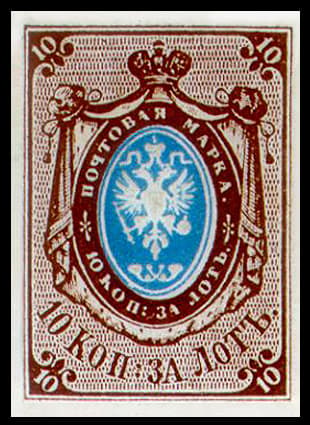
Russia 1857 First Issue 10 Kopeck
Imperial Russia's first stamp nearly came out round, was rushed to the provinces unperforated because the punching machine from Vienna arrived broken, and was cancelled by hand with a pen cross; a genuine unused copy is now one of the great rarities of European philately.
- Year
- 1857
- Maker
- Russian Empire (Tsar Alexander II)
- By price in stamps
- 63 of 100
Create a free account to see every recorded price and every grade.
Create a free account- Issued
- December 10, 1857 (Julian calendar; December 22 in the Gregorian), valid for postage from January 1, 1858
- Ruler
- Emperor Alexander II
- Designer and engraver
- Franz (Feodor) Kepler, senior engraver of the state printing works for state papers
- Design
- Embossed double-headed eagle over two crossed post horns in a blue oval, inside a brown frame with the imperial mantle and crown
- Value and rate
- 10 kopecks, for a letter weighing up to one lot (about 12.8 grams)
- Printing
- Typography in two operations, brown frame and blue center, on white hand-made paper
- Watermark
- A colorless numeral "1", 15 mm high
- Perforation
- Imperforate; the perforated 10 kopecks followed in January 1858
- Unused copies
- Exceedingly rare; most "unused" examples offered are used stamps with the pen cancel removed
- Highest single stated here
- $30,000, unused with part original gum, at auction in the United States, December 2021
A round stamp that never was
Russia already had prepaid postal stationery before it had stamps. Envelopes paying the 5 kopeck local fee in St. Petersburg and Moscow appeared in 1845, and stamped envelopes were extended across the empire on December 1, 1848. The adhesive stamp came later. In 1851 Alexey Charukovsky, a head of postal rail transport, was sent abroad to study how other countries used stamps. He visited England, France, Belgium, the Netherlands, Italy, Austria, Switzerland and Germany and came home in 1852, but the Crimean War stalled any change.
In 1855 Charukovsky submitted a plan to Count Vladimir Adlerberg, the head of the Postal Department. He proposed round stamps with perforation around the picture, printed in several colors with the imperial coat of arms, on paper protected against forgery. The round shape had a practical reason: Charukovsky feared that a rectangular stamp pasted carelessly on an envelope might catch a corner on a post box or another letter and peel off, sending the letter back to its sender. His project was approved on November 12, 1856.
On July 30, 1856, essays of round stamps were made under Jacques Reichel, head of the typographical department of the state printing works, in two designs, the coat of arms and a head of Mercury, each in green, blue, black and carmine. They were not approved.
Kepler's design and a broken machine
The stamp Russia actually issued was rectangular. Franz (Feodor) Kepler, a senior engraver at the state printing works, submitted his design on October 21, 1856, after studying the foreign stamps and designs Charukovsky had brought back. His model was a printer's sample stamp that the Prague firm Gottlieb Haase and Sons had proposed for Austria.
On October 20, 1857, Alexander II approved two-color samples in 10, 20 and 30 kopeck values. On November 9 he ordered that they be called "postage stamps" instead of "stempel" stamps, and printing of the 10 kopecks began that month. The paper was white and hand-made, with a watermarked numeral "1" 15 mm high. Two presses were used: one, from Berlin, printed the blue oval with the embossed coat of arms and post emblem, and the second printed the brown frame. The stamps measure about 16.3 by 22.4 mm and were printed in sheets of 100, made up of four blocks of 25.
The plan was to perforate them. But the punching machine ordered from the State Printing Works in Vienna arrived only on November 19 and in disrepair, so part of the printed 10 kopeck stamps went to the Postal Department imperforate for distribution to the provinces. That accident is why Russia's first stamp exists without perforations, and why the imperforate 10 kopecks is the catalog's number one.
Stamps for a reforming empire
Alexander II had come to the throne in March 1855, in the middle of the Crimean War, and was crowned in September 1856. His reign became known for reform, above all the 1861 Edict of Emancipation that abolished serfdom, earning him the name Alexander the Liberator. The introduction of postage stamps belongs to the first years of that reforming reign.
A circular of the Postal Department dated December 10, 1857 (December 22 by the Gregorian calendar) announced the stamps. From January 1, 1858, ordinary private letters to anywhere in the empire, the Kingdom of Poland and the Grand Duchy of Finland had to carry the stamp matching the letter's weight. The stamps went on sale on December 10, 1857; their use began on January 1, 1858, and on March 1, 1858 in the Caucasus, Transcaucasia and Siberia.
Getting postmarks to the empire's many post offices took time, so the Postal Department ordered stamps to be cancelled with pen and ink, two crossed lines, as stamped envelopes had been. Within weeks the stamp was superseded: on January 10, 1858, perforated 20 and 30 kopeck stamps in the same design appeared, along with a perforated 10 kopecks. The numeral watermark was soon abandoned, and later 1858 printings are on unwatermarked paper.
Used, unused, and the market
Used copies are not rare, and they are collected by plate, printing and postmark. A March 2007 sale of a Russian specialist collection in the United States offered dozens of them: single used copies on and off piece sold for $220 to $1,000, a horizontal pair on piece brought $3,000, and folded letters franked with a single copy reached $2,300 to $4,750. The star of that group was a folded letter from Riga to Walk with a pair carrying both departure and arrival markings, said to be the only such cover known, which sold for $10,000.
Unused copies are another matter. About half of all used 1857 stamps carry a pen cancel, and some of those cancels have been removed to make a used stamp look unused. Specialists say most "unused" examples offered have been cleaned, and only very few genuine copies with original gum are known.
In October 2014 a lightly hinged copy with original gum, described as among the finest, was offered in New York with an estimate of $50,000 to $70,000. In December 2021 an unused copy with a substantial part of its original gum, which probably came off a cover without ever being cancelled and carried a 1991 expert certificate calling it a world rarity, sold in the United States for $30,000. In September 2022 an unused horizontal pair with original gum, described as the only genuine unused pair in private hands outside the Popov Museum in St. Petersburg, sold for $130,000; as a pair, that price is not a single-stamp comparison.
Some of the most important pieces have long histories. The Smithsonian National Postal Museum holds a block of four of the 10 kopecks that came from the collection of Agathon Faberge, son of Peter Carl Faberge. It is part of George H. Kaestlin's collection of about 14,000 Imperial Russian stamps, donated by his niece in 1984 and rediscovered in the museum's backlog in 2011. A strip of five is recorded as the largest known multiple.
How to identify Russia's number one
The 1857 stamp is imperforate, 10 kopecks, with a brown frame and a blue oval holding the white embossed eagle and post horns. Hold it to the light: the genuine first printing is on hand-made paper watermarked with a colorless numeral "1". Paper thickness ranges from 0.08 to 0.11 mm. Two plates exist; the first has an extra short vertical line that was removed from the second. Auction descriptions also separate sub-printings by shade, paper thickness and the strength of the embossing.
The perforated 10 kopecks of 1858 shares the design but is perforated about 14.5 by 15, and the unwatermarked printings of 1858 lack the "1".
Entire forgeries exist, mostly crude lithographs with no watermark and a badly drawn background of vertical lines, lacking the fine alternating lines of short strokes or dots in the original. For any copy described as unused, an expert certificate matters: a 2022 sale description noted that "unused" examples surfacing over the years have generally been found to be cleaned or to have had their pen cancels removed.
Legacy
Kepler's design had a long life. The 1, 3 and 5 kopeck values of 1864 introduced a new coat-of-arms design, but the 10, 20 and 30 kopecks kept the original pattern; one history notes that the 10 and 20 kopecks did not change design until 1875, 17 years after the first stamps. In 1874 Russia was one of the 22 original members of the General Postal Union.
Soviet and Russian postal authorities have repeatedly commemorated the first stamp with stamps, miniature sheets and postcards, and its history is the subject of numerous articles and books.
The numbers
- Issue date
- December 10, 1857 (Julian) / December 22, 1857 (Gregorian); valid from January 1, 1858
- Value
- 10 kopecks, letter up to 1 lot (about 12.8 g)
- Colors
- Brown frame, blue center with embossed eagle
- Printing
- Typography, two presses
- Paper
- White hand-made paper, 0.08 to 0.11 mm thick
- Watermark
- Numeral "1", 15 mm high
- Perforation
- Imperforate
- Size
- About 16.3 x 22.4 mm
- Sheet
- 100 stamps in four blocks of 25
- Plates
- Two (I and II)
- Quantity printed
- Not reliably stated in the sources consulted
- Largest known multiple
- Strip of five
Timeline
Alexey Charukovsky is sent abroad to study the use of postage stamps.
Charukovsky returns to Russia; the Crimean War delays any change.
Charukovsky submits a stamp project to Count Vladimir Adlerberg, head of the Postal Department.
Round essays in two designs are made under Jacques Reichel; they are not approved.
Franz Kepler submits his rectangular design.
Charukovsky's project to introduce adhesive stamps is approved.
Alexander II approves two-color samples in 10, 20 and 30 kopeck values.
Printing of the 10 kopecks begins on watermarked hand-made paper; the perforating machine from Vienna arrives on November 19 in disrepair.
The Postal Department's circular issues the stamp (December 22 by the Gregorian calendar); stamps go on sale.
Stamps become mandatory for ordinary private letters in the empire, Poland and Finland.
Perforated 10, 20 and 30 kopeck stamps appear.
Stamp use begins in the Caucasus, Transcaucasia and Siberia.
George H. Kaestlin's Imperial Russia collection, including a block of four ex-Faberge, is donated to the Smithsonian.
A Russian specialist collection is sold in the United States, with used singles from $220 and a pair on cover at $10,000.
The Kaestlin collection is rediscovered in the Smithsonian's backlog.
A lightly hinged copy with original gum is offered in New York at an estimate of $50,000 to $70,000.
An unused copy with part original gum sells for $30,000 in the United States.
An unused pair with original gum sells for $130,000 in the United States.
The world in 1857
Elisha Otis's first elevator is installed at 488 Broadway in New York City.
The Indian Rebellion of 1857 begins when the 3rd Light Cavalry rebels against its British officers.
The Panic of 1857 begins in the United States.
The Russian ship of the line Lefort sinks in a squall in the Gulf of Finland with the loss of 826 lives.
U.S. Consul Townsend Harris meets the Shogun in Edo, the first such meeting with a foreign diplomat.
Emperor Franz Joseph orders Vienna's city walls demolished, making way for the Ringstrasse.
Alexander II's Edict of Emancipation abolishes serfdom in Russia.
Price record
| Date | Price | Kind |
|---|---|---|
| Mar 7, 2007 | $220 | Sold at auctionUsed, pen cancel lightened so that it appears unused. Sold at auction in the United States. |
| Mar 7, 2007 | $1,000 | Sold at auctionUsed on piece, red decorative Dinaburg 1858 postmark, ex-Faberge, with expert certificate. Sold at auction in the United States. |
| Mar 7, 2007 | $550 | Sold at auctionUsed on piece, deep shade, pen cancel and bilingual Derpt/Dorpat postmark. Sold at auction in the United States. |
| Mar 7, 2007 | $475 | Sold at auctionUsed on piece, Libawa June 21, 1858 datestamp, with expert certificate. Sold at auction in the United States. |
| Mar 7, 2007 | $475 | Sold at auctionUsed, numeral 115 postmark of Mariupol. Sold at auction in the United States. |
| Mar 7, 2007 | $750 | Sold at auctionUsed, boxed Murom May 1858 datestamp, with expert certificate. Sold at auction in the United States. |
| Mar 7, 2007 | $350 | Sold at auctionUsed, right sheet margin, pen cancel. Sold at auction in the United States. |
| Mar 7, 2007 | $950 | Sold at auctionUsed, bottom sheet margin, Riga March 18, 1858 cancel, with expert certificate. Sold at auction in the United States. |
| Dec 7, 2021 | $30,000 | Sold at auctionUnused with part original gum, never cancelled, 1991 expert certificate. Sold at auction in the United States. |
| Dec 7, 2021 | $210 | Sold at auctionUsed, pen cross on small piece. Sold at auction in the United States. |
| Dec 7, 2021 | $425 | Sold at auctionUsed, Kokenhusen round postmark with year completed by pen. Sold at auction in the United States. |
A realized auction price is what a buyer actually paid on the date shown, including the buyer's premium where the sale reported it. It is the strongest kind of reference price, and it is a record of one sale of one object on one day, not a promise of what the next example will bring.
By reference price, Russia 1857 First Issue 10 Kopeck is number 63 of 100 in the stamps entries of the FLOAT 100. 82 of those 100 rest on a realized sale; the rest carry an asking price or a guide value, and each page says which. Rank within the FLOAT 100 itself (60 here) is editorial: how much an object defines its field, not price alone.
Did you know
- Russia's first stamps were nearly round: the planner feared a square corner would snag on a mailbox and tear the stamp off.
- The stamp exists imperforate because the perforating machine ordered from Vienna arrived broken.
- Post offices had no cancelling devices at first, so clerks crossed out the stamps by hand with pen and ink.
- Kepler based his design on a sample stamp that a printer in Prague had proposed for Austria.
- About half of all used copies carry pen cancels, and some have been chemically removed to fake an unused stamp.
- A block of four once owned by Agathon Faberge, son of the jeweler, sat unrecognized in the Smithsonian's backlog until 2011.
How this page is made
- The figure
- One reference price, shown with its own kind. FLOAT does not average it with anything or adjust it for time.
- Realized or not
- A realized price is a completed sale. An asking price, an estimate and a price-guide value are not sales, and are labeled as such wherever they appear.
- The story
- Researched from published records and checked fact by fact. Updated Oct 3, 2026.
- Archive
- Oct 5, 2026