FLOAT 100 · Stamps · No. 10
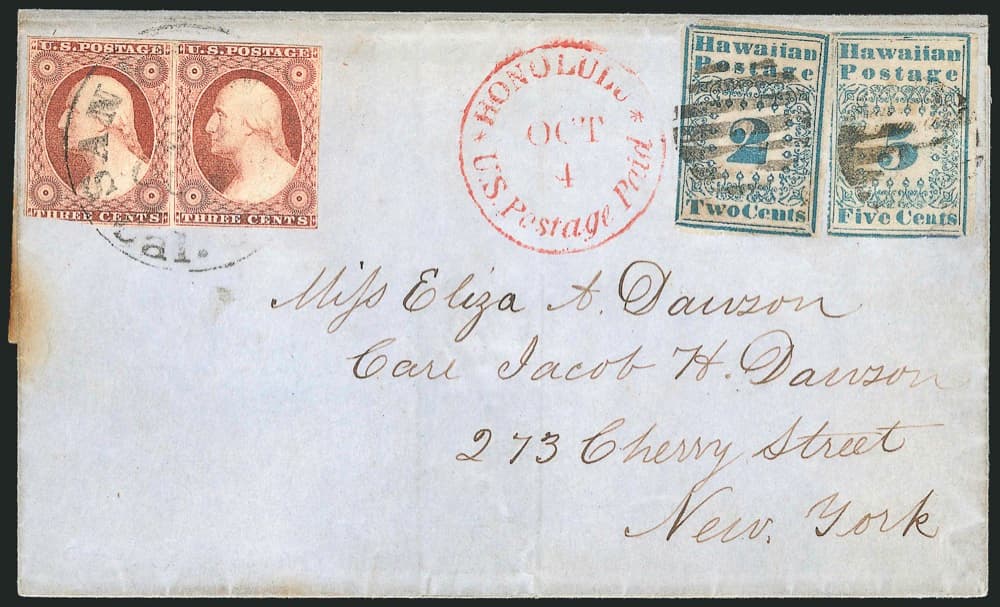
Hawaiian Missionaries (Dawson Cover)
Hawaii's first stamps were set from newspaper type on paper as thin as tissue, and the only envelope ever found with the rarest of them survived because someone stuffed it into a factory furnace so tightly that the fire went out.
- Year
- 1851
- Maker
- Kingdom of Hawaii (postmaster H.M. Whitney)
- By price in stamps
- 10 of 100
Create a free account to see every recorded price and every grade.
Create a free account- Issued
- October 1, 1851, Honolulu, Kingdom of Hawaii
- Values
- 2 cents (newspapers), 5 cents (Hawaiian postage on a letter), 13 cents (a letter all the way to the U.S. East Coast)
- Made by
- Postmaster Henry Martyn Whitney, on the press of the government newspaper The Polynesian
- Paper
- Pelure, an extremely thin paper; all three values printed in blue
- Survivors
- About 200 of all values (a census of 197), including 28 unused and 32 on cover
- Rarest value
- The 2-cent: 15 recorded, only one unused
- The Dawson Cover
- The only known cover with a 2-cent Missionary, and the only intact cover with two different Missionary values (2c and 5c)
- Found
- Around 1905, in a bundle of letters stuffed into the furnace of an abandoned factory; one edge still shows the scorch
- Last public sale
- June 2013, at auction in New York, against a $2 million to $3 million estimate
Stamps for a kingdom in the middle of the Pacific
The California Gold Rush of 1849 sent a flood of mail through San Francisco, and the Kingdom of Hawaii set about organizing its mail. On September 9, 1850, Hawaii's minister Robert Crichton Wyllie, asked the San Francisco postmaster to apply the treaty provisions for mail. The Honolulu Post Office opened on December 21, 1850, and the next day Henry Martyn Whitney was appointed the kingdom's first postmaster.
Whitney, born in 1824 at Waimea on Kauai to the missionaries Samuel and Mercy Whitney, had trained in journalism in New York. Authorized in June 1851, he designed the kingdom's first stamps and printed them on the press of The Polynesian, the government newspaper. They went on sale on October 1, 1851.
The design was as plain as a newspaper notice: a large numeral framed by a printer's ornament, the value repeated in words at the bottom, and "Hawaiian Postage" across the top. All three values were printed in the same blue on pelure, a paper so thin that the collector Bill Gross likened it to toilet paper.
Each value paid a specific leg of a long journey. The 2-cent stamp paid for newspapers and printed circulars. The 5-cent stamp paid Hawaii's own share of postage on a letter. The 13-cent stamp prepaid the whole trip to the U.S. East Coast via San Francisco: 5 cents for Hawaii, 2 cents for the ship's captain, and 6 cents of U.S. postage for distances over 3,000 miles. Because some U.S. post offices did not accept the first 13-cent stamp as payment of American postage, Whitney revised its label in 1852 to read "H.I. & U.S. Postage."
Why they are called Missionaries
Collectors named the stamps after the people who used them. Most survivors are found on the correspondence of the Christian missionaries working in the islands. The National Postal Museum notes that Whitney himself was the son of missionaries.
Whitney went on to a long career as Hawaii's pioneer publisher. He founded the Pacific Commercial Advertiser on July 2, 1856, and in 1861 the Hawaiian-language newspaper Ka Nupepa Kuokoa, which published until 1927. He died in Honolulu on August 17, 1904, at 80.
The Missionaries were Hawaii's only stamps until the Kamehameha III issue of 1853. The printing method left a clue for specialists: the stamps were set in pairs, and each value exists in two slightly different types, Type I from the left position and Type II from the right. The 5-cent Type II, for example, has a distinctive small "n" in "Cents."
The cover that would not burn
The Dawson Cover is a folded letter addressed in the hand of William C. Dawson to "Miss Eliza A. Dawson, Care Jacob H. Dawson," at 273 Cherry Street in New York, with "Give my love to all" written on the back. It carries a 2-cent and a 5-cent Missionary, both the right-hand Type II, tied by the Honolulu seven-bar grid cancel, a red Honolulu "U.S. Postage Paid" datestamp of October 4, 1852, and a horizontal pair of U.S. 3-cent stamps of 1851 tied by a San Francisco datestamp of October 27.
After it reached New York, the letter disappeared. Around 1905 a workman preparing an abandoned factory for reuse found a bundle of old correspondence shoved into a furnace. The bundle had been packed so tightly that the fire went out, leaving the cover with only a slight singe along one edge, still visible today. The workman recognized that the stamps might matter.
The cover's owners read like a roll call of American philately: George H. Worthington, who acquired it in 1905; Alfred F. Lichtenstein; Alfred H. Caspary, who bought it in December 1917 for $6,100; a collector for whom the Weill brothers paid $25,000 in 1957, and who sold it for $90,000 in 1968; Alfred J. Ostheimer III; the Honolulu Advertiser collection formed under publisher Thurston Twigg-Smith and his Persis Corporation; and Guido Craveri and Tito Giamporcaro.
The Persis collection, kept for years in a little-known vault on the third floor of the Advertiser building, sold at auction in New York in 1995 for $9.8 million in all. The Dawson Cover alone realized $2.09 million, a $1.9 million bid plus a 10 percent premium; a Honolulu newspaper reported the buyer as a Swiss collector. In June 2013 it was offered at auction in New York as part of the Steven C. Walske collection of Hawaiian postal history, estimated at $2 million to $3 million. Published results list it as sold for $1,950,000; other accounts give $1.9 million or $2.24 million.
How rare is rare
A census of the whole issue counts 197 Missionaries. Only 28 are unused and 32 are on cover. The 2-cent is the rarest value, with 15 recorded and a single unused copy. Multiples are almost unknown: a pair of the 1852 13-cent and a strip of the first 13-cent on cover, now in the permanent collection of the Smithsonian's National Postal Museum, are the only two recorded.
The unique unused 2-cent has its own price trail. Bill Gross bought it at auction in 1997 for $575,000 and sold it at auction in New York on October 3, 2018, for $619,500. Unused 13-cent stamps are also scarce; in 2016 the auction director offering Gross's Hawaii collection said only seven unused examples of the 13-cent were known.
Rarity has brought fakes and worse. In 1920, 43 more Missionaries surfaced in a group acquired by George H. Grinnell; a 1922 court case found them to be forgeries. A darker story attaches to the 2-cent: as a Honolulu newspaper retold it, a French collector in the 1890s tried to buy one from a friend in Paris and, when the friend refused, murdered him and stole the stamp.
Aristocrats of philately
The Dawson Cover was shown among "The Aristocrats of Philately" at exhibitions in New York in 1971 and 1996 and in Philadelphia in 1976, and by invitation in the Courts of Honor of 15 international exhibitions, the last in Washington in 2006. LIFE magazine featured it in "The World's Greatest Stamps" on May 3, 1954, and it appeared on the cover of Esquire in October 1956. It was displayed in the National Postal Museum's "Gems of Hawaii: The Persis Collection" exhibit during the museum's first anniversary.
In 2002 the U.S. Postal Service reproduced the Missionaries on a souvenir sheet of four stamps, designed by Richard Sheaff and sold for $1.48, with the Dawson Cover pictured on it.
The stamps also reached Hollywood. In the 1963 film Charade, a fortune is hidden in a few rare stamps, one of them a 3-cent Hawaiian Missionary meant to represent the rarer 2-cent. Hawaii itself became a U.S. territory in 1898 and the 50th state in 1959.
The numbers
- Issue date
- October 1, 1851 (2c, 5c, 13c "Hawaiian Postage"); 13c "H.I. & U.S. Postage" in 1852
- Known
- About 200 Missionaries in all (census of 197): 28 unused, 32 on cover; 2c: 15 recorded, 1 unused
- Paper
- Pelure, an extremely thin, fragile paper
- Setting
- Set in pairs, giving Type I and Type II of each value
- Printing
- Typeset on the press of The Polynesian, Honolulu, all values in blue
- Dawson Cover franking
- 2c and 5c Missionaries plus a pair of U.S. 1851 3c stamps
Timeline
Foreign minister Robert Crichton Wyllie asks the San Francisco postmaster to implement treaty mail provisions.
The Honolulu Post Office opens; Henry Martyn Whitney is appointed Hawaii's first postmaster the next day.
The 2-cent, 5-cent and 13-cent Missionaries are issued.
A revised 13-cent stamp reading "H.I. & U.S. Postage" is issued.
The Dawson Cover is postmarked in Honolulu; it is postmarked in San Francisco on October 27.
The Kamehameha III issue ends the Missionaries' run as Hawaii's only stamps.
A workman finds the Dawson Cover in a bundle of letters stuffed into a factory furnace; George H. Worthington acquires it.
Alfred H. Caspary buys the Dawson Cover for $6,100.
A court finds the 43 Grinnell Missionaries to be forgeries.
LIFE features the Dawson Cover in "The World's Greatest Stamps."
The Weill brothers buy the cover for $25,000 on behalf of a collector.
Shown among "The Aristocrats of Philately" in New York.
Sold at auction in New York with the Persis (Honolulu Advertiser) collection, realizing $2.09 million.
Bill Gross buys the unique unused 2-cent for $575,000.
The Postal Service pictures the Dawson Cover on a Hawaiian Missionaries souvenir sheet.
Offered at auction in New York with the Steven C. Walske collection against a $2-3 million estimate.
The unique unused 2-cent sells at auction in New York for $619,500.
The world in 1851
Hong Xiuquan begins the Taiping Rebellion in China.
The Great Exhibition opens in London's Crystal Palace.
The Australian gold rush is officially proclaimed.
Isaac Singer receives a patent for his improved sewing machine.
The yacht America wins the first America's Cup race off the coast of England.
The New York Times publishes its first issue.
Herman Melville's Moby-Dick is published in the United States.
Louis-Napoleon Bonaparte stages a coup d'etat in France.
Price record
| Date | Price | Kind |
|---|---|---|
| 1995 | $2,090,000 | Sold at auctionDawson Cover sold at auction in New York with the Persis (Honolulu Advertiser) collection: $1.9 million plus 10% premium. |
| 1997 | $575,000 | Sold at auctionThe unique unused 2-cent Missionary (not the cover), bought by Bill Gross. |
| Jun 2013 | $2,000,000 | Estimate, not a saleDawson Cover presale estimate of $2 million to $3 million (low end shown). |
| Jun 2013 | $1,950,000 | Sold at auctionDawson Cover sold at auction in New York from the Steven C. Walske collection, as listed in the sale results; other accounts give $1.9 million or $2.24 million. |
| Oct 3, 2018 | $619,500 | Sold at auctionThe unique unused 2-cent Missionary (not the cover), sold at auction in New York from the Bill Gross collection. |
A realized auction price is what a buyer actually paid on the date shown, including the buyer's premium where the sale reported it. It is the strongest kind of reference price, and it is a record of one sale of one object on one day, not a promise of what the next example will bring.
By reference price, Hawaiian Missionaries (Dawson Cover) is number 10 of 100 in the stamps entries of the FLOAT 100. 82 of those 100 rest on a realized sale; the rest carry an asking price or a guide value, and each page says which. Rank within the FLOAT 100 itself (10 here) is editorial: how much an object defines its field, not price alone.
Did you know
- The Dawson Cover survived a furnace because the bundle of letters around it was packed so tightly that the fire went out.
- The 13-cent Missionary paid the postage of two countries at once, plus 2 cents for the ship's captain.
- Bill Gross compared the stamps' pelure paper to toilet paper.
- By a story long told in philately, a Paris collector in the 1890s was murdered by a friend who wanted his 2-cent Missionary.
- The 1963 film Charade hides a fortune in rare stamps, including a 3-cent Hawaiian Missionary standing in for the 2-cent.
- A 1922 court case found 43 Missionaries that had surfaced in 1920 to be forgeries.
- For $1.48 in 2002 anyone could buy the Postal Service's sheet of four reproduced Missionaries, picturing the Dawson Cover.
How this page is made
- The figure
- One reference price, shown with its own kind. FLOAT does not average it with anything or adjust it for time.
- Realized or not
- A realized price is a completed sale. An asking price, an estimate and a price-guide value are not sales, and are labeled as such wherever they appear.
- The story
- Researched from published records and checked fact by fact. Updated Oct 1, 2026.
- Archive
- Oct 5, 2026