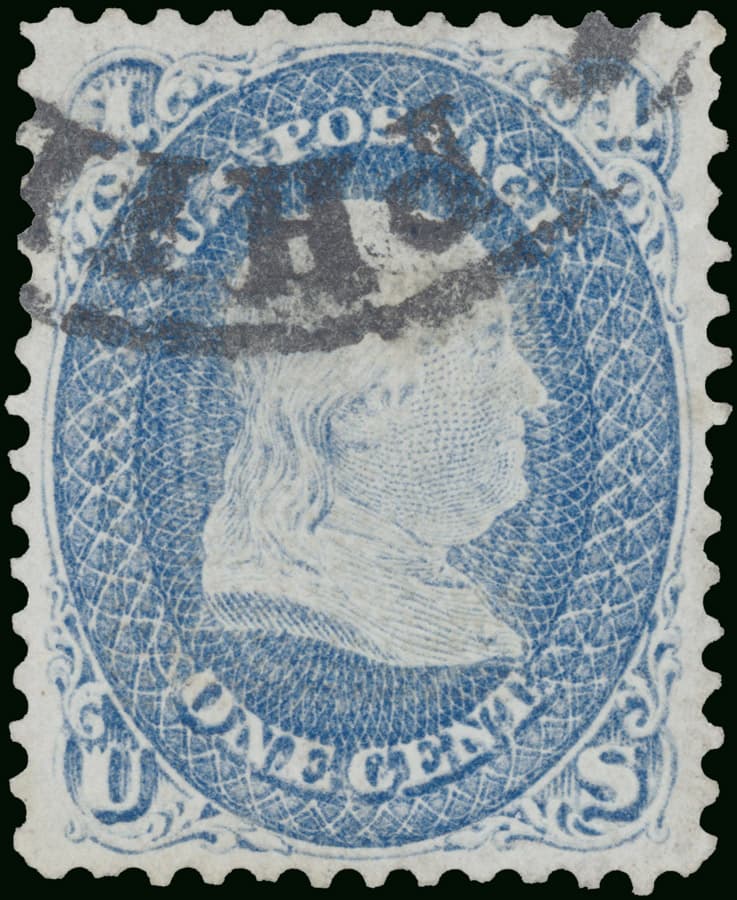
FLOAT 100 · Stamps · No. 11
US 1c Franklin 'Z' Grill
A one-cent stamp that looks like thousands of others, set apart only by the shape of tiny ridges pressed into its back, was once swapped for the unique plate block of the most famous error in American stamps and is now the most valuable United States stamp ever sold at auction.
- Year
- 1868
- Maker
- United States (USPOD), National Bank Note Co.
- By price in stamps
- 3 of 100
Create a free account to see every recorded price and every grade.
Create a free account- Catalog number
- Scott 85A, 1-cent blue Benjamin Franklin with Z grill
- Issued
- 1868; the 1-cent, 10-cent and 15-cent Z grills were grilled for only a short run in mid-to-late February 1868
- Printer
- National Bank Note Company, New York City
- Grill inventor
- Charles F. Steel of the National Bank Note Company, patented October 22, 1867
- Produced
- An estimated 1,000 one-cent stamps received the Z grill
- Known today
- Two. One is in the Benjamin K. Miller Collection of the New York Public Library; the other is the only one collectors can own
- How to tell
- Each grill point has a horizontal ridge on top; every other grill has an X-shaped point or a vertical ridge
- Cancels
- The library's copy has a grid cancel; the privately owned copy has a Philadelphia circular datestamp
- Record
- $4,366,000 at auction in New York, June 14, 2024, the most ever paid for a single United States stamp
A war on washed stamps
After the Civil War the federal government worried that it was losing revenue to people who cleaned the cancellations off used stamps and mailed them again. The Smithsonian's National Postal Museum records a run of experiments meant to stop it: cancelling devices that scraped or cut the stamp, inks and papers that dissolved when washed, and even one misguided trial involving gunpowder.
The answer that stuck came from Charles F. Steel, a supervisor at the National Bank Note Company in New York, which printed the nation's stamps. Steel patented a process, Letters Patent No. 70,147, dated October 22, 1867, that pressed a waffle-like pattern of tiny pyramids into the stamp. The embossing broke the paper fibers so cancelling ink soaked in and could not be washed out. The Post Office Department issued the first grilled stamps in 1867, and in 1868 amended the printing contract to require grills on stamps before delivery.
Grills were expensive and weakened the paper, and the museum notes that experts now agree the reuse problem was greatly exaggerated and the cost of preventing it far exceeded the revenue protected. Grilling ended in 1875. In the meantime the printer tried many sizes and shapes of grill, and that experimentation is what created the rarity.
The letter Z and the ridge that gives it away
In 1916 William L. Stevenson, a philatelist from Flint, Michigan, published a booklet classifying the grills by letter, A through J, based mainly on size. One type did not fit his scheme. It was about the size of the common E grill, but the top of each point formed a horizontal ridge, a shape sometimes described as a rooftop or as >—<. Unable to place it in sequence, Stevenson called it Z. His system was adopted by the standard U.S. catalog in 1926, giving each grill type its own number and its own album space.
That album space is the whole story. The 1-cent Z grill shares its design with the ordinary blue 1-cent Franklin stamp of the 1861 series; only the grill differs. Collectors have turned over countless 1-cent grilled Franklins hoping to find the horizontal ridges instead of the common E or F grill. Only twice has the answer been yes.
Reported measurements of the grill vary slightly by source: about 11 by 14 millimeters, with counts given as 13 to 14 points by 17 to 18, 14 to 15 by 17 to 18, or 13 to 14 by 18. Dealers who know what to look for have found Z grills misidentified as E grills, which are the same size.
A few days of grilling in 1868
No grill-production logs survive, so the timing of the Z grill has been worked out from the earliest known dated uses and from the government stamp agent's delivery records. A detailed reconstruction published with the Zoellner collection in 1998 concludes that the Z was the first grill put into regular production after the experimental A and C grills, that it was in use from about January 7, 1868, and that the 1-cent, 10-cent and 15-cent values were grilled with it sometime between February 19 and 28. The authors flag every date other than earliest known uses as conjecture.
The run was short. The F grill replaced the Z in March 1868 (March 17 in the 1998 reconstruction). The National Postal Museum estimates that about 1,000 one-cent Z grills were produced, compared with roughly 500,000 two-cent and 100,000 three-cent stamps carrying the same grill. Most 1-cent stamps of the period paid for public notices and circulars, which recipients threw away.
The survivors reflect those numbers. Only two 1-cent, two 15-cent and six 10-cent Z grills have ever been found and certified genuine.
From a Flint collector to a Louis Vuitton trunk
Stevenson recorded two 1-cent Z grills in his 1916 booklet. The one with a grid cancel, probably his own, was sold with a group of his grilled stamps through the dealer Elliott Perry to Benjamin K. Miller on December 16, 1923, and Miller gave his collection to the New York Public Library. It was on display at the library for more than fifty years until a theft in 1977 sent the collection into secure storage. It was shown at the National Postal Museum from May 27, 2006, to October 1, 2007, and is now on long-term loan there. As library property it cannot be sold.
The second stamp, cancelled with a Philadelphia circular datestamp, vanished between 1916 and 1957. That year it was certified for the first time and sold by Lester G. Brookman to the collector Wilbur H. Schilling Jr. When Schilling's collection was dispersed it brought $42,500 at a 1975 auction, and that May it was certified again as a genuine "double Z grill, cancelled Philadelphia." In 1977 it sold for $90,000 and passed to Dr. Jerry Buss, the owner of the Los Angeles Lakers.
When the Buss collection was sold in 1986 the stamp went to Robert Zoellner for $418,000 including a 10 percent premium, a record for a United States stamp. At the 1998 sale of the Zoellner collection, an 11-year-old named Zachary Sundman held the bidding paddle for his father, the stamp dealer Donald Sundman, as they outbid the bond investor Bill Gross at $935,000.
Gross got it seven years later in what collectors call the greatest stamp swap in history. On November 2, 2005, Sundman traded the 1-cent Z grill to Gross, represented by his adviser Charles Shreve, for the unique plate-number block of the 24-cent Inverted Jenny, which Gross had bought for $2.97 million. The trade was valued at about $3 million, and with it every space in Gross's album of United States stamps was filled.
On June 14, 2024, Gross sold it at auction in New York as the centerpiece of the last part of his collection, presented in a custom Louis Vuitton trunk. Against an estimate of $4 million to $5 million, it sold to an anonymous telephone bidder for $4,366,000, a record for any single United States stamp. Gross's 100 most valuable single stamps brought $18.1 million that night.
The key to a complete collection
Because the catalog gives the Z grill its own number, a truly complete collection of United States stamps needs one, and only one collector at a time can have it. The 1998 catalog put it plainly: unless another is discovered, there is only one example available to collectors. Robert Zoellner owned a complete set of Z grills; Bill Gross completed his entire United States collection with it.
Its numbering is odd too. The catalog's numbering system was set up before Z grills were recognized as a separate variety, so the stamp has no number of its own and shares 85 with other grilled stamps, as 85A.
Its sister rarity is the 15-cent Lincoln Z grill, also known in just two examples. Gross's copy, which he bought in 1998 for $209,000, sold in the same June 2024 sale; reports give the price as $2.35 million and $2,773,000, a difference consistent with whether the buyer's premium is counted.
The numbers
- Issue
- 1868, 1-cent blue Franklin of the 1861 design, grilled at the National Bank Note Company
- Quantity grilled
- An estimated 1,000 with the Z grill; 1,489,800 one-cent grilled stamps (Z and E) were delivered in the first quarter of 1868
- Known
- 2 (1-cent); also 2 of the 15-cent and 6 of the 10-cent Z grill
- Grill
- About 11 x 14 mm; points with horizontal ridges; point counts reported as 13-15 by 17-18
- Paper
- Paper embossed with the grill, which breaks the fibers so cancelling ink cannot be washed out
Timeline
Charles F. Steel of the National Bank Note Company receives patent No. 70,147 for the stamp grill.
Approximate start of regular Z grill production, on the 2-cent stamp, per a 1998 reconstruction.
The 1-cent, 10-cent and 15-cent values are grilled with the Z grill in a short run, probably between February 19 and 28.
The F grill replaces the Z grill.
Grilling of U.S. stamps ends.
William L. Stevenson publishes his grill classification, naming the Z grill and recording two 1-cent examples.
Benjamin K. Miller acquires the grid-cancelled 1-cent Z grill from Stevenson's grills, sold through Elliott Perry.
The standard U.S. catalog adopts Stevenson's grill system.
The Philadelphia-cancelled copy reappears, is certified and is sold by Lester G. Brookman to Wilbur H. Schilling Jr.
Sold at auction for $42,500 when the Schilling collection is dispersed.
Sold for $90,000; it passes to Lakers owner Jerry Buss. The Miller collection goes into storage after a theft.
Sold to Robert Zoellner for $418,000, a record for a U.S. stamp.
A third certificate of genuineness is issued, signed by expert Herbert Bloch.
Sold for $935,000 to Donald Sundman, with his 11-year-old son Zachary holding the paddle.
Sundman trades it to Bill Gross for the unique Inverted Jenny plate block, completing Gross's U.S. collection.
Both 1-cent Z grills go on display at the National Postal Museum, through October 1, 2007.
Sold at auction in New York for $4,366,000 to an anonymous telephone bidder.
The world in 1868
Japan's Emperor Meiji proclaims the Meiji Restoration.
The Jolly Corks in New York City rename themselves the Benevolent and Protective Order of Elks.
A Brazilian squadron forces the Passage of Humaita, a turning point in the Paraguayan War.
The U.S. House votes 126 to 47 to impeach President Andrew Johnson; New Orleans holds its first Mardi Gras float parade the same day.
The Fourteenth Amendment is ratified, guaranteeing citizenship and equal protection.
A magnitude 8.5 to 9.0 earthquake strikes Peru, killing more than 25,000 people.
Ulysses S. Grant defeats Horatio Seymour for the presidency.
Price record
| Date | Price | Kind |
|---|---|---|
| 1975 | $42,500 | Sold at auctionSold at auction when the Wilbur H. Schilling Jr. collection was dispersed. |
| 1977 | $90,000 | Sold at auctionSold at auction; the stamp then passed to Jerry Buss. |
| 1986 | $418,000 | Sold at auctionSold from the Buss collection to Robert Zoellner, including 10% premium. Record for a U.S. stamp at the time. |
| Oct 1998 | $935,000 | Sold at auctionSold from the Zoellner collection to Donald Sundman, including 10% premium. |
| Jun 14, 2024 | $4,000,000 | Estimate, not a salePresale estimate of $4 million to $5 million (low end shown). |
| Jun 14, 2024 | $4,366,000 | Sold at auctionSold at auction in New York from the Bill Gross collection to an anonymous telephone bidder. Record for any single U.S. stamp. |
A realized auction price is what a buyer actually paid on the date shown, including the buyer's premium where the sale reported it. It is the strongest kind of reference price, and it is a record of one sale of one object on one day, not a promise of what the next example will bring.
By reference price, US 1c Franklin 'Z' Grill is number 3 of 100 in the stamps entries of the FLOAT 100. 82 of those 100 rest on a realized sale; the rest carry an asking price or a guide value, and each page says which. Rank within the FLOAT 100 itself (11 here) is editorial: how much an object defines its field, not price alone.
Did you know
- The Z grill is called Z because the man who classified the grills in 1916 could not fit it into his A-to-J sequence.
- The stamp's 1998 winning bid was placed by an 11-year-old boy holding the paddle for his father.
- In 2005 it was swapped for the unique plate block of the Inverted Jenny, in what collectors call the greatest stamp swap in history.
- The only other copy belongs to the New York Public Library and is on long-term loan to the Smithsonian's National Postal Museum.
- The library put its stamp collection into storage after a theft in 1977; it had been on display for more than fifty years.
- One owner was Jerry Buss, who also owned the Los Angeles Lakers.
- The record-setting copy was sold in 2024 inside a custom Louis Vuitton trunk.
- Experts now agree the stamp-washing problem grills were meant to solve was greatly exaggerated; grilling ended in 1875.
How this page is made
- The figure
- One reference price, shown with its own kind. FLOAT does not average it with anything or adjust it for time.
- Realized or not
- A realized price is a completed sale. An asking price, an estimate and a price-guide value are not sales, and are labeled as such wherever they appear.
- The story
- Researched from published records and checked fact by fact. Updated Oct 1, 2026.
- Archive
- Oct 5, 2026