FLOAT 100 · Stamps · No. 9
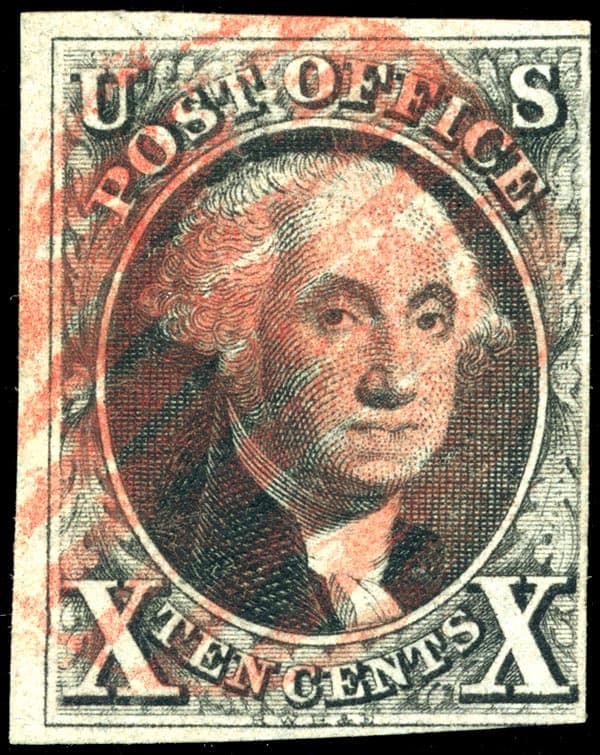
US 1847 10c Washington (First Issue)
Half of the first United States postage issue, a black ten-cent Washington made from a banknote printer's stock engravings, paid for letters going more than 300 miles, was dead after four years, and left behind fewer than a million copies and a block of six found tucked inside a Bible.
- Year
- 1847
- Maker
- United States (USPOD)
- By price in stamps
- 84 of 100
Create a free account to see every recorded price and every grade.
Create a free account- Catalog number
- Scott 2, 10-cent black, George Washington
- Issued
- July 1, 1847, New York City; Boston received stamps July 2 and Philadelphia July 7
- Authorized by
- The Post Office Act of March 3, 1847; Postmaster General Cave Johnson chose the subjects and colors
- Printer
- Rawdon, Wright, Hatch & Edson, banknote engravers of New York City
- Portrait
- From an existing engraving by Asher B. Durand, after Gilbert Stuart's 1796 Athenaeum portrait
- Rate paid
- A half-ounce letter carried more than 300 miles, or a double-weight letter within 300 miles
- Printed / sold
- 1,050,000 printed; about 865,000 sold
- Format
- Imperforate; plate of 200 in two panes of 100
- Withdrawn
- Demonetized in July 1851; the dies and plates were destroyed December 12, 1851
- Most famous multiples
- The Bible block, the unique unused block of six, and the Rush cover, with the largest strip on cover
The country's first postage stamps
Before 1847 the only postage stamps in the United States were private issues. Following the 1845 law that set uniform letter rates, postmasters in eleven cities produced their own provisional stamps in 1845 and 1846; the New York postmaster, Robert H. Morris, paid for his himself. Congress followed Britain's 1840 example with the Post Office Act of March 3, 1847, authorizing the Postmaster General "to prepare postage stamps, which, when attached to any letter or packet, shall be evidence of the payment of postage chargeable on such letter."
Rates depended on distance. A letter weighing up to half an ounce cost 5 cents to send up to 300 miles and 10 cents to send farther, so the government needed exactly two stamps. Benjamin Franklin, the first postmaster general, went on the brown 5-cent stamp. George Washington, the first president, went on the 10-cent stamp, printed in black.
Using stamps was not yet required. A sender could still pay in cash and have the letter marked "paid," or the recipient could pay on delivery. Stamps did not become mandatory until 1856.
Made from a banknote printer's stock
The job went to Rawdon, Wright, Hatch & Edson, the prominent New York banknote engraving firm, which had engraved and printed the New York postmaster's provisional two years earlier and possibly proposed the work at Postmaster General Cave Johnson's request. Its bid was 25 cents per thousand stamps in two colors or 20 cents per thousand in one. Johnson chose the cheaper single color.
In an age when individual banks printed their own currency, the firm kept an inventory of engraved dies that could be dropped into any design. Rather than cut new portraits, its engravers used stock banknote engravings and frames. The National Postal Museum notes that the vignettes of Franklin and Washington came from existing engravings by Asher B. Durand; the Washington portrait follows Gilbert Stuart's famous 1796 Athenaeum painting. Trial colors were sent to Johnson, who picked black for the 10-cent stamp.
The stamps were line engraved by the transfer process invented by Jacob Perkins: a single reversed image was engraved into a die, rocked into a soft-steel transfer roll, and then rocked 200 times into a plate holding two panes of 100. The firm, which became part of the American Bank Note Company in 1858, kept ownership of the 1847 dies and plates. The museum suggests that lack of government control was one reason the issue was withdrawn; from then on, printing contracts gave the government possession of plates and dies.
Delivering the first stamps
On June 26, 1847, the printers told Johnson that 200,000 ten-cent and 600,000 five-cent stamps were ready. A special agent, believed to be Third Assistant Postmaster General John Marron, reached New York on June 29. Before noon on July 1 he handed 20,000 ten-cent and 60,000 five-cent stamps to the New York postmaster, Robert Morris; production delays meant New York was the only office with stamps on the official first day.
Marron delivered 10,000 ten-cent stamps to Boston on July 2, spent the Fourth of July weekend there, and left another 10,000 at Philadelphia on July 7 before returning to Washington with the rest. No cover is known from July 1. The earliest known cover with one of the new stamps was postmarked at New York on July 2, and the National Postal Museum has exhibited a pair of 10-cent stamps on a second-day cover lent by the collector Bill Gross.
Because there was no stamp for intermediate amounts, some post offices accepted 10-cent stamps cut in half, diagonally or vertically, to pay the 5-cent rate. The Post Office Department never authorized these bisects, which are listed separately by collectors today.
Identifying a 10-cent 1847
The stamp was issued without perforations or a watermark, so each one had to be cut from the sheet, and collectors prize examples with clear margins on all four sides. Cancellations are most often red, but blue, black, green, "Paid," steamboat, numeral, town and pen cancels are all found.
The 10-cent plate wore far less than the 5-cent plate. The museum attributes this to a carbon-based black ink that was not abrasive, unlike the metal-oxide brown inks, and to a smaller run: 1,050,000 ten-cent stamps were printed, less than a quarter of the 5-cent total. Its four printings are almost indistinguishable. The scholar Elliott Perry plated all 200 positions; the plate has four double transfers and a set of well-known varieties with names like the Harelip and the Stick Pin.
Sales were far smaller than printings: about 865,000 of the 10-cent were sold, against about 3.7 million of the 5-cent. No full sheet of 200 is believed to survive. The largest surviving pieces are two panes of 100 plate proofs, one of each value, overprinted "Specimen."
Collectors also need to watch for later printings. After the original dies and plates were destroyed in December 1851, the American Bank Note Company produced reprints of both values in or about 1858, 1878 and 1895, which has led the National Postal Museum to ask whether the transfer rolls were ever destroyed.
The Bible block and the Rush cover
The Bible block is the unique unused block of six 10-cent stamps and the largest surviving block of the issue, discovered over a century ago slipped between the pages of a Bible. Bill Gross bought it at the 1993 auction of the Ryohei Ishikawa collection for $464,500 and sold it at auction in New York on October 3, 2018, for $590,000 to Gordon Eubanks, a collector who specializes in the 1847 issue.
The Rush cover was mailed on September 26, 1848, by Benjamin Rush in Philadelphia to his father, Richard Rush, the American minister to France, in Paris, to go by the British mail steamer Europa. It bears a horizontal strip of six 10-cent stamps from positions 55 through 60 of the left pane, the third stamp showing the Harelip variety, the largest known multiple of the 10-cent on cover. Its use of 1847 stamps to pay the historic "retaliatory" rate is most unusual, and the auctioneer Philip H. Ward Jr. once called it "the most important cover known to American philately." Its owners included John F. Seybold, Henry C. Gibson Sr., Philip G. Rust, Leonard Kapiloff and Gross. Offered at auction in New York in October 2020 with a $400,000 to $500,000 estimate, it sold for $510,000.
Also in 2020, the Waukegan cover, which stands out for its quality among the five covers and one front known with a strip of four 10-cent stamps, sold for $155,000.
The first two spaces in the album
Stamps of 1847 traditionally fill the first two spaces in an album of United States stamps, and the National Postal Museum observes that most young collectors could never afford them, so those spaces stayed empty. That scarcity built a mystique around the issue as the genesis of American philately.
The stamps had a short life. The Post Office Act of March 3, 1851, cut the basic letter rate to 3 cents, and the 1847 stamps were demonetized in July 1851, replaced by new stamps from a different printer. The National Postal Museum gives the date as July 1 in one account and says in another that the stamps were invalid after July 30, with exchanges for new stamps allowed through September 29, 1851. On December 12, 1851, three officials watched the original dies and plates destroyed.
Used single copies remain within reach of many collectors. A widely read stamp weekly has noted that the standard specialized catalog valued a used four-margin 10-cent at $775, a guide value rather than a sale, with premiums for very fine examples and for scarce cancellations. Unused copies and multiples are another matter, as the Bible block shows.
The numbers
- Issue date
- July 1, 1847
- Printed
- 1,050,000 (four printings)
- Sold
- About 865,000 (one source gives 863,800)
- Plate
- One plate of 200 subjects in two panes of 100; four double transfers
- Perforation
- Imperforate
- Watermark
- None
- Printing
- Line engraved, black ink
Timeline
New York postmaster Robert H. Morris issues the first U.S. postmaster's provisional; eleven cities issue provisionals in 1845 and 1846.
Congress passes the Post Office Act authorizing federal postage stamps.
Rawdon, Wright, Hatch & Edson report 200,000 ten-cent and 600,000 five-cent stamps ready.
The first 20,000 ten-cent stamps are delivered to the New York post office and probably go on sale that afternoon.
Earliest known cover with an 1847 stamp is postmarked in New York; Boston receives its stamps.
Philadelphia receives 10,000 ten-cent stamps.
Benjamin Rush mails the Rush cover, with a strip of six 10-cent stamps, from Philadelphia to Paris.
A new Post Office Act cuts the basic letter rate to 3 cents.
The 1847 stamps are demonetized; exchanges are allowed through September 29.
The 1847 dies and plates are destroyed before three official witnesses.
Use of postage stamps becomes mandatory.
Rawdon, Wright, Hatch & Edson becomes part of the American Bank Note Company, which later makes reprints of the 1847 stamps.
Bill Gross buys the Bible block for $464,500.
The National Postal Museum opens a 150th-anniversary display of the 1847 issue.
The Bible block sells at auction in New York for $590,000.
The Rush cover sells at auction in New York for $510,000.
The world in 1847
Thomas Edison is born; Alexander Graham Bell follows on March 3.
Brigham Young leads 148 Mormon pioneers into the Salt Lake Valley.
Liberia becomes independent.
U.S. general Winfield Scott enters Mexico City during the Mexican-American War.
Siemens & Halske is founded to build electrical telegraphs.
Charlotte Bronte publishes Jane Eyre; Wuthering Heights and Agnes Grey follow on December 14.
James Young Simpson discovers the anesthetic properties of chloroform.
The Great Famine continues in Ireland. The United States has 29 states.
Price record
| Date | Price | Kind |
|---|---|---|
| Oct 3, 2018 | $590,000 | Sold at auctionThe Bible block, sold at auction in New York from the Gross collection to Gordon Eubanks. |
| 2020 | $155,000 | Sold at auctionThe Waukegan cover, with a strip of four 10-cent stamps. |
| Oct 2020 | $400,000 | Estimate, not a saleThe Rush cover (strip of six on cover), presale estimate $400,000 to $500,000 (low end shown). |
| Oct 2020 | $510,000 | Sold at auctionThe Rush cover, sold at auction in New York from the Gross collection. |
A price-guide value is an editorial estimate, not a transaction and not an asking price. Guides lag the market and smooth over grade and condition. It is neither a floor nor a ceiling: a sale can land above or below it, and it should be checked against a realized sale before anything rests on it.
By reference price, US 1847 10c Washington (First Issue) is number 84 of 100 in the stamps entries of the FLOAT 100. 82 of those 100 rest on a realized sale; the rest carry an asking price or a guide value, and each page says which. Rank within the FLOAT 100 itself (9 here) is editorial: how much an object defines its field, not price alone.
Did you know
- On the first day, only one post office in the country, New York, had the new stamps.
- The portrait came from a banknote printer's stock engraving, not a new design.
- People sometimes cut the 10-cent stamp in half to pay the 5-cent rate, though the Post Office never authorized it.
- The only unused block of six was found slipped between the pages of a Bible.
- No complete sheet of 1847 stamps is known to survive.
- The stamps were valid for only about four years.
- Stamps were optional when they were introduced; prepaying with stamps did not become mandatory until 1856.
How this page is made
- The figure
- One reference price, shown with its own kind. FLOAT does not average it with anything or adjust it for time.
- Realized or not
- A realized price is a completed sale. An asking price, an estimate and a price-guide value are not sales, and are labeled as such wherever they appear.
- The story
- Researched from published records and checked fact by fact. Updated Oct 1, 2026.
- Archive
- Oct 5, 2026