FLOAT 100 · Stamps · No. 44
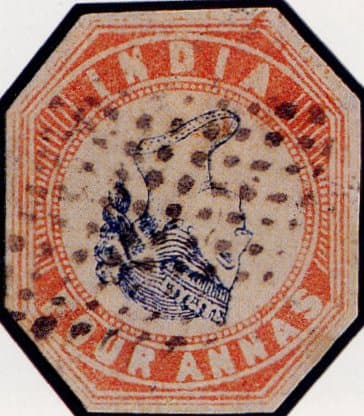
India 1854 'Inverted Head 4 Annas'
Map printers in Calcutta set out to make the British Empire's first two-color stamp, turned a handful of sheets the wrong way round, and created a rarity that went unnoticed for years and now survives in about 28 copies, every one of them used.
- Year
- 1854
- Maker
- East India Company / British India
- By price in stamps
- 45 of 100
Create a free account to see every recorded price and every grade.
Create a free account- Issued
- October 1854, Calcutta; the first 4-anna stamps went on sale on October 15, 1854
- Printed by
- The Survey Office in Calcutta, under Deputy Surveyor-General Captain Thuillier, by lithography
- Design
- Queen Victoria's head in blue inside an octagonal red frame
- The error
- Queen's head upside down relative to the frame, from the first printing (Head Die I, Frame Die I)
- Cause
- At least six frame sheets were turned 180 degrees before the heads were printed
- Surviving examples
- 28 recorded, all postally used; about 25 cut to the octagonal shape and 2 or 3 cut square
- Institutional copies
- Three in the Tapling Collection at the British Library (two on cover), one in the Royal Collection, one in the Government of India collection in Delhi
- Notable sale
- A fault-free cut-to-shape example from the Medina collection, January 23, 2013: $110,350 including premium
Stamps from a map office
When British India prepared its first general postage stamps in 1854, it chose lithography, a process the Survey Office in Calcutta already used to print maps. The job went to the Deputy Surveyor-General, Captain Thuillier. Working from preliminary sketches, he had a local engraver make the dies, and after one abortive attempt his office had a half-anna blue and a one-anna red ready for sale on October 1, 1854.
Then the plans changed. An expected 8-anna value was dropped in favor of a 2-anna green, and the 4-anna, now the top value, was to be printed in two colors: a red frame around a blue head of Queen Victoria. At the time the only stamps anywhere printed in more than one color came from the Swiss cantons of Zurich and Basel, made with sophisticated European equipment.
Separate copper dies were engraved for the head and for an octagonal frame. These were transferred to small lithographic stones that produced only 12 impressions at a time, widely spaced in three rows of four, with a checkerboard of wavy lines between them. The red frames were printed first and left to dry overnight; the blue heads were printed on top in a second pass. The design of the Queen's head is credited to H. M. Smith of the lithographic department, and the sheets were printed on East India Company paper watermarked with the company's arms.
The 4-anna went on sale at Calcutta's post office on October 15, 1854, the first two-color postage stamp produced and sold in the British Empire. Demand was heavy, and four more printings followed over the next year, using four different head dies and two frame dies; later sheets were enlarged from 12 to 24 stamps by closing up the spacing.
How the Queen ended up on her head
The two-pass process had an obvious weak point. Any sheet of red frames fed into the press upside down for the second pass would come out with the Queen's head inverted. According to the standard account, at least six sheets of frames were inadvertently turned 180 degrees before the heads were printed, during the first printing, which used Head Die I and Frame Die I. The fault came from how the sheets were placed, not from the dies or stones.
The inverted stamps were sold and used like any others. Precisely when collectors noticed them is disputed. The philatelist E. A. Smythies claimed the error was discovered at a meeting of the Philatelic Society of London in 1874, but no publication of the 1870s mentions it. Reprints made in 1891 are the first conclusive evidence that the error was known. L. L. R. Hausburg mentioned it in 1907 without being sure which printing it came from, and a Mr. Séfi described it in the West End Philatelist in January 1912.
Twenty-eight survivors
About 28 examples are recorded, and all of them are postally used. Most, about 25, were cut to the octagonal shape of the frame, as was common practice with these stamps; only two or three were cut square. Specialists can place several on the original sheet: the two on cover in the Tapling Collection at the British Library come from positions 3 and 4, the Royal Collection's example from position 5, and the Government of India's example, on piece, from position 2. Another source puts the survivors at 20 to 30.
Several of the finest copies are institutional. The Tapling Collection holds three, including the two on cover; the Royal Collection has one; the Government of India collection in Delhi has one; and the C. D. Desai collection had two cut square. An example from the collection of the Earl of Crawford was shown at the World Philatelic Exhibition in Washington in 2006.
Fakes have circulated for as long as the stamp has been famous. One appeared in the Masson sale and one or two in the sales of the Ferrary collection. Some forgers erased the head chemically and reprinted it inverted; such work can be detected under ultraviolet light.
A Medina copy comes to market
Because most examples are cut to shape and many were damaged in use, condition drives the market. On January 23, 2013, a cut-to-shape example described as completely free of the faults associated with many of these stamps was offered at auction in London from the Medina collections of India, formed over decades by the collector Mohammed Sayeed. Its presale estimate was 50,000 to 70,000 pounds.
After bidding in the room and by telephone from the United Kingdom and abroad, it sold to an overseas private collector. Reports give the hammer price as 58,000 pounds, about $91,805, and the total with buyer's premium as 69,600 pounds, reported as $110,350.
The stamp is often called one of the world's first multicolored stamp varieties, and one of the most sought-after stamps of 19th-century philately.
The numbers
- Issue date
- October 15, 1854 (first printing began October 13, 1854)
- Printing
- Two-pass lithography: red frame first, blue head second; 12 stamps per sheet in the first printing
- Error sheets
- At least six sheets with frames turned 180 degrees
- Known
- About 28, all used; about 25 cut to shape, 2 or 3 cut square
- Paper
- East India Company paper watermarked with the company's arms; imperforate
- Dies
- Head Die I and Frame Die I
Timeline
India's first general issues, the half-anna blue and one-anna red, go on sale.
The first printing of the 4-anna begins at the Survey Office in Calcutta; at least six sheets of frames are turned the wrong way.
The 4-anna goes on sale at the Calcutta post office, the British Empire's first two-color stamp.
A second printing of the 4-anna follows; three more come in 1855.
E. A. Smythies later claimed the invert was discovered at a Philatelic Society of London meeting this year; no publication of the time confirms it.
Reprints provide the first conclusive evidence that the error was known.
L. L. R. Hausburg mentions the error, unsure which printing it came from.
Mr. Séfi describes the error in the West End Philatelist.
The Earl of Crawford's example is shown at the World Philatelic Exhibition in Washington.
A fault-free example from the Medina collections sells at auction in London for 69,600 pounds with premium.
The world in 1854
The East India Company annexes Jhansi State under the doctrine of lapse.
Commodore Matthew Perry signs the Convention of Kanagawa, opening two Japanese ports to American trade.
The Bombay Spinning and Weaving Company is established as India's first cotton mill.
Wood's despatch proposes sweeping changes to education in India.
A cholera outbreak in London begins; Dr. John Snow traces one cluster to a single water pump.
The Charge of the Light Brigade at Balaclava during the Crimean War.
The Suez Canal Company is formed in Egypt.
Price record
| Date | Price | Kind |
|---|---|---|
| Jan 23, 2013 | $110,350 | Sold at auctionSold at auction in London from the Medina collections; fault-free cut-to-shape example. 69,600 pounds including premium; hammer price 58,000 pounds (reported as $91,805). |
A realized auction price is what a buyer actually paid on the date shown, including the buyer's premium where the sale reported it. It is the strongest kind of reference price, and it is a record of one sale of one object on one day, not a promise of what the next example will bring.
By reference price, India 1854 'Inverted Head 4 Annas' is number 45 of 100 in the stamps entries of the FLOAT 100. 82 of those 100 rest on a realized sale; the rest carry an asking price or a guide value, and each page says which. Rank within the FLOAT 100 itself (44 here) is editorial: how much an object defines its field, not price alone.
Did you know
- India's first stamps were printed by the government's map-making office, because it already did lithography.
- When the 4-anna appeared, the only two-color stamps in the world came from the Swiss cantons of Zurich and Basel.
- Every known Inverted Head is used; no unused copy is recorded.
- The red frames were printed first and left to dry overnight before the blue heads went on, which is how a sheet could be turned the wrong way.
- Two of the three examples in the British Library's Tapling Collection are still on their original covers.
- Early forgers bleached out the head and reprinted it upside down; ultraviolet light gives them away.
How this page is made
- The figure
- One reference price, shown with its own kind. FLOAT does not average it with anything or adjust it for time.
- Realized or not
- A realized price is a completed sale. An asking price, an estimate and a price-guide value are not sales, and are labeled as such wherever they appear.
- The story
- Researched from published records and checked fact by fact. Updated Oct 1, 2026.
- Archive
- Oct 5, 2026