FLOAT 100 · Stamps · No. 45
India 'Scinde Dawk' 1/2 Anna
Asia's first postage stamp was a blob of red sealing wax stamped with the East India Company's mark; it cracked so easily that it was replaced within months, and fewer than 100 of the whole family survive.
- Year
- 1852
- Maker
- Scinde (Sindh) District Post, British East India Company
- By price in stamps
- 64 of 100
Create a free account to see every recorded price and every grade.
Create a free account- Issued
- July 1, 1852, in the Scinde (Sindh) district of British India, now in Pakistan
- Introduced by
- Bartle Frere, Chief Commissioner of Sindh, with Karachi postmaster Edward Lees Coffey
- Value
- Half an anna, the only denomination
- Design
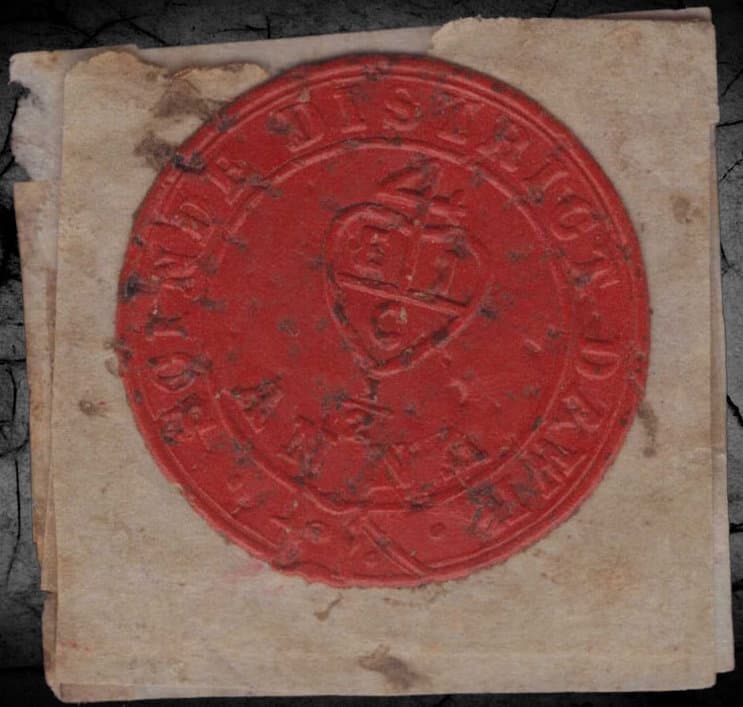
- Embossed circle inscribed "SCINDE DISTRICT DAWK" and "1/2 ANNA" around the East India Company's heart-shaped merchants' mark with the letters E I C
- Three versions
- Red sealing-wax wafer; colorless embossing on white paper; blue embossing on white paper
- Made by
- Embossed in London by a firm of security printers at Frere's request
- In use
- July 1, 1852, to September 30, 1854; remaining stock destroyed by 1856
- Surviving examples
- Fewer than 100 known
- Distinction
- The first adhesive postage stamps in Asia
A runner post on the Indus
"Dawk" is the anglicized spelling of the Hindustani word dak, meaning post, and "Scinde" was the British spelling of Sindh, the lower Indus Valley in what is now Pakistan. The Scinde Dawk was a very old system of runners, paid according to the distance they traveled and the weight of the letters they carried. After the East India Company conquered Sindh in February 1843, following the Battle of Miani, the old system proved inadequate for the company's military and commercial needs.
In 1850 Bartle Frere became Chief Commissioner of Sindh. An admirer of Rowland Hill's postal reforms in Britain, he set out to give the province cheap, uniform postage that did not depend on distance. In 1851 the runners were replaced by horses and camels on routes that followed the Indus valley, linking government offices and post offices from Karachi through Kotri and Hyderabad north to Sukkur. Frere worked with the active support of Edward Lees Coffey, the postmaster of Karachi.
Prepayment by stamps was a basic feature of the new system. The first stamps were issued on July 1, 1852. They were only valid in the province, but they were the first adhesive postage stamps in Asia, and forerunners of the stamps later used throughout India, Burma and the Straits Settlements.
Wax, then white, then blue
The design is an embossed circle with the words "SCINDE DISTRICT DAWK" and the value "1/2 ANNA" around the merchants' mark of the East India Company: a heart shape divided into three segments, each holding one of the letters E, I and C. Every Scinde Dawk had the same value, half an anna.
The first version was embossed on wafers of red sealing wax fixed to paper. Wax was a poor material for a stamp. It cracked and broke apart, and a red Scinde Dawk without cracks is rarely seen. It was soon replaced by a colorless embossing on white paper, which proved hard to read in dim light; one account says the problem was visibility by candlelight. The final version was embossed in blue on white paper, with an extra ring added to the design.
Accounts agree that the stamps were embossed in London at Frere's request. Letters of the Sindh postmaster mention receiving 10,000 stamps from England and ordering fresh supplies, and white and blue examples survive in the printer's own archive collection, now at the Postal Museum in London.
Withdrawn, but not quite
The Scinde Dawks were in use for just over two years. They were withdrawn on September 30, 1854, as the first stamps valid across British India arrived from the Survey Office in Calcutta, and the remaining stock was ordered destroyed.
The order was not fully carried out. In June 1856 the Director-General of Posts in India received a letter that still bore a Scinde Dawk. The remaining stock was then destroyed by the collector of Karachi.
Several thousand Scinde Dawks were used between 1852 and 1854, yet very few survive. Fewer than 100 are known today. One collector's account suggests why: they were often used as seals, and many were destroyed when letters were opened. Nine types of cancellation are recorded on them.
Identifying a genuine Scinde Dawk
Collectors catalog the three versions separately: in the standard British catalog numbering for India, the white is S1, the blue S2 and the red S3. Condition varies widely. The red is almost always cracked, and many of the paper versions are creased, thinned or repaired. Unused white and blue examples are extremely rare, and multiples of any version are enormous rarities.
Forgeries are plentiful. The easiest to detect are not embossed at all. Cruder fakes misalign the second "A" of ANNA with the "K" of DAWK, or fail to separate the "1/2" from the central heart-shaped emblem. Collectors are advised to buy valuable examples only with an expert certificate.
What survivors bring
Prices depend heavily on version and condition. On May 19, 2011, a very rare unused blue example with excellent embossing and large margins, with a natural inclusion spot at the second N of ANNA, sold for $28,342.
On May 21, 2013, a red half anna led the second part of the Medina collection of India at auction in London, selling for 10,000 pounds ($15,199). Repairs, and the fact that it was tied to a small piece of paper it did not originally belong to, held the price down. In June 2016 another scarlet example, impressed in red wax, sold at auction for $27,000.
A June 2019 auction in New York showed how much condition matters. A sound used blue example with a perfectly struck "96" cancel of Hyderabad brought $5,750; a faulty blue on piece, $2,900; a red with the usual cracks, repaired and painted in, $5,500; and single white examples with creases or tears, $450 to $800. A vertical pair of the white, a rare multiple, brought $11,000 in the same sale.
The numbers
- Issue date
- July 1, 1852
- Withdrawn
- September 30, 1854; remainders destroyed by 1856
- Known
- Fewer than 100 surviving, all versions
- Supply
- Postal letters record a shipment of 10,000 stamps from England; total printed not recorded
- Format
- Embossed circle; red on sealing-wax wafers, colorless or blue on white paper
- Catalog numbers
- S1 (white), S2 (blue), S3 (red) in the British catalog; A1-A3 in the U.S. catalog
Timeline
The East India Company conquers Sindh after the Battle of Miani.
Bartle Frere becomes Chief Commissioner of Sindh.
Frere reforms the Scinde District post; horses and camels replace runners along the Indus.
The red wax Scinde Dawk is issued, the first adhesive postage stamp in Asia.
The Scinde Dawks are withdrawn and the remaining stock ordered destroyed.
The first stamps valid throughout British India go on sale.
A letter bearing a Scinde Dawk reaches the Director-General of Posts; the remaining stock is then destroyed in Karachi.
Sir Bartle Frere dies.
A very rare unused blue example sells for $28,342.
A repaired red example leads the Medina collection sale in London at 10,000 pounds.
A scarlet wax example sells at auction for $27,000.
Six single Scinde Dawks of all three versions sell at auction in New York, from $450 to $5,750.
The world in 1852
HMS Birkenhead sinks near Cape Town; troops stand firm on deck so as not to swamp the lifeboats.
Uncle Tom's Cabin is published in book form in Boston.
The Second Anglo-Burmese War begins.
Frederick Douglass delivers "What to the Slave Is the Fourth of July?" in Rochester, New York.
Franklin Pierce is elected president of the United States.
The first roadside pillar boxes in the British Isles go into use on Jersey, at the suggestion of the novelist and postal official Anthony Trollope.
Napoleon III becomes Emperor of the French.
Price record
| Date | Price | Kind |
|---|---|---|
| May 19, 2011 | $28,342 | Sold at auctionBlue, unused; very rare, excellent embossing, large margins. |
| May 21, 2013 | $15,199 | Sold at auctionRed (scarlet) wax, repaired and tied to a piece it did not originally belong to; sold at auction in London for 10,000 pounds. |
| Jun 2016 | $27,000 | Sold at auctionScarlet, impressed in red wax. |
| Jun 2019 | $5,750 | Sold at auctionBlue, used; sound, strong embossing, Hyderabad "96" cancel. Sold at auction in New York. |
| Jun 2019 | $5,500 | Sold at auctionRed, used on paper; usual cracks, repaired and painted in. Sold at auction in New York. |
| Jun 2019 | $2,900 | Sold at auctionBlue, on piece; creased, toned and with a surface flaw. Sold at auction in New York. |
| Jun 2019 | $800 | Sold at auctionWhite, on piece; clipped into an octagon. Sold at auction in New York. |
| Jun 2019 | $750 | Sold at auctionWhite, on piece; creases and a tear into the design. Sold at auction in New York. |
| Jun 2019 | $450 | Sold at auctionWhite, used; huge margins, strengthened crease. Sold at auction in New York. |
A realized auction price is what a buyer actually paid on the date shown, including the buyer's premium where the sale reported it. It is the strongest kind of reference price, and it is a record of one sale of one object on one day, not a promise of what the next example will bring.
By reference price, India 'Scinde Dawk' 1/2 Anna is number 64 of 100 in the stamps entries of the FLOAT 100. 82 of those 100 rest on a realized sale; the rest carry an asking price or a guide value, and each page says which. Rank within the FLOAT 100 itself (45 here) is editorial: how much an object defines its field, not price alone.
Did you know
- The first version was not printed on paper at all; it was a wafer of red sealing wax with the design pressed into it.
- The white version was hard to see in dim light, which is why the last version was embossed in blue.
- A letter carrying a Scinde Dawk reached the head of the Indian postal service nearly two years after the stamps were withdrawn, prompting the destruction of the leftover stock.
- The design is the East India Company's merchants' mark: a heart divided into three parts holding the letters E, I and C.
- Many were used as seals, and were destroyed when the letters were opened.
- A crude fake can be caught by checking whether the second A of ANNA lines up with the K of DAWK.
How this page is made
- The figure
- One reference price, shown with its own kind. FLOAT does not average it with anything or adjust it for time.
- Realized or not
- A realized price is a completed sale. An asking price, an estimate and a price-guide value are not sales, and are labeled as such wherever they appear.
- The story
- Researched from published records and checked fact by fact. Updated Oct 1, 2026.
- Archive
- Oct 5, 2026