FLOAT 100 · Stamps · No. 5
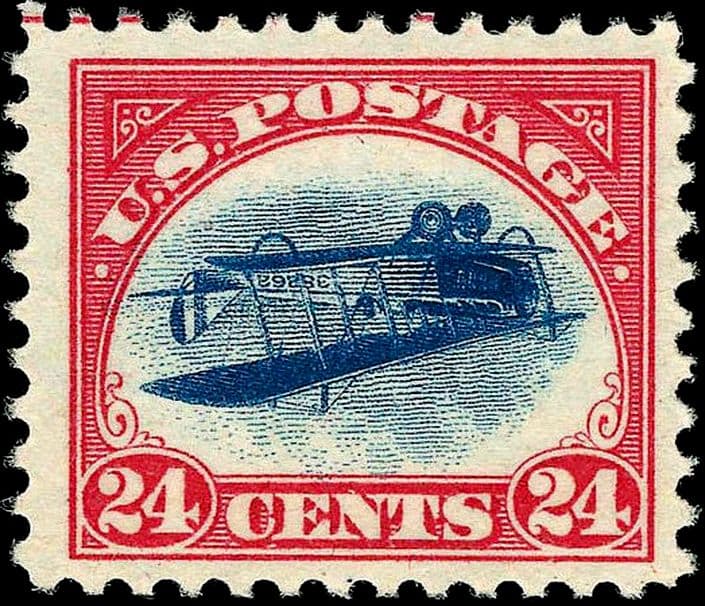
Inverted Jenny (24c Airmail Invert), Position 49
One stamp from America's most famous misprint vanished into a Chicago family's safe-deposit box in 1918; when it came out a century later, untouched by light or hinge, it became the finest Inverted Jenny there is and the first U.S. stamp to sell for more than $2 million.
- Year
- 1918
- Maker
- United States (USPOD), Bureau of Engraving and Printing
- By price in stamps
- 8 of 100
Create a free account to see every recorded price and every grade.
Create a free account- Stamp
- 24-cent carmine rose and blue airmail, the 1918 Curtiss Jenny, with the blue airplane printed upside down; catalog number C3a
- Printed by
- Bureau of Engraving and Printing, Washington, D.C.; engraving began May 4, 1918, and printing May 10
- Error sheet
- One pane of 100, bought by William T. Robey for $24 at the New York Avenue post office in Washington on May 14, 1918
- Position
- 49: the ninth stamp in the fifth row, still bearing dealer Eugene Klein's pencil "49" on the back
- Condition
- Mint, never hinged, original gum; graded XF 90 in 2018 and Extremely Fine-Superb 95 in 2022 by two grading services
- Hidden
- Held by three generations of a Chicago-area family, mostly in safe-deposit boxes, from 1918 until 2018
- Resurfaced
- Authenticated in 2018; reported by The New York Times on September 6, 2018
- Sales
- $1,593,000 at auction in New York, November 2018; $2,006,000 at auction in New York, November 8, 2023
- Owner
- Collector Charles Hack, buyer in 2023, as reported in the press
A stamp printed in a hurry
In the spring of 1918 the U.S. Post Office decided to start regular airmail service on May 15, flying between Washington, Philadelphia and New York. It set a rate of 24 cents, far above the 3 cents then charged for a first-class letter, and ordered a new stamp just for it, printed in red and blue and showing a Curtiss JN-4 "Jenny," the biplane modified for the mail by removing the second pilot seat to make room for mailbags.
The work was rushed. Engraving began on May 4 and printing on May 10, in sheets of 100. Because the stamp had two colors, each sheet had to go through the flat-bed press twice: once for the carmine frame and once for the blue airplane. That process had already produced inverted errors in 1869 and 1901, and at least three misprinted sheets were caught and destroyed during production. One pane of 100 got through.
For years collectors assumed the frames were upside down. In fact the frames were printed first and the airplanes are inverted; where a plane drifts over the frame, the blue ink lies on top of the red. The Smithsonian's National Postal Museum gives two possible explanations: either a sheet of printed frames was fed into the press upside down for the second impression, or the printer mounted the airplane plate inverted after inking and wiping it.
"My heart stood still"
Initial deliveries reached post offices on Monday, May 13, and May 14 was the first day the stamp was on sale in all three airmail cities. The collector William T. Robey had written to a friend on May 10 that the two-part design made inverts possible and it would pay to watch for them. On May 14 he went to the New York Avenue post office window. When the clerk brought out a sheet with the airplanes upside down, Robey later wrote, "my heart stood still." He paid the $24 face value for the 100 stamps and asked to see more; the other sheets were normal. The clerk later said he had not noticed because he had never seen an airplane.
Postal inspectors tried to get the sheet back, and Robey hid it under his mattress. On Sunday, May 19, he gave Philadelphia dealer Eugene Klein a one-day option to buy it for $15,000. Klein exercised the option the next afternoon and had already arranged to resell the sheet for $20,000 to Col. Edward H. R. Green, son of Hetty Green. Robey and his father-in-law delivered the sheet to Klein's office on Tuesday, May 21.
Before the sheet was divided, Klein wrote a small pencil number on the back of each stamp, 1 through 10 across the top row to 91 through 100 across the bottom, so every stamp's position would be known forever. Green kept a number of stamps, including the plate-number block, and Klein sold the rest as singles and blocks. Position 49, the ninth stamp in the fifth row, was sold by Klein to a collector in 1918. Then its trail went cold.
A century in the dark
For a hundred years no one in the stamp world knew where Position 49 was. A 1986 book that tracked each of the 100 stamps recorded it as "No record." Until August 2018, there were no known images or records of a transaction since Green acquired the sheet on May 21, 1918.
In 2018 a man in Illinois called a New York expertizing body and said he had an Inverted Jenny. The curator, Lewis Kaufman, looked at the cellphone photo and suspected it was No. 49, one of only two positions unaccounted for. The executive director, Larry Lyons, called back. The stamp had come down through the owner's mother's side of the family: a great-uncle apparently bought it after the sheet was broken up, and after he died his widow left it to the owner's mother in the 1930s. It had spent most of those years in one safe-deposit box or another.
The owner would neither mail it nor bring it to New York, so Lyons flew to Chicago and went with him to the bank. The box sat in a Mosler safe, a coincidence Lyons enjoyed, since Gustave Mosler of the safe-making family had been president of the American Philatelic Society from 1929 to 1931. "I had a big magnifying glass with me, and the colors were so fresh," Lyons said. "And then I turned it over and saw the 49 and went 'Jackpot.'" The New York Times reported the find on September 6, 2018.
Two record sales
Position 49 was offered at auction in New York in November 2018, its first time on the market since 1918. The catalog called it the finest example in existence, "by virtue of its pristine gum and phenomenal centering," with a "deep rich color unlike any we have ever encountered." It sold for a hammer price of $1,350,000, or $1,593,000 with the 18 percent premium, then a record for an Inverted Jenny. The collector Charles Hack bid on it and lost; his top bid was reported as $50,000 short of the winning price.
The 2018 buyer kept it in the dark. In 2022 the stamp was certified by one grading service and recertified by another, and both assigned Mint Never Hinged, Extremely Fine-Superb 95. It was offered again at auction in New York on November 8, 2023, with an estimate of $1.5 million to $2 million. It brought a hammer price of $1,700,000, or $2,006,000 with the 18 percent premium. The auctioneer called it the first time a single United States stamp had brought more than $2 million at auction.
The buyer was Hack, then 76, who had been chasing Inverted Jennys since childhood. He bought his first in the early 2000s for about $300,000 and paid $1 million for Position 57 in 2007. He called Position 49 "the holy grail of postage" and said he planned to keep it in a safe away from light. "This is the premium copy," he said. "It doesn't get any better than this."
Why this one is the best
Many of the 100 Inverted Jennys have been damaged over the years. Colonel Green let moisture reach some of his; eight straight-edge copies were found stuck together in an envelope in his estate; hinges have left thins and creases; one was taped to an exhibit page and another was sucked into a vacuum cleaner. One was mailed and is the only cancelled example. Position 18 was stolen in 1977 and had its top perforations cut off to disguise it, and Position 66, stolen at a stamp show in Norfolk, Virginia, in 1955, is still missing.
Position 49 escaped all of that. It has never been hinged, its gum is original, and because it was kept away from light its colors are rich and its paper bright. Only six never-hinged stamps from the sheet are recorded. According to the 2023 sale description, none of the other five grades above 85, and the only other stamps with XF-Superb 95 centering have been hinged. That is the basis for calling Position 49 the finest Inverted Jenny that can exist.
To identify it, look for the pencil "49" that Klein wrote on the back, centering that the auction description calls precise, and long, full perforations all around. The 2022 certificate from one service reads "Genuine, Never Hinged, PF Graded XF-S 95."
The upside-down airplane
The plane on the stamp was not just any Jenny. Engraver Marcus Baldwin's airplane was Jenny No. 38262, one of only six modified mail planes, and that same aircraft was the first to leave Washington on the inaugural airmail flight on May 15, 1918, at 11:47 a.m.
The Inverted Jenny became the most requested stamp for viewing at the National Postal Museum, and its record of sales is so closely followed that the complete history of every one of the 100 is publicly documented. It has turned up in Brewster's Millions (1985) and in a 1993 episode of The Simpsons. In 2013 the Postal Service reissued the design as a $2 souvenir sheet, printing 2.2 million sheets with the plane inverted and, deliberately, 100 with it right side up.
The numbers
- On sale
- Delivered to post offices May 13, 1918; error sheet bought May 14, 1918
- Face value
- 24 cents (the airmail rate)
- Quantity
- One pane of 100 inverts known
- Printing
- Engraved, two passes through a flat-bed press; frame carmine rose, airplane blue
- Position
- 49 (row 5, stamp 9)
- Grade
- Mint Never Hinged, XF-Superb 95 (2022); XF 90 (2018)
- Perforations
- Full on all sides, per the 2018 auction description
Timeline
Engraving of the 24-cent airmail stamp begins.
Printing begins; Robey writes to a friend that it would pay to watch for inverts.
Initial deliveries of the new stamp reach post offices.
Robey buys the inverted sheet for $24 at the New York Avenue post office in Washington.
Regular airmail service begins between Washington, Philadelphia and New York.
Eugene Klein exercises his option to buy the sheet for $15,000, having arranged a resale to Col. Green for $20,000.
The sheet is delivered to Klein, who numbers each stamp on the back before it is broken up; Position 49 is later sold to a collector in 1918.
A book tracking all 100 stamps lists Position 49 as "No record."
The New York Times reports that Position 49 has been authenticated after 100 years out of sight.
Sold at auction in New York for $1,593,000 with premium, a record for an Inverted Jenny.
Certified and recertified Mint Never Hinged, Extremely Fine-Superb 95.
Sold at auction in New York for $2,006,000 to Charles Hack, a record for any U.S. stamp.
The world in 1918
President Woodrow Wilson presents his Fourteen Points.
Congress establishes U.S. time zones and approves daylight saving time.
Britain merges its army and navy air services into the Royal Air Force, the first independent air force.
The U.S. Post Office Department begins the world's third regular airmail service.
Women in Canada, outside Quebec, win the right to vote in federal elections.
The "Spanish flu" becomes a pandemic.
The former Russian emperor Nicholas II and his family are executed.
Germany signs the armistice that ends World War I.
Price record
| Date | Price | Kind |
|---|---|---|
| May 14, 1918 | $24 | Private saleFace value paid by William T. Robey for the entire sheet of 100 at a post office window. |
| May 20, 1918 | $15,000 | Private saleEntire sheet of 100, Robey to dealer Eugene Klein. |
| May 21, 1918 | $20,000 | Private saleEntire sheet of 100, Klein to Col. Edward H. R. Green. |
| Nov 15, 2018 | $1,593,000 | Sold at auctionSold at auction in New York; hammer $1,350,000 plus 18% premium. Then a record for an Inverted Jenny. |
| Nov 8, 2023 | $1,500,000 | Estimate, not a salePresale estimate of $1.5 million to $2 million (low end shown). |
| Nov 8, 2023 | $2,006,000 | Sold at auctionSold at auction in New York; hammer $1,700,000 plus 18% premium. Buyer Charles Hack. Record for a U.S. stamp. |
A realized auction price is what a buyer actually paid on the date shown, including the buyer's premium where the sale reported it. It is the strongest kind of reference price, and it is a record of one sale of one object on one day, not a promise of what the next example will bring.
By reference price, Inverted Jenny (24c Airmail Invert), Position 49 is number 8 of 100 in the stamps entries of the FLOAT 100. 82 of those 100 rest on a realized sale; the rest carry an asking price or a guide value, and each page says which. Rank within the FLOAT 100 itself (5 here) is editorial: how much an object defines its field, not price alone.
Did you know
- The postal clerk who sold the sheet said he did not notice the error because he had never seen an airplane.
- Robey's profit on the sheet was $14,976, made within a week.
- The plane on the stamp, Jenny No. 38262, was the very plane that flew the first airmail out of Washington.
- Position 49's safe-deposit box sat in a Mosler safe; a Mosler had once led the American Philatelic Society.
- The 2023 buyer had lost the 2018 auction for the same stamp by about $50,000.
- The airplanes, not the frames, are upside down: the blue ink sits on top of the red.
- In 2013 the Postal Service printed 100 right-side-up Jenny souvenir sheets on purpose, and its inspector general later called that improper.
How this page is made
- The figure
- One reference price, shown with its own kind. FLOAT does not average it with anything or adjust it for time.
- Realized or not
- A realized price is a completed sale. An asking price, an estimate and a price-guide value are not sales, and are labeled as such wherever they appear.
- The story
- Researched from published records and checked fact by fact. Updated Oct 1, 2026.
- Archive
- Oct 5, 2026