FLOAT 100 · Stamps · No. 4
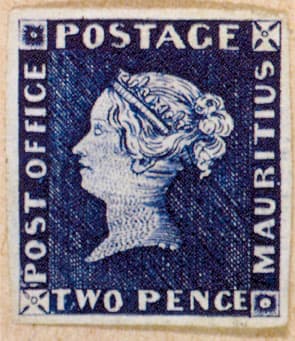
Mauritius 'Post Office' 2d Twopence
The original "Blue Mauritius": a future king paid a world-record price for one in 1904, and another spent the end of World War II hidden in a German mine.
- Year
- 1847
- Maker
- Mauritius (British colony)
- By price in stamps
- 15 of 100
Create a free account to see every recorded price and every grade.
Create a free account- Issued
- September 21, 1847, Port Louis, Mauritius, then a British colony
- Engraved and printed by
- Joseph Osmond Barnard, 31, an English-born engraver who had arrived on the island in 1838
- Design
- Profile of Queen Victoria after Britain's 1841 stamps; "POST OFFICE" in the left panel; "JB" at the lower right of the bust
- Color and value
- Deep blue, two pence (2d), the higher of the two values
- Printed
- 500, from a single plate that also carried the one-penny engraving
- Surviving
- A census compiled for the book Blue Mauritius lists 12 two-pence examples, four of them unused; sources differ on the unused count
- Royal copy
- Bought at auction in London in 1904 for £1,450 on behalf of the future King George V; considered the finest known example and now in the Royal Collection
- Kanai copy
- An unused example from the Kanai collection sold at auction in Zurich in 1993 for $1,148,850 with premium
Two pence for the rest of the island
Mauritius set standardized inland postage rates in 1846 under Ordinance No. 13: one penny for delivery within town and two pence for other localities. To pay them, the colony issued two stamps on September 21, 1847, a one penny in orange-red and a two pence in deep blue. They were the first stamps authorized by any British colonial government.
Both were engraved by Joseph Osmond Barnard on one small copper plate, with a single engraving of each value, and 500 of each were printed by the intaglio method. The designs copied the British stamps of the day, with Queen Victoria in profile. Barnard's initials "JB" appear at the lower right of the bust.
The left panel reads "POST OFFICE." The next printing, in 1848, changed the words to "POST PAID," which is why the 1847 stamps are known as the Post Office Mauritius. The blue two pence became the stamp collectors called the "Blue Mauritius," the name Helen Morgan used for her 2006 history of the issue.
The engraver, and a story that was never true
Barnard was born in 1816 into a Jewish family in Portsmouth, England, and reached Mauritius in 1838 as a stowaway, put ashore from a ship bound for Sydney. Mauritius Post describes him as a jeweler. He was 31 when he engraved the stamps.
In 1928 Georges Brunel wrote that the words "POST OFFICE" were an error, and the story grew into a tale of a half-blind old watchmaker who forgot the wording until he passed a post office sign. Scholars have found no basis for it. Handstamps used on Mauritian letters before 1847 already read "Post Office," Mauritius Post says the wording copied a date stamp in use since the 1820s, and the first United States stamps of July 1847 used the same words.
A king's stamp
No collector knew of the Post Office stamps until 1864, when Mme. Borchard, wife of a Bordeaux merchant, found examples of both values in her husband's business correspondence. Prices climbed quickly: by 1897 only 17 Post Office stamps were known, and two of them sold that year for £1,860. Philipp von Ferrary owned six by 1893. The Independent's review of Blue Mauritius recounts a collector with 12,544 lesser stamps who announced in an 1891 lonely hearts advertisement that he would marry only a woman who owned one.
In 1904 an unused two pence was knocked down at auction in London for £1,450 to a buyer acting for the Prince of Wales, the future King George V, then a world record for a stamp. A secretary reportedly remarked the next day that "some damned fool" had paid a fortune for one stamp; George answered, "I am that damned fool." Helen Morgan's census describes this copy, with its large margins, as the finest known example. It remains in the Royal Collection.
Another unused two pence descended through the great collections. It was found by Mme. Borchard, bought with an unused one penny by Henry Duveen in 1909 and by Arthur Hind in 1923, the pair for about $30,000, and acquired by the collector Hiroyuki Kanai in 1965. When the Kanai Mauritius collection was sold at auction in Zurich in 1993, it brought 1,725,000 Swiss francs, reported as $1,148,850 with the 15 percent premium, slightly more than the unused one penny in the same sale. A consortium of Mauritian companies bought both.
The same 1993 sale included the Bordeaux cover, the only cover bearing one stamp of each value. Mailed on October 4, 1847, to the Bordeaux wine merchants Ducau et Lurguie and found in their papers by a student in 1902, it sold for a price reported as 5,750,000 and as 6,123,750 Swiss francs, $3,829,500 in one account and about $4 million in others.
The two pence that went into a mine
A second envelope from the same Bordeaux merchants carries a single two pence, with a piece torn from the left side near the "O" of "OFFICE." A French student found it among the merchants' papers as well. It sold in 1903 for £1,200 and was resold the same year for £1,400, and in 1904 the postal museum in Berlin acquired it, displaying it in a glass wall frame with seven other stamps.
In 1943 the frame was stored in the Reichsbank in Berlin to protect it from bombing, then hidden in a potassium mine near Eisleben. After the war it came into the hands of an American captain, Dennis Sweeney, who tried to sell it through a stamp dealer; the dealer alerted Interpol and Germany claimed it. Sweeney handed it to a U.S. customs agent in 1977, and in 1990 the frame was returned to a reunified Germany and shown in Bonn.
Two pence Post Office stamps can be seen today in several public collections: the Museum for Communication in Berlin, the Museum for Communication in The Hague, the Postal Museum in Stockholm, the British Library in London, and in Port Louis, where the Blue Penny Museum shows the unused Kanai two pence and one penny bought in 1993 by a consortium of Mauritian companies, reported as $2 million for the two. To protect them, the originals there are lit only for short periods.
Counting the blues
The two pence is deep blue, imperforate, with Queen Victoria facing left and "POST OFFICE" down the left side. The shading dots in the portrait gave the queen what one reviewer called the look of smallpox. The stamps have been reprinted from the original plate and forged many times, so a genuine example is identified against the recorded census.
Sources give different counts. Hiroyuki Kanai's 1981 book Classic Mauritius puts the total of both values at 27, and the census compiled for Helen Morgan's research companion lists 12 two-pence examples, four unused and eight used. A summary published with a stage play about the stamps says three unused are known, and Mauritius Post's museum page says only 12 Post Office stamps of both values remain. A used two pence sold at auction in London in 2011 for about £1 million. The Independent noted that the blue two pence is even more coveted than the red penny.
The numbers
- Issue date
- September 21, 1847
- Face value
- Two pence, the rate for delivery outside town under the 1846 rates
- Quantity printed
- 500
- Known
- 12 in the Blue Mauritius census (four unused); sources differ
- Printing
- Intaglio, from a single copper plate with one engraving of each value
- Perforation
- None (imperforate)
- Engraver's mark
- "JB" at lower right of the bust
Timeline
Ordinance No. 13 sets inland postage at 1d in town and 2d for other localities.
The 2d deep blue and 1d orange-red Post Office stamps are issued; 500 of each are printed.
The Bordeaux cover, with one 1d and one 2d, is mailed to wine merchants in Bordeaux.
The "POST PAID" issue replaces the Post Office stamps.
Mme. Borchard finds 1d and 2d examples in Bordeaux, the first known to collectors.
A collector advertises that he will marry only a woman who owns a Post Office Mauritius.
Two Post Office stamps sell for £1,860; 17 are known.
A student finds the Bordeaux cover.
The second Bordeaux envelope, with a damaged 2d, sells for £1,200 and is resold for £1,400.
An unused 2d is bought at auction in London for £1,450 for the future King George V, a world record; the Berlin postal museum acquires the second Bordeaux envelope.
Arthur Hind buys the unused 2d later owned by Kanai, together with an unused 1d, for about $30,000.
Berlin's frame of rarities is stored in the Reichsbank, then hidden in a potassium mine near Eisleben.
Hiroyuki Kanai acquires the unused 2d.
Dennis Sweeney hands the Berlin frame to a U.S. customs agent.
The frame is returned to a reunified Germany and shown in Bonn.
The Kanai Mauritius collection is sold at auction in Zurich; the unused 2d brings $1,148,850 and the Bordeaux cover about $4 million.
The Blue Penny Museum opens in Port Louis with the unused Kanai 2d and 1d bought in 1993.
A used 2d sells at auction in London for about £1 million.
The world in 1847
Yerba Buena, California, is renamed San Francisco.
The United States issues its first postage stamps.
Liberia becomes independent.
U.S. troops under Gen. Winfield Scott enter Mexico City.
Werner von Siemens and Johann Georg Halske found Siemens & Halske to build electrical telegraphs.
Charlotte Bronte publishes Jane Eyre.
Emily and Anne Bronte publish Wuthering Heights and Agnes Grey.
Price record
| Date | Price | Kind |
|---|---|---|
| 1993 | $1,148,850 | Sold at auctionUnused 2d from the Kanai collection, sold at auction in Zurich to a consortium of Mauritian companies; including 15% premium. Also given as 1,725,000 Swiss francs ($1,150,000). |
| Nov 3, 1993 | $3,829,500 | Sold at auctionThe Bordeaux cover with one 2d and one 1d, sold at auction in Zurich. Also reported as 5,750,000 or 6,123,750 Swiss francs and as about $4 million. |
| Jun 28, 2011 | $1,686,629 | Sold at auctionAt auction in London: GBP 1,053,090 (including buyer's premium), shown in USD at the Federal Reserve rate on the sale date (1 GBP = 1.6016 USD). |
A realized auction price is what a buyer actually paid on the date shown, including the buyer's premium where the sale reported it. It is the strongest kind of reference price, and it is a record of one sale of one object on one day, not a promise of what the next example will bring.
By reference price, Mauritius 'Post Office' 2d Twopence is number 15 of 100 in the stamps entries of the FLOAT 100. 82 of those 100 rest on a realized sale; the rest carry an asking price or a guide value, and each page says which. Rank within the FLOAT 100 itself (4 here) is editorial: how much an object defines its field, not price alone.
Did you know
- When an aide grumbled that some damned fool had paid a fortune for one stamp, the future George V replied, "I am that damned fool."
- The £1,450 paid for George's stamp in 1904 was a world record for a stamp.
- A two pence from the Berlin postal museum spent part of World War II in a potassium mine.
- In 1891 a collector advertised that he would marry only a woman who owned a Post Office Mauritius.
- The stamp's portrait shading makes Queen Victoria look, to one reviewer, as if she had smallpox.
- "POST OFFICE" was not an error: the first U.S. stamps, issued two months earlier, used the same words.
How this page is made
- The figure
- One reference price, shown with its own kind. FLOAT does not average it with anything or adjust it for time.
- Realized or not
- A realized price is a completed sale. An asking price, an estimate and a price-guide value are not sales, and are labeled as such wherever they appear.
- The story
- Researched from published records and checked fact by fact. Updated Oct 1, 2026.
- Archive
- Oct 5, 2026