FLOAT 100 · Stamps · No. 6
Penny Black
Britain printed more than 68 million of them in less than a year, so most are cheap; the rare ones are the covers, plates and proofs that show the exact weeks in 1840 when the modern mail was invented.
- Year
- 1840
- Maker
- Great Britain (Royal Mail / Treasury)
- By price in stamps
- 78 of 100
Create a free account to see every recorded price and every grade.
Create a free account- Issued
- On sale May 1, 1840; valid for postage May 6, 1840, Great Britain
- Face value
- One penny, the new flat rate for a letter up to half an ounce, regardless of distance
- Design
- Profile of Queen Victoria, drawn by Henry Corbould after William Wyon's 1834 medal, engraved by Charles Heath and his son Frederick
- Printer
- Perkins, Bacon & Petch, London
- Printed
- 68,808,000 stamps on 286,700 sheets of 240
- Survivors
- About 1.3 million are estimated to exist
- Format
- Imperforate, gummed, small crown watermark; cut from the sheet with scissors
- Catalog
- Numbers 1 to 3 in the standard British catalog; the rarest plate is Plate 11, of which only 168,000 were printed in black
- Replaced by
- The Penny Red, February 1841
- Record single stamp
- £216,000 ($345,131) in London in 2011, for a mint stamp from an imprimatur sheet
A penny for any letter
In the 1830s British postage was expensive, complicated and usually paid by the person who received the letter. Charges depended on distance and on how many sheets a letter contained, and because most mail went postage due, the Post Office carried many letters that were never accepted or paid for. Before reform, a delivery usually cost more than four pence.
Rowland Hill, a schoolmaster and reformer born in Kidderminster in 1795, attacked the system in a pamphlet, Post Office Reform: its Importance and Practicability, which he submitted to the Chancellor of the Exchequer on January 4, 1837. He called for a single rate of one penny, paid in advance, for every standard letter, later defined as half an ounce, carried anywhere in the British Isles.
To prove the postage had been paid, Hill proposed either prepaid stationery or a printed label, "a bit of paper just large enough to bear the stamp, and covered at the back with a glutinous wash." He was describing the postage stamp. Postal reform became law in 1839, Hill was hired by the Treasury to run it, and on January 10, 1840, the penny rate took effect. The stamps took nearly four more months.
Designing a stamp no one could forge
In 1839 the Treasury ran a public competition for ideas on how a stamp could be put into practice. It drew some 2,600 entries, and none was considered suitable. Hill instead backed a plain design built around the young queen's profile, on the theory that a finely engraved face would be hard to forge.
Hill and his assistant Henry Cole had to move fast. Hill chose the security printers Perkins, Bacon & Petch in London. The firm commissioned the artist Henry Corbould to draw Victoria, working from a medal by William Wyon made in 1834, when she was 15. Charles Heath and his son Frederick engraved the die. That youthful portrait stayed on British stamps until the queen died in 1901.
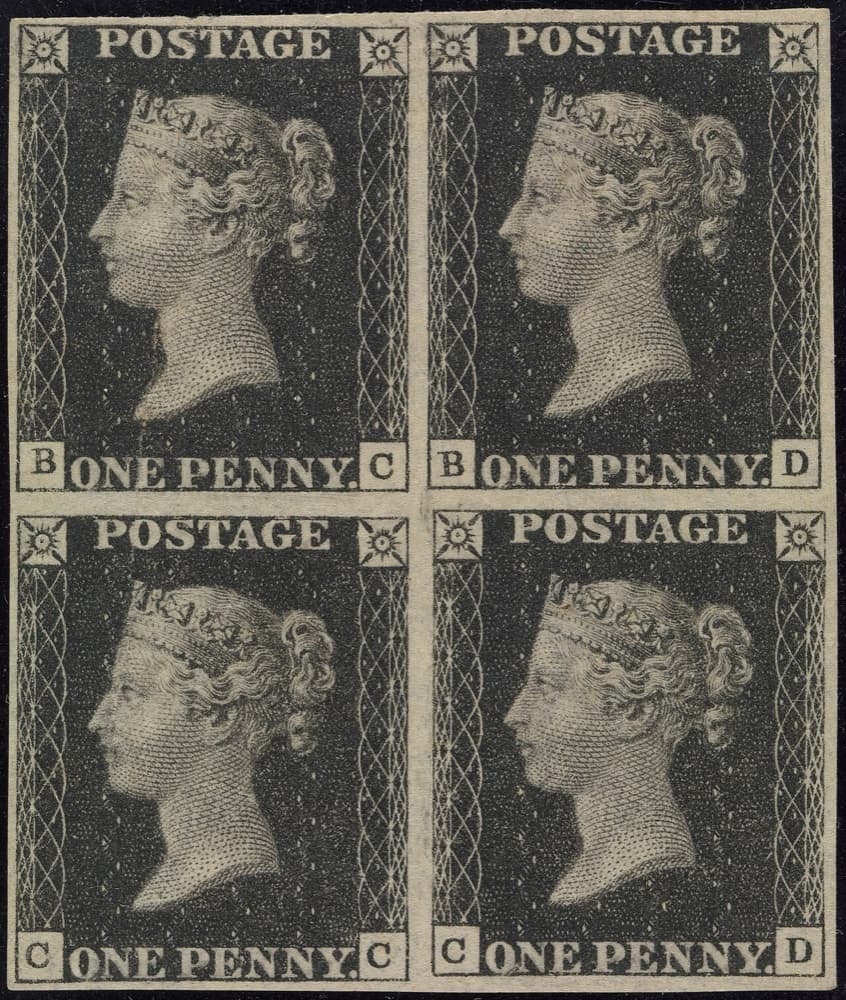
The finished stamp reads POSTAGE across the top and ONE PENNY across the bottom over a background of fine engine turning. The upper corners carry Maltese crosses with radiating discs; the lower corners carry check letters, from A A at top left to T L at bottom right, that fix each stamp's position in the sheet of 240. Each approved die was transferred 240 times onto a steel plate.
The stamp carries no country name. Because Britain issued the first stamps, it never needed one, and British stamps are still the only ones in the world that omit it, using the monarch's portrait instead.
May 1840: the first days of the stamp
The Penny Black went on sale on May 1, 1840, alongside the illustrated Mulready envelopes and letter sheets, but neither was valid until May 6. Some people used them early anyway. A Mulready letter sheet franked with a Penny Black and postmarked May 2, 1840, addressed to William Blenkinsop of the Bedlington Iron Works, was turned inside out and mailed again on May 4. It is described as the earliest known posted envelope using a prepaid stamp, and the only known item carrying both the Penny Black and the Mulready sheet. The Smithsonian's National Postal Museum showed it in Washington in May 2014.
Earlier still is the Wallace Document, a sheet from the scrap album of the reforming member of Parliament Robert Wallace, with a Penny Black and a Mulready proof he noted were presented to him by the Chancellor of the Exchequer on April 10, 1840. It is regarded as the earliest verifiably dated example of the stamp.
The public ridiculed the Mulready design. Six days after its introduction Hill wrote in his journal that "the public have shown their disregard and even distaste for beauty," and stationers sold mocking caricatures. The plain little stamp won. More than 70 first-day covers dated May 6, 1840, are known; the so-called Kirkcudbright cover is the only one with more than two Penny Blacks, carrying ten.
Plates, letters and red crosses
Demand wore the plates out quickly. Eleven plates printed Penny Blacks, with Plate 1 reworked so heavily that collectors count it twice, as 1a and 1b. Plate 11 was made to print the red stamps that would replace the black, but when the red ink was not ready it printed a 700-sheet run in black: only 168,000 stamps, which makes Plate 11 the rarest Penny Black.
Specialists "plate" a Penny Black, assigning it to a plate and position, from small differences: the hand-punched check letters and where they sit in their squares, the shapes of the corner stars, guide-line flaws and double letters. Margins matter most to value. Because the sheets had no perforations, clerks cut the stamps apart with scissors, and stamps with cut-into or missing margins are common and worth little. Four clear, even margins are what collectors pay for.
Post offices were told to cancel the stamps with a red Maltese Cross handstamp, but every postmaster mixed his own ink, so crosses survive in ruby, brown, magenta, orange and blue. Where the official handstamp broke or went missing, postmasters made their own, and these distinctive crosses, such as the one used at Wotton-under-Edge, are prized.
The red cancel was also the stamp's flaw. It was hard to see on a black stamp and could be cleaned off, so stamps were reused. The Post Office ran color and ink trials and on February 10, 1841, replaced the stamp with the Penny Red, cancelled in black. A related rarity is the VR official, printed in April 1840 with the letters V and R in the top corners for government use; the scheme was abandoned, most sheets were destroyed, and only a few postally used examples exist.
Common stamp, rare pieces
With 68,808,000 printed and an estimated 1.3 million surviving, a survival rate of about 2 percent, the Penny Black is not rare. In 2019 used copies in poor to reasonable condition sold in Britain for as little as £15 to £30, and fine used copies for about £250 to £400, while sound unused copies ran from about £1,250 into five or six figures. Blocks are very rare, and the only known complete sheets belong to the Postal Museum in London.
The great prices belong to the pieces that document the stamp's birth. The May 2, 1840, cover sold in London for £140 in 1960, for £65,000 (about $125,000) in 1988, and in Lugano in 1991 for 3.4 million Swiss francs (about $2.4 million). Offered at auction in New York on February 2, 2024, with an estimate of $1.5 million to $2.5 million, it did not find a buyer. The Wallace Document sold for €25,000 (about $33,750) in 2013, then failed to sell in London in December 2021 against an estimate of £4 million to £6 million.
The record for a single Penny Black is £216,000 ($345,131), paid in London in 2011 for a mint stamp from one of the imprimatur sheets, the sheets officials approved before full production. A first-day cover of May 6, 1840, brought £45,600 at auction in England on July 25, 2017, and in 2015 a block of four VR officials sold for £31,860.
The stamp that changed the mail
Cheap, prepaid mail worked. In 1840, the first year of the penny post, the number of letters sent in Britain more than doubled, and by 1850 mail volume had grown more than fourfold. Hill's ideas were adopted around the world, and other countries soon issued their own stamps; the United States followed in 1847.
Hill went on to run the Post Office as its secretary from 1854 to 1864, was knighted in 1860, and was buried in Westminster Abbey after his death in 1879. The Penny Black remains the first stamp nearly every collector wants, and because so many survive, it is one of the very few great rarities of the hobby that an ordinary collector can actually own.
The numbers
- Issue date
- On sale May 1, 1840; valid May 6, 1840
- Quantity printed
- 68,808,000 (286,700 sheets of 240)
- Estimated survivors
- About 1.3 million
- Plates
- 1a, 1b and 2 through 11; Plate 11 printed only 168,000 in black
- Perforation
- Imperforate
- Paper
- Gummed, watermarked small crown
- Size
- About 19 x 22 mm (3/4 by 7/8 inch)
- In use
- Less than a year; replaced February 1841
Timeline
Rowland Hill submits Post Office Reform: its Importance and Practicability to the Chancellor of the Exchequer.
Postal reform becomes law; the Treasury competition for stamp ideas draws about 2,600 entries, none adopted.
The uniform penny rate for a half-ounce letter takes effect across Britain.
VR official stamps are printed for government use; the scheme is abandoned and most sheets destroyed.
Robert Wallace MP receives a Penny Black and a Mulready proof, later mounted as the Wallace Document.
Imprimatur impressions are taken from Plate 1 for official approval.
The Penny Black and Mulready stationery go on sale.
A Penny Black on a Mulready letter sheet is postmarked in London, four days before the stamp is valid.
The Penny Black becomes valid for postage; more than 70 first-day covers survive.
The Penny Red replaces the Penny Black, with black ink for cancellations.
Rowland Hill dies in Hampstead; he is buried in Westminster Abbey.
The May 2, 1840, cover sells in London for £140.
The May 2 cover sells in London for £65,000, about $125,000.
The May 2 cover sells in Lugano for 3.4 million Swiss francs, about $2.4 million.
A mint imprimatur Penny Black sets the record for a single example at £216,000 ($345,131) in London.
The May 2 cover is shown in the United States for the first time, at the Smithsonian's National Postal Museum.
A May 6, 1840, first-day cover brings £45,600 at auction in England.
The Wallace Document, estimated at £4 million to £6 million, fails to sell in London.
The May 2 cover, estimated at $1.5 million to $2.5 million, fails to sell at auction in New York.
The world in 1840
The steamship Lexington burns and sinks off Long Island; 139 people die.
The Treaty of Waitangi is signed in New Zealand.
Queen Victoria marries her cousin, Prince Albert of Saxe-Coburg and Gotha.
The first commercial photographic portrait studio opens on Broadway in Manhattan.
The Great Natchez Tornado kills 317 people in Mississippi.
RMS Britannia leaves Liverpool, starting a transatlantic steam mail and passenger service.
William Henry Harrison defeats Martin Van Buren in the U.S. presidential election.
Napoleon's remains, brought back from Saint Helena, are laid to rest at Les Invalides in Paris.
Price record
| Date | Price | Kind |
|---|---|---|
| Nov 3, 1988 | $125,000 | Sold at auctionMay 2, 1840, Penny Black on Mulready letter sheet, sold at auction in London for £65,000 (approximately $125,000 as reported). |
| Mar 23, 1991 | $2,400,000 | Sold at auctionSame May 2, 1840, cover, sold at auction in Lugano for 3.4 million Swiss francs (approximately $2.4 million as reported). |
| 2011 | $345,131 | Sold at auctionMint Penny Black from an imprimatur sheet, sold at auction in London for £216,000; record for a single Penny Black. |
| Sep 24, 2013 | $33,750 | Sold at auctionThe Wallace Document (Penny Black dated April 10, 1840), sold at auction for €25,000 (roughly $33,750 at the time). |
| Dec 7, 2021 | $5,300,000 | Estimate, not a saleWallace Document presale estimate of £4 million to £6 million (about $5.3 million to $7.9 million); low end shown. It did not sell. |
| Feb 2, 2024 | $1,500,000 | Estimate, not a saleMay 2, 1840, cover, offered at auction in New York; presale estimate of $1.5 million to $2.5 million, low end shown. It did not sell. |
| Apr 23, 2025 | $1,500 | Sold at auctionUsed gray-black single from the rare Plate 11, lettered QH, with light black Maltese Cross, sold at auction. |
A realized auction price is what a buyer actually paid on the date shown, including the buyer's premium where the sale reported it. It is the strongest kind of reference price, and it is a record of one sale of one object on one day, not a promise of what the next example will bring.
By reference price, Penny Black is number 78 of 100 in the stamps entries of the FLOAT 100. 82 of those 100 rest on a realized sale; the rest carry an asking price or a guide value, and each page says which. Rank within the FLOAT 100 itself (6 here) is editorial: how much an object defines its field, not price alone.
Did you know
- The Penny Black was on sale from May 1, 1840, but not valid until May 6. People who used it early were technically breaking the rules, and those covers are now among the most valuable.
- Great Britain still prints no country name on its stamps, because the first stamps had no need for one.
- Queen Victoria's portrait on the stamp was based on a medal made when she was 15, and it stayed on British stamps for her whole reign.
- Only one known first-day cover carries more than two Penny Blacks: the Kirkcudbright cover, with ten.
- Plate 11 was built to print red stamps. Because the red ink was not ready, it printed 700 sheets in black, making it the rarest Penny Black.
- The stamp was replaced so quickly partly because its red cancel could be washed off, letting thrifty Victorians reuse it.
- The only known complete sheets of Penny Blacks belong to the Postal Museum in London.
How this page is made
- The figure
- One reference price, shown with its own kind. FLOAT does not average it with anything or adjust it for time.
- Realized or not
- A realized price is a completed sale. An asking price, an estimate and a price-guide value are not sales, and are labeled as such wherever they appear.
- The story
- Researched from published records and checked fact by fact. Updated Oct 1, 2026.
- Archive
- Oct 5, 2026