FLOAT 100 · Stamps · No. 12
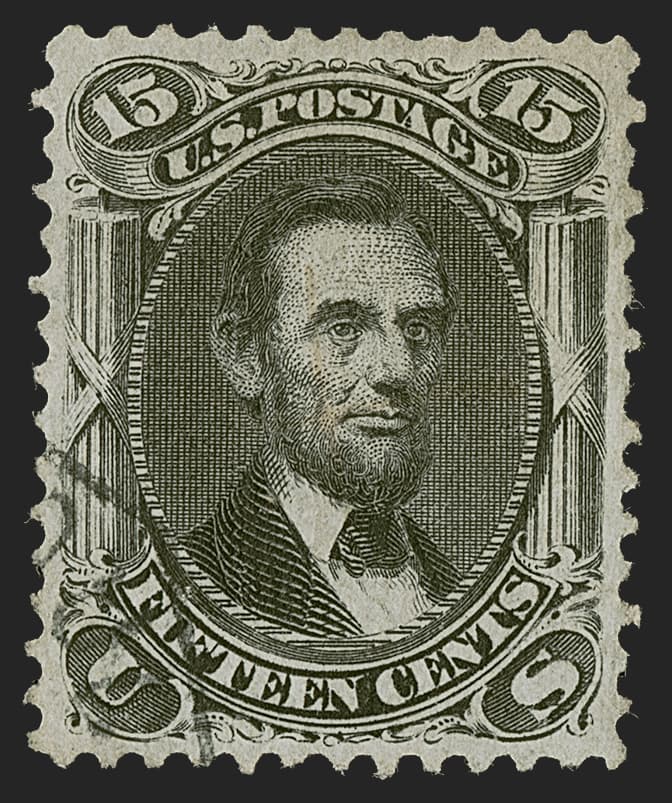
US 15c Lincoln 'Z' Grill
America's first mourning stamp became one of its two rarest when a few sheets went through an unusual grilling machine for a few days in 1868; nobody found a single copy for more than forty years, and the first one turned up in a famous collection labeled as something common.
- Year
- 1868
- Maker
- United States (USPOD), National Bank Note Co.
- By price in stamps
- 11 of 100
Create a free account to see every recorded price and every grade.
Create a free account- Catalog number
- Scott 85F, 15-cent black Abraham Lincoln with Z grill, perforated 12
- Design first issued
- April 1866, a year after Lincoln's assassination; earliest known use April 14, 1866
- Grilled
- 1868, during the short life of the Z grill; one detailed reconstruction places the 15-cent run between February 19 and 28, 1868
- Printer
- National Bank Note Company, New York
- Produced
- Not recorded; the National Postal Museum estimates probably about 1,000, similar to the 1-cent Z grill
- Known today
- Two, both in private hands, so two collectors can own one at the same time
- How to tell
- The top of each grill point forms a horizontal ridge; every other U.S. grill has an X-shaped point or a vertical ridge
- The two copies
- The finer Newbury-Peyton-Zoellner-Gross example and the Costales-Schilling example with a geometric cancel
- Highest public sale
- $2,773,000 at auction in New York, June 14, 2024, for the finer copy
A mourning stamp and a waffle pattern
In April 1866 the Post Office Department issued a 15-cent stamp printed in black and bearing the face of Abraham Lincoln, killed by an assassin in April 1865. The Smithsonian's National Postal Museum notes that the stamp is usually classed as a regular issue meant to pay the first-class rate to France or Prussia, but its timing and its black ink led many to see it as a commemorative mourning stamp. Until then, the people shown on American stamps had been dead for several years, if not decades. The earliest known use of the stamp is April 14, 1866, the first anniversary of the shooting. The portrait was engraved from a photograph of Lincoln taken by C.S. German in 1861, shortly before his first inauguration.
At the same moment the government was fighting a quieter battle. After the Civil War it feared it was losing revenue to people who washed cancellations off used stamps and mailed them again. It tried cancelers that scraped or cut the stamp surface, inks and papers that dissolved when cleaned, and, the postal museum records, even one misguided trial involving gunpowder.
The method that stuck was credited to Charles F. Steel, a supervisor at the National Bank Note Company, which printed the nation's stamps. Steel's process embossed a waffle-like pattern of tiny pyramids into the paper, breaking its fibers so the canceling ink soaked in. The first grilled stamps appeared in 1867, and in 1868 the government amended the printing contract to require grills on stamps before delivery. The grilled paper was fragile and hard to separate at the perforations, and the company kept experimenting with grill sizes and shapes. Those experiments made the rarities.
A few days on the wrong machine
No grill-production logs survive, so the story of the Z grill has been pieced together from the earliest dated uses of each stamp and from the government stamp agent's delivery counts. A detailed reconstruction published with the Zoellner collection in 1998 concludes that the Z was the first grill put into regular production, starting about January 7, 1868, on one of two grilling machines, and that the 2-cent, 3-cent and 12-cent values were grilled with it first. The authors say plainly that every date other than an earliest known use is conjecture.
In that reconstruction, some sheets of 1-cent, 10-cent and 15-cent stamps went through the Z-grill machine sometime between February 19 and 28, 1868, probably while the second machine was grilling the same values with the E grill. On March 17 the F grill replaced the Z. Delivery records and early dated uses suggest that regular grilling of 15-cent stamps did not begin until April, with E and F grills, so the handful of 15-cent sheets that received the Z were an early, short exception. Grilled 15-cent stamps from February or March may have been stockpiled or mixed in with ungrilled sheets.
The National Postal Museum estimates that about 1,000 one-cent Z grills were produced and probably a similar number of 15-cent stamps, against roughly 500,000 two-cent and 100,000 three-cent stamps with the same grill. Not every account agrees on the timing: one collector reference dates the 15-cent Z grilling to mid-April 1868. What every source agrees on is the result. Only two 15-cent Z grills have ever been found and certified genuine.
The letter Z and the ridge that gives it away
In 1916 the philatelist William L. Stevenson published a classification of the grills, using the letters A to J mostly by size. One type would not fit. It was the same size as the E grill, but the top of each tiny pyramid formed a horizontal ridge, which some collectors call a rooftop. Every other grill used on U.S. stamps has an X-shaped point or a vertical ridge. Unable to place it in his sequence, Stevenson called it Z.
That ridge is the only difference between Scott 85F and far more common 15-cent Lincolns. The design, the black ink and the perforation 12 are the same. Because a Z grill and an E grill are the same size, dealers who knew what to look for have found Z grills sold as E grills. The National Postal Museum gives the Z grill as 13 to 14 points wide by 18 points high; catalogs have revised the point count over the years after a published dispute among experts.
The catalog number itself is an accident of history. The standard U.S. stamp catalog had numbered U.S. stamps long before the Z grill was recognized, so instead of renumbering every later stamp it slotted the Z grills in after No. 85, the 3-cent D grill, as 85A through 85F. The 15-cent Lincoln is the last of them, which is why one of the rarest American stamps shares its number with five others.
Two stamps, two lines of owners
For more than forty years after Stevenson's 1916 study, no 15-cent Z grill was known. Then, in 1961, after Michael Newbury consigned his father Saul Newbury's collection for sale in New York, a staff member noticed that a 15-cent stamp the family had owned as an ordinary E grill had the horizontal ridges of the Z. The expert Elliott Perry judged it genuine, and The Philatelic Foundation issued certificate 14038 on June 5, 1961.
The Newbury stamp was sold at auction in 1963 to Eugene N. Costales, acting for Bernard Peyton, a reclusive collector from Princeton, New Jersey, and a descendant of the du Pont family. When Peyton's U.S. collection was sold under the name "Isleham" in 1986, Robert Zoellner bought the 15-cent Z grill for $110,000 including the buyer's premium, more than the $90,000 the 1-cent Z grill had brought in 1977. Zoellner went on to complete every stamp in the U.S. catalog, and at his 1998 sale the bond investor Bill Gross bought the 15-cent for $209,000.
The publicity around the 1961 find sent Costales looking, and he found the second example. It received a genuine opinion from The Philatelic Foundation in 1962 and was sold to Wilbur Schilling Jr. It came to market in a 1975 New York rarities sale and went to a New York City collector, who kept it for 44 years as part of a lifelong effort to fill every space in a U.S. national album. On July 10, 2019, it sold at auction in New York for $1,610,000 including a 15 percent premium, a new auction record for a single U.S. stamp at the time. The sale description calls it centered to the right, completely sound, with a geometric cancel. The same floor bidder also bought the 10-cent Z grill and the 3-cent B grill that day, and all three left by armored car.
Gross sold his collection at auction in New York in June 2024. On the evening of June 14, his 15-cent Z grill, described as the finer of the two, sold for $2,773,000 including an 18 percent premium, against a catalog value of $2 million. The same night his 1-cent Z grill set the record for any U.S. stamp at $4,366,000. The buyer of the 15-cent has been reported as the collector Trevor Fried.
Why it matters
The 1-cent Z grill gets the headlines, but the 15-cent is exactly as rare: two known of each. The difference is ownership. One of the two 1-cent stamps belongs to the New York Public Library, so only one can ever be bought. Both 15-cent stamps are in private hands, and the auction firm that sold the Gross collection pointed out that two collectors can own one at the same time.
For anyone trying to complete a collection of classic U.S. stamps, the 15-cent Z grill is one of the gates that cannot be walked around. The 2019 sale description called it a key to forming a complete U.S. collection. One collector who considered bidding on the finer copy in 1998 later wrote that he decided not to at the last moment, and that Gross got a relative bargain as a result.
The numbers
- Design issued
- April 1866 (earliest known use April 14, 1866)
- Z grill applied
- 1868; February 19-28 in one reconstruction, mid-April in another
- Color and printing
- Black, line-engraved, National Bank Note Company
- Perforation
- 12
- Grill
- Z grill, horizontal ridges, about 13-14 by 18 points
- Produced
- Unrecorded; probably about 1,000 (National Postal Museum estimate)
- Known
- 2 certified genuine
Timeline
The Post Office Department issues the 15-cent black Lincoln stamp, a year after the assassination.
Earliest known use of the 15-cent Lincoln, on the first anniversary of the shooting.
The first grilled U.S. stamps are issued, using Charles F. Steel's embossing process.
Approximate start of Z-grill production on the first grilling machine, per a 1998 reconstruction based on the earliest known use of a 2-cent Z grill.
Some sheets of 1-cent, 10-cent and 15-cent stamps receive the Z grill, sometime between February 19 and 28 in the 1998 reconstruction (conjectural).
The F grill replaces the Z grill on the first machine, ending Z-grill production (conjectural date).
Regular grilling of 15-cent stamps begins with E and F grills.
William L. Stevenson publishes his classification of grills and names the odd horizontal-ridge type Z.
The Philatelic Foundation certifies a 15-cent Z grill found in the Saul Newbury collection, where it had been identified as an E grill.
A second 15-cent Z grill, found by Eugene Costales, receives a genuine opinion and is sold to Wilbur Schilling Jr.
The Newbury copy sells at auction to Costales, acting for collector Bernard Peyton.
The Schilling copy is offered in a New York rarities sale and goes to a New York City collector.
Robert Zoellner buys the Newbury-Peyton copy at the "Isleham" sale for $110,000 including premium.
Bill Gross buys the finer copy at the Zoellner sale for $209,000 including premium.
The Schilling copy sells at auction in New York for $1,610,000, an auction record for a single U.S. stamp at the time.
The Gross copy sells at auction in New York for $2,773,000, the same evening the 1-cent Z grill brings $4,366,000.
The world in 1868
Emperor Meiji, aged 15, declares the restoration of imperial rule in Japan.
In New York City the Jolly Corks are renamed the Benevolent and Protective Order of Elks.
The U.S. House of Representatives impeaches President Andrew Johnson; the same day New Orleans holds the first Mardi Gras parade with floats.
The University of California is founded when the Organic Act is signed into law.
Memorial Day is observed in the United States for the first time.
The Fourteenth Amendment to the U.S. Constitution is adopted.
Ulysses S. Grant is elected president of the United States.
Price record
| Date | Price | Kind |
|---|---|---|
| 1986 | $110,000 | Sold at auctionNewbury-Peyton copy, bought by Robert Zoellner at the "Isleham" sale, including 10% premium. Another account gives $100,000, likely the price before premium. |
| 1998 | $209,000 | Sold at auctionSame copy, bought by Bill Gross at the Zoellner sale in New York, including 10% premium. |
| Jul 10, 2019 | $750,000 | Estimate, not a salePresale estimate for the Costales-Schilling copy, sale of the New Amsterdam collection, New York. |
| Jul 10, 2019 | $1,610,000 | Sold at auctionCostales-Schilling copy, sold at auction in New York; $1,400,000 hammer plus 15% premium. Last on the market in 1975. |
| Jun 14, 2024 | $2,773,000 | Sold at auctionThe finer Gross copy, sold at auction in New York including 18% premium ($2,350,000 before premium). Its presale estimate was given as a range of $1.5 million to $2 million. |
A realized auction price is what a buyer actually paid on the date shown, including the buyer's premium where the sale reported it. It is the strongest kind of reference price, and it is a record of one sale of one object on one day, not a promise of what the next example will bring.
By reference price, US 15c Lincoln 'Z' Grill is number 11 of 100 in the stamps entries of the FLOAT 100. 82 of those 100 rest on a realized sale; the rest carry an asking price or a guide value, and each page says which. Rank within the FLOAT 100 itself (12 here) is editorial: how much an object defines its field, not price alone.
Did you know
- The first 15-cent Z grill ever found spent years in a well-known collection labeled as a much more common E grill.
- The only physical difference between this stamp and ordinary 15-cent Lincolns is the direction of microscopic ridges on the tops of the grill points.
- The 15-cent Lincoln of 1866 is often called the first U.S. mourning stamp; earlier stamp subjects had been dead for years or decades.
- Its earliest known use, April 14, 1866, fell exactly one year after Lincoln was shot.
- In 2019 one buyer took the 15-cent Z grill, the 10-cent Z grill and the 3-cent B grill home by armored car.
- Unlike the 1-cent Z grill, both known 15-cent Z grills are privately owned.
How this page is made
- The figure
- One reference price, shown with its own kind. FLOAT does not average it with anything or adjust it for time.
- Realized or not
- A realized price is a completed sale. An asking price, an estimate and a price-guide value are not sales, and are labeled as such wherever they appear.
- The story
- Researched from published records and checked fact by fact. Updated Oct 1, 2026.
- Archive
- Oct 5, 2026