FLOAT 100 · Stamps · No. 3
Mauritius 'Post Office' 1d Penny
Five hundred were engraved by a 31-year-old former stowaway on an island in the Indian Ocean; one that rode on an envelope to a governor's wife's fancy dress ball sold in 2021 for the highest price ever paid for a philatelic item.
- Year
- 1847
- Maker
- Mauritius (British colony)
- By price in stamps
- 5 of 100
Create a free account to see every recorded price and every grade.
Create a free account- Issued
- September 21, 1847, Port Louis, Mauritius, then a British colony
- Engraved and printed by
- Joseph Osmond Barnard, born in England in 1816, who arrived in Mauritius in 1838
- Design
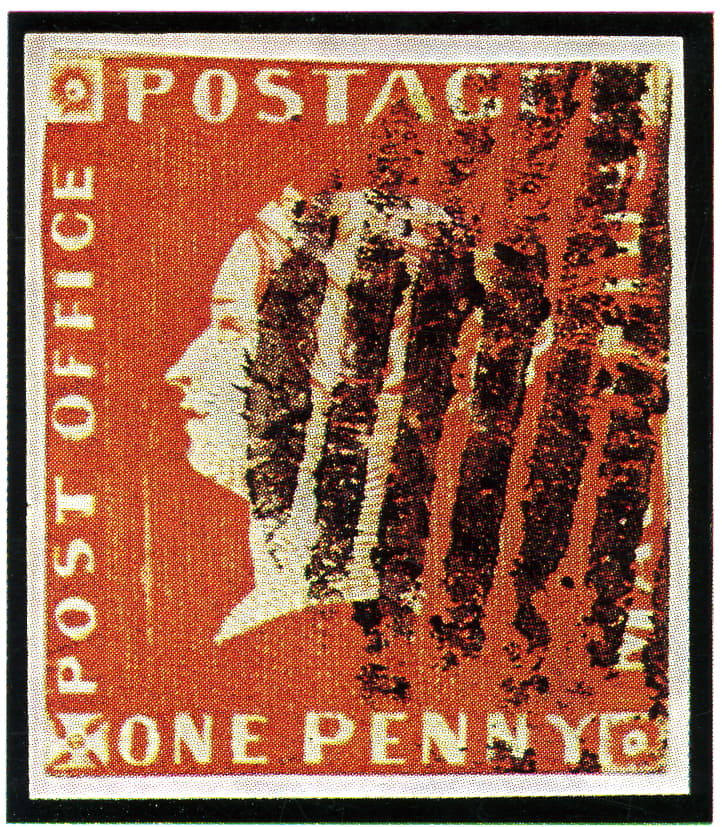
- Profile of Queen Victoria after the British stamps of 1841; "POST OFFICE" in the left panel; engraver's initials "JB" at the lower right of the bust
- Color and value
- Orange-red, one penny (1d); the companion two pence was deep blue
- Printed
- 500 of each value, from a single plate bearing one engraving of each
- Surviving
- 27 Post Office stamps of both values are generally counted; a census compiled for the book Blue Mauritius lists 15 one-penny examples
- Famous covers
- The Ball cover, the Bombay cover (two 1d stamps) and the Bordeaux cover (1d plus 2d)
- Record
- The Ball cover sold at auction in Germany on June 26, 2021, for 10,027,800 euros with premium, about $11.96 million, the highest price paid for any philatelic item
A colony's first stamp
In 1846 Mauritius passed Ordinance No. 13, which set standardized postage rates for inland mail: one penny for delivery within town and two pence for other parts of the island. The colony became, in the words of Mauritius Post, the fifth country in the world and the first British colony to require prepayment of postage with stamps. Great Britain had issued the first stamps only six years earlier, in 1840.
On September 21, 1847, Mauritius issued its first two stamps: a one penny in orange-red and a two pence in deep blue. Five hundred of each were printed from a single small plate that carried one engraving of each value, so every stamp was printed one at a time. The designs followed the British stamps then in use, with the profile head of Queen Victoria. They were printed by the intaglio method, from lines cut into the plate.
The stamps are named for two words in the left panel: "POST OFFICE." The next issue, in 1848, read "POST PAID" instead. They were the first stamps authorized by any British colonial government and the first stamps of the British Empire produced outside Great Britain.
The engraver and the myth
The stamps were engraved by Joseph Osmond Barnard, an Englishman of Jewish descent from Portsmouth, born in 1816. He reached Mauritius in 1838 as a stowaway, put off a ship bound for Sydney. He was 31 when he cut the plate, and his initials "JB" sit at the lower right of the queen's bust. Mauritius Post describes him as a jeweler. The plate itself was a small copper plate described as the size of a lady's visiting card.
A durable legend holds that "POST OFFICE" was a mistake. Its source is a 1928 book by Georges Brunel, and it grew with retelling into the tale of a half-blind old watchmaker who forgot the wording, walked past a post office sign on his way to see the postmaster, and engraved what he had seen. Philatelic scholars reject the story. Barnard was young; rubber handstamps used on Mauritian letters before 1847 already read "Post Office"; and so did the first two United States stamps, issued in July 1847. Mauritius Post says the wording replicated a date stamp in use since the 1820s.
The plate had its own afterlife. It surfaced in London in 1912, was the subject of an inconclusive government commission in 1914 and 1915, was last shown publicly in 1935 and then dropped out of sight for decades. In 2016 it was sold at auction for 1,230,000 euros to an anonymous collector.
Lady Gomm's ball
On September 30, 1847, nine days after the stamps went on sale, Lady Elizabeth Gomm, wife of the Governor of Mauritius, gave a fancy dress ball at Government House in Port Louis. Of the hundreds of envelopes sent to guests, three are known to survive, each franked with a single one-penny Post Office stamp. They are among the earliest items to carry postage stamps through the Mauritian mail.
Legend has the stamps printed for the ball. They were in fact issued to pay the inland postage rates that Ordinance No. 13 had set the year before, and simply arrived in time for the party. No invitation was found inside any of the three envelopes, and Helen Morgan, author of Blue Mauritius, suggests they more likely held admission cards.
Two of the ball covers are in institutions: one in the British Library in London, one in the British Royal Collection. The third belonged to Henry Adam, a young man in 1847 who dug it out of his papers some fifty years later. He sold it in 1899 to a French stamp dealer for £680 and reportedly asked that his surname be blotted out on the front.
From a Bordeaux desk to the record books
Collectors in Europe did not know the stamps existed until 1864, when Mme. Borchard, the wife of a Bordeaux merchant, found one-penny and two-pence copies in her husband's business letters. By 1897 only 17 were known, all found in France or Mauritius, and in that year two sold for £1,860. Philipp von Ferrary, the richest collector of the age, owned six of them from 1893. Later owners of Post Office stamps and covers included Arthur Hind, Alfred Lichtenstein, Alfred Caspary and Hiroyuki Kanai.
The Bordeaux cover carries one stamp of each value. It was mailed on October 4, 1847, to the wine merchants Ducau et Lurguie, arrived on December 28, and was found among their papers by a student in 1902. Hiroyuki Kanai later bought it for 120 million yen. When the Kanai Mauritius collection was sold at auction in Zurich in 1993, the cover brought a price reported as 5,750,000 Swiss francs and as 6,123,750 Swiss francs, $3,829,500 in one account and about $4 million in others. The same sale included Kanai's unused one penny, which brought $1,072,260 with premium and was bought by a consortium of Mauritian companies.
The Bombay cover carries two one-penny stamps. It was sent by the Rev. Langrish Banks, who worked in Mauritius for the Bible Society, to the society's secretary in Bombay, and was cancelled January 4, 1850, more than two years after the stamps were issued. A railway employee, Charles Howard, reportedly bought it in a Bombay bazaar for five rupees and sold it a year later for £1,600. It passed through several collections, including Lichtenstein's from 1917, and in 2016 it sold at auction in Geneva for 2.4 million euros to an anonymous collector.
Henry Adam's ball cover set the all-time mark. Offered on June 26, 2021, at auction in Germany as the only ball cover in private hands, it opened at 4 million euros and was hammered at 8.1 million euros, or 10,027,800 euros with the 23.8 percent premium, about $11.96 million on the day of the sale. It is the most expensive philatelic item ever sold at auction. The buyer was described only as a German-speaking collector based in Europe.
How to know one, and where to see one
A genuine one penny is orange-red, imperforate, and shows Queen Victoria's profile with "POST OFFICE" at the left. The Independent's review of Blue Mauritius notes that the small dots of shading in the portrait make the queen look as if she had smallpox. Because the stamps have been reprinted from the original plate and forged many times, any example is judged against the known census rather than on looks.
Counts of survivors vary by source. Hiroyuki Kanai's 1981 book Classic Mauritius and other writers give 27 Post Office stamps of both values; the census of examples compiled for Helen Morgan's research companion lists 15 one-penny and 12 two-pence stamps, which sums to the same 27, while Mauritius Post's museum page says only 12 remain. Unused one-penny stamps are the scarcest form: one source says one is known unused, while the Morgan census lists two.
Examples can be seen in the British Library and the Royal Collection, at the Postal Museum and the Blue Penny Museum in Port Louis, at the Museum for Communication in Berlin and the Postal Museum in Stockholm. The Blue Penny Museum, opened in November 2001, shows the unused one penny and two pence from the Kanai collection, bought at the 1993 auction by a consortium of Mauritian companies, reported as $2 million for the two, and returned to the island after almost 150 years. To protect them, the originals are lit only for short periods; most of the time visitors see copies.
The numbers
- Issue date
- September 21, 1847
- Face value
- One penny, for town delivery under the 1846 rates
- Quantity printed
- 500
- Known
- 27 Post Office stamps of both values; 15 one-penny in the Blue Mauritius census (sources disagree on unused copies: one or two)
- Printing
- Intaglio, from a single copper plate with one engraving of each value
- Perforation
- None (imperforate)
- Engraver's mark
- "JB" at lower right of the bust
Timeline
Joseph Osmond Barnard arrives in Mauritius as a stowaway.
Ordinance No. 13 sets inland postage at 1d for town delivery and 2d elsewhere.
The one penny orange-red and two pence deep blue Post Office stamps are issued; 500 of each are printed.
Lady Gomm's fancy dress ball at Government House; three envelopes franked with 1d stamps survive.
The Bordeaux cover, with a 1d and a 2d, is mailed to wine merchants in Bordeaux; it arrives December 28.
The next issue replaces "POST OFFICE" with "POST PAID."
The Bombay cover, with two 1d stamps, is cancelled on a letter to the Bible Society in Bombay.
Mme. Borchard finds Post Office stamps in her husband's Bordeaux correspondence, the first known to collectors.
Philipp von Ferrary owns six Post Office stamps.
With only 17 known, two Post Office stamps sell for £1,860.
Henry Adam sells his ball cover to a French stamp dealer for £680.
A student finds the Bordeaux cover in the merchants' papers.
The original copper plate surfaces in London.
Georges Brunel's book launches the myth that "POST OFFICE" was an engraver's error.
The Kanai Mauritius collection is sold at auction in Zurich; the unused 1d brings $1,072,260 and the Bordeaux cover about $4 million.
The Blue Penny Museum opens in Port Louis with the unused 1d and 2d bought at the 1993 auction.
The Bombay cover sells at auction in Geneva for 2.4 million euros; the original printing plate is also sold at auction.
The Ball cover sells at auction in Germany for 8.1 million euros hammer, a record for any philatelic item.
The world in 1847
Yerba Buena, California, is renamed San Francisco.
The United States issues its first postage stamps, also inscribed "Post Office."
Brigham Young leads Mormon pioneers into the Salt Lake Valley.
Liberia becomes independent.
U.S. troops under Gen. Winfield Scott enter Mexico City.
Charlotte Bronte publishes Jane Eyre under the pen name Currer Bell.
James Young Simpson first uses chloroform as an anesthetic on a patient in Edinburgh.
The Great Famine continues in Ireland.
Price record
| Date | Price | Kind |
|---|---|---|
| 1993 | $1,072,260 | Sold at auctionUnused 1d from the Kanai collection, sold at auction in Zurich to a consortium of Mauritian companies; including 15% premium. Also given as 1,610,000 Swiss francs ($1,073,340). |
| Nov 3, 1993 | $3,829,500 | Sold at auctionThe Bordeaux cover (one 1d and one 2d), sold at auction in Zurich. Also reported as 5,750,000 or 6,123,750 Swiss francs and as about $4 million. |
| Jun 26, 2021 | $11,960,000 | Sold at auctionThe Ball cover with one 1d stamp, sold at auction in Germany; hammer 8.1 million euros, 10,027,800 euros with 23.8% premium, about $11.96 million on the day. Record for any philatelic item. |
A realized auction price is what a buyer actually paid on the date shown, including the buyer's premium where the sale reported it. It is the strongest kind of reference price, and it is a record of one sale of one object on one day, not a promise of what the next example will bring.
By reference price, Mauritius 'Post Office' 1d Penny is number 5 of 100 in the stamps entries of the FLOAT 100. 82 of those 100 rest on a realized sale; the rest carry an asking price or a guide value, and each page says which. Rank within the FLOAT 100 itself (3 here) is editorial: how much an object defines its field, not price alone.
Did you know
- The words "POST OFFICE" were not a mistake, whatever the legend says; the first U.S. stamps of July 1847 carried the same words.
- The engraver was not an old, half-blind watchmaker. He was 31 and had arrived on the island as a stowaway.
- A railway employee reportedly bought the Bombay cover in a bazaar for five rupees; it sold in 2016 for 2.4 million euros.
- Henry Adam kept his ball envelope for about fifty years, then asked that his own name be blotted out when he sold it.
- Only 17 Post Office stamps were known in 1897; the count has since reached 27.
- The original printing plate was last shown publicly in 1935 and did not reappear on the market until 2016.
- In Port Louis the original stamps are lit only briefly; most of the time visitors look at copies.
How this page is made
- The figure
- One reference price, shown with its own kind. FLOAT does not average it with anything or adjust it for time.
- Realized or not
- A realized price is a completed sale. An asking price, an estimate and a price-guide value are not sales, and are labeled as such wherever they appear.
- The story
- Researched from published records and checked fact by fact. Updated Oct 1, 2026.
- Archive
- Oct 5, 2026