FLOAT 100 · Stamps · No. 7
Two Penny Blue
The Penny Black's twin was printed from the same portrait for heavier letters, came off the press for only about four months in 1840, and survives in about one-tenth the numbers, which is why the 1840 printing without white lines is the harder of the world's first two stamps to find.
- Year
- 1840
- Maker
- Great Britain (Royal Mail)
- By price in stamps
- 61 of 100
Create a free account to see every recorded price and every grade.
Create a free account- Issued
- Printing began May 1, 1840; valid for postage May 6, 1840, Great Britain
- Face value
- Two pence, for letters over half an ounce and up to one ounce
- Design
- Same die and Queen Victoria profile as the Penny Black; only the color and the words TWO PENCE differ
- Printed
- 6,460,000 stamps, from Plates 1 and 2 only, until August 29, 1840
- This entry
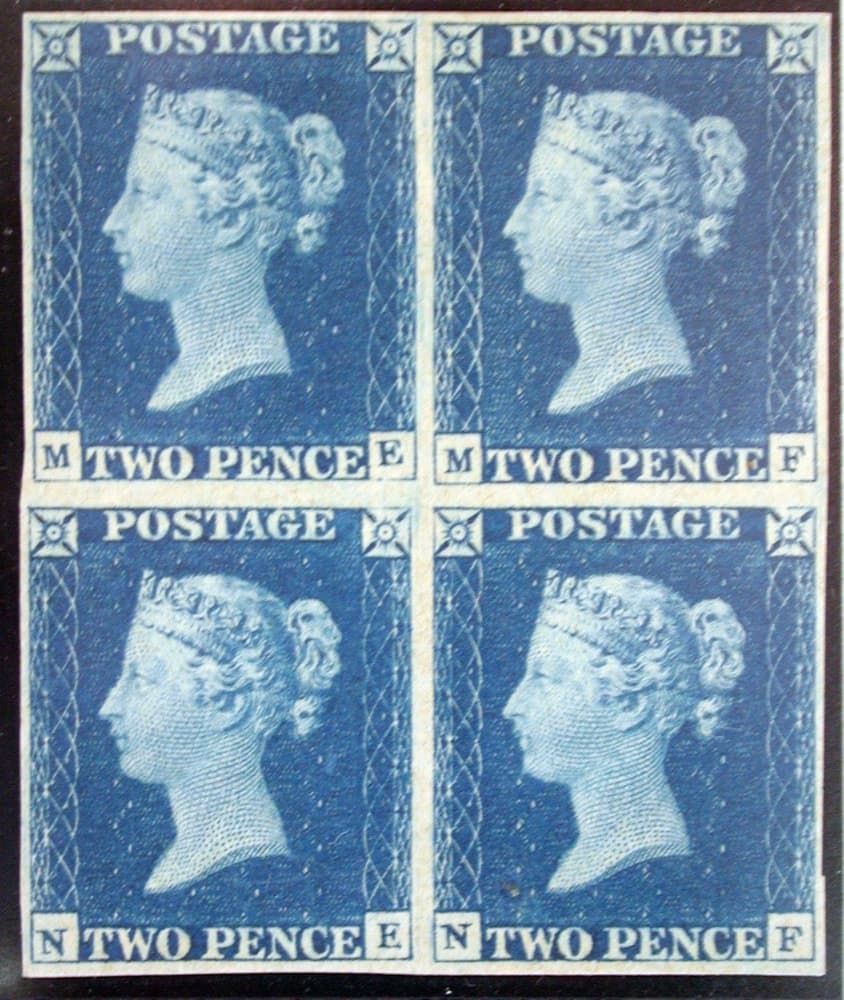
- The first, 1840 state with no white lines, unused, very fine, with large part original gum
- How to tell
- No thin white line under POSTAGE or above TWO PENCE; the 1841 printing adds those lines
- Format
- Imperforate, sheets of 240, cut apart with scissors
- Plates destroyed
- 1843
- Largest known block
- A mint Plate 1 block of 38, bought by King George V in the 1920s
A second stamp for heavier letters
When Rowland Hill's postal reform set a flat rate of one penny for a half-ounce letter on January 10, 1840, it created an immediate need for a second value. A letter just over half an ounce cost two pence, so alongside the Penny Black Hill ordered a two pence stamp good for letters up to a full ounce.
Hill changed as little as possible. According to the Smithsonian's National Postal Museum, he altered only the stamp's color and lettering, creating the Twopenny Blue. It was struck from the same die as the Penny Black, so except for its denomination the design is the same: Queen Victoria's profile, based on a medal by William Wyon made when she was 15, with POSTAGE across the top and TWO PENCE across the bottom.
Like the Penny Black, it was printed in sheets of 240 without perforations, and like the Penny Black it carried no country name. Being first, Britain did not need one, and its stamps still omit it.
Four months on the press
Printing began on May 1, 1840, and the stamp was valid for postage from May 6, the same day as the Penny Black. Accounts of its first sale differ. One account says it went on sale at the Inland Revenue office in London on May 6; another says it was only actually available from May 8, even though May 6 is the earliest postmark seen on one. Standard histories of the Penny Black also give May 8 as the date the two pence stamp was issued.
The original printing was short. In total 6,460,000 stamps were printed from just two plates until August 29, 1840. Plate 1 was in use from May to July 1840 and Plate 2 from July 1840 to February 1841. Both plates were destroyed in 1843.
Far fewer two pence letters were mailed than penny letters. One collector's guide notes that the stamp was rarely used, because heavier items were unusual mail for most people at the time. Against a Penny Black run of about 68.8 million, that makes the 1840 Twopenny Blue roughly ten times scarcer, and copies are now significantly rarer and more expensive than the Penny Black.
White lines: telling 1840 from 1841
The Penny Black's weakness was its red cancel, which could be cleaned off so the stamp could be reused. After trials of new inks, the Post Office replaced it with the Penny Red on February 10, 1841, and a better blue ink was found for the two pence stamp. Printing of a revised Twopenny Blue began on February 27, 1841, and it went on sale in March.
To make the new printing easy to tell from the old, a thin horizontal white line was added at the top and bottom of the inscriptions. That is the quickest test for this entry. Look under the word POSTAGE and above TWO PENCE: if there is no white line, the stamp is from the 1840 printing, Plates 1 or 2. The "white lines added" stamps from Plates 3 and 4 are far more common, and later perforated printings came from Plates 4, 5 and 6.
As with the Penny Black, margins drive value. The stamps were cut from the sheet by hand, so many copies have margins that touch or cut into the design. An unused 1840 example with four clear margins and much of its original gum, the grade this entry describes, is the scarce form of a stamp that was already scarce. Cancellations matter too: a Maltese Cross cancel is generally worth more than a later numeral cancel.
Blocks, a king, and what they bring
The most famous Twopenny Blue item is a mint corner block of 38 stamps from Plate 1, the largest known surviving block of that plate. King George V bought it in the 1920s, and the Smithsonian's National Postal Museum has featured it in its exhibition The Queen's Own.
Multiples of the 1840 stamp are rare in any condition, and condition still governs price. At one sale on April 23, 2025, a used Plate 2 block of four with a major re-entry at position QL, one of only two on that plate, sold for $5,250, while a used Plate 1 block of four with a heavy corner crease and a small tear sold for $1,800 against an estimate of $2,500 to $3,500.
At the other end of the market, the far more common 1841 white-lines stamps have sold online for as little as £10 to £15 in 2021, and in 2015 an unused pair of the 1840 stamp from Plate 1 sold for £7,080.
The numbers
- Issue date
- Printed from May 1, 1840; valid May 6, 1840
- Quantity printed
- 6,460,000 (1840 printing, Plates 1 and 2)
- Printing ended
- August 29, 1840
- Plates
- Plate 1 (May-July 1840), Plate 2 (July 1840-February 1841)
- Perforation
- Imperforate
- Sheet
- 240 stamps
- Rate
- Letters over half an ounce, up to one ounce
- Successor
- White lines added printing, from February 27, 1841
Timeline
The uniform penny rate takes effect; letters over half an ounce cost two pence.
Printing of the Twopenny Blue begins.
The stamp becomes valid for postage; May 6 is the earliest postmark seen on one.
The date several accounts give for the stamp actually becoming available to the public.
Plate 2 replaces Plate 1.
The 1840 printing ends after 6,460,000 stamps.
The Penny Red replaces the Penny Black; a better blue ink is found for the two pence value.
Printing of the revised two pence stamp, with white lines added, begins; it goes on sale in March.
Plates 1 and 2 are destroyed.
Plate 6 goes out of use, ending the six plates used for the two pence stamp from 1840 to 1858.
An unused 1840 Plate 1 pair sells for £7,080.
A used Plate 2 block of four with a major re-entry sells at auction for $5,250.
The world in 1840
The steamship Lexington burns and sinks off Long Island; 139 people die.
The Treaty of Waitangi is signed in New Zealand.
Queen Victoria marries Prince Albert of Saxe-Coburg and Gotha.
The Great Natchez Tornado kills 317 people in Mississippi.
Frederick William IV succeeds to the throne of Prussia.
RMS Britannia leaves Liverpool on a transatlantic steam mail and passenger service.
William Henry Harrison defeats Martin Van Buren for the U.S. presidency.
Price record
A price-guide value is an editorial estimate, not a transaction and not an asking price. Guides lag the market and smooth over grade and condition. It is neither a floor nor a ceiling: a sale can land above or below it, and it should be checked against a realized sale before anything rests on it.
By reference price, Two Penny Blue is number 61 of 100 in the stamps entries of the FLOAT 100. 82 of those 100 rest on a realized sale; the rest carry an asking price or a guide value, and each page says which. Rank within the FLOAT 100 itself (7 here) is editorial: how much an object defines its field, not price alone.
Did you know
- The Twopenny Blue and the Penny Black were struck from the same die; only the color and the value differ.
- About 6.46 million 1840 Twopenny Blues were printed against roughly 68.8 million Penny Blacks.
- The easiest way to spot the 1840 stamp is what it lacks: the thin white lines added under POSTAGE and above TWO PENCE in 1841.
- King George V owned the largest known block of the 1840 Plate 1 printing, 38 mint stamps.
- The improved two pence stamp of 1841 stayed in use, alongside the Penny Red, for the next 38 years.
- Both of the 1840 two pence plates were destroyed in 1843.
How this page is made
- The figure
- One reference price, shown with its own kind. FLOAT does not average it with anything or adjust it for time.
- Realized or not
- A realized price is a completed sale. An asking price, an estimate and a price-guide value are not sales, and are labeled as such wherever they appear.
- The story
- Researched from published records and checked fact by fact. Updated Oct 1, 2026.
- Archive
- Oct 5, 2026