FLOAT 100 · Stamps · No. 8
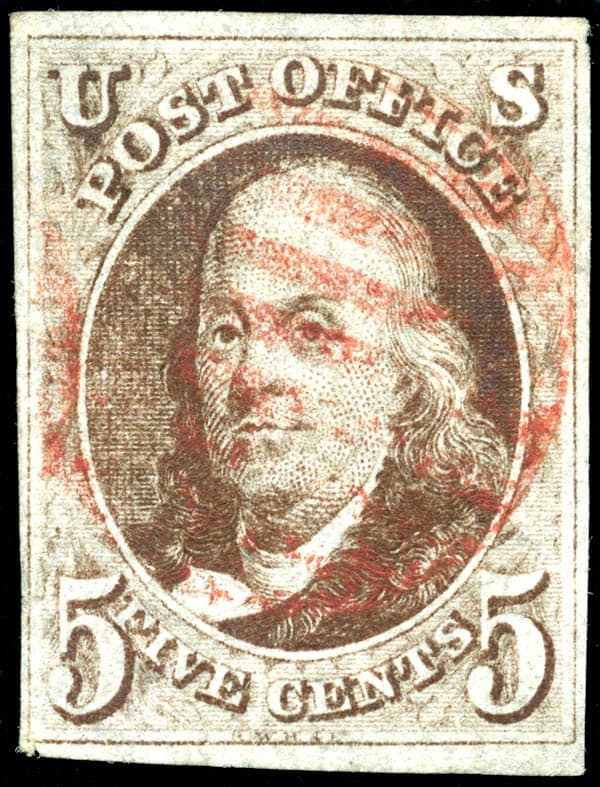
US 1847 5c Franklin (First Issue)
America's first national stamp was meant to show Andrew Jackson, was printed by a banknote firm from stock engravings, and was withdrawn after only four years, in part, historians believe, because the printer, not the government, owned the plates.
- Year
- 1847
- Maker
- United States (USPOD)
- By price in stamps
- 89 of 100
Create a free account to see every recorded price and every grade.
Create a free account- Issued
- July 1, 1847, New York City; Boston July 2, Philadelphia July 7
- Authorized by
- The Post Office Act of March 3, 1847
- Face value
- 5 cents, a half-ounce letter carried up to 300 miles
- Subject
- Benjamin Franklin, first postmaster general under the Continental Congress
- Portrait
- Based on artwork by James B. Longacre; vignette engraved by Asher B. Durand
- Printer
- Rawdon, Wright, Hatch & Edson, New York City banknote engravers
- Catalog
- Number 1 in the standard U.S. catalog; red brown on thin bluish wove paper, imperforate
- Printed
- 4,400,000, of which 688,000 were destroyed at demonetization; a dealer estimate puts the number issued at 3,600,000
- Demonetized
- 1851, after the rate fell to 3 cents
- This entry
- A four-margin used example
Seven years behind Britain
Great Britain issued the world's first prepaid postage stamp, the Penny Black, in 1840. The United States took seven more years. Before 1847 the only stamps in the country were privately produced, issued by postmasters in cities such as New York and Providence, and now known as postmasters' provisionals. Most mail was still rated by hand: a postmaster wrote the charge in the upper right corner, based on the number of sheets and the distance, and the charge could be paid by the sender, by the recipient, or split between them.
The pressure to modernize was real. The Smithsonian's National Postal Museum points to steady immigration, the push onto the western frontier, growing industry, rising literacy and the war with Mexico. On March 3, 1847, Congress passed an act authorizing the postmaster general "to prepare postage stamps, which, when attached to any letter or packet, shall be evidence of the payment of postage chargeable on such letter." Stamps became valid on July 1, 1847.
The 5-cent stamp paid for a letter of up to half an ounce sent up to 300 miles. Its companion, a 10-cent George Washington stamp, covered longer distances and heavier letters.
Franklin replaces Jackson
Postmaster General Cave Johnson gave the job to Rawdon, Wright, Hatch & Edson, the leading banknote engraving firm in New York, which had engraved and printed the New York postmaster's provisional two years earlier. The firm quoted twenty-five cents per thousand stamps for two colors and twenty cents for one; Johnson chose one color.
Johnson first told the firm to put the recently deceased President Andrew Jackson on the 5-cent stamp. The firm's essay showed Benjamin Franklin instead, and a letter of March 20, 1847, from the printer to the assistant postmaster general explains: "In accordance with your suggestion, we have substituted the Head of Franklin for that of Gen. Jackson." The National Postal Museum notes that Franklin, who had helped win independence and had served as the first postmaster general of the united colonies, made a more unifying figure for a divided nation.
Because the firm's customers were mostly banks, it kept a stock of engraved dies that could be dropped into any design, and it used stock banknote engravings and frames rather than cutting new ones. The Franklin vignette came from an existing engraving by Asher B. Durand, based on artwork by James B. Longacre. Several trial colors went to Johnson, who chose brown for the 5-cent and black for the 10-cent. The initials RWH&E are engraved at the bottom of the stamp.
The first days, July 1847
On June 26, 1847, the printers told Johnson that 600,000 five-cent and 200,000 ten-cent stamps were ready. A special agent, believed to be Third Assistant Postmaster General John Marron, reached New York on June 29. Before noon on July 1 he delivered 60,000 five-cent and 20,000 ten-cent stamps to the New York postmaster, Robert Morris. He then carried 40,000 five-cent stamps to Boston on July 2 and another 40,000 to Philadelphia on July 7.
No cover is known from the first day. The earliest known cover with one of the new stamps was postmarked in New York on July 2, 1847, and the earliest documented use of the 5-cent stamp itself is July 7, 1847. The stamps were gummed but not perforated, so clerks cut them from the sheet with scissors.
Not every postmaster welcomed them. Because a postmaster's pay depended on the business at his own office, some resented handling letters prepaid with stamps bought elsewhere; at least one tore stamps off covers and charged the recipient. The red ink used for many cancels could also be removed. One correspondent told the Post Office Department he could rub red cancels off by scrubbing the stamps against his wool trousers.
Shades, printings and how to spot a reproduction
The plate held 200 stamps in two panes of 100, laid down one impression at a time from a transfer roll, a process invented by Jacob Perkins. The 5-cent plate went to press five times. The brown inks, which contained metal oxides, wore away its fine lines; after the third printing the plate was nearly useless, so it was cleaned with acid before the fourth. That deepened the lines but also widened them, giving later stamps a soft, fuzzy look, and many of the finest lines vanished from the fourth and fifth printings. Each printing can be told apart by its impression.
Collectors recognize more than twenty-five major shades of the 5-cent stamp and almost a hundred more varieties beneath them. Plate varieties include six double transfers, a "T" crack and the "dot in S." Cancels are usually a red grid, a town postmark or a pen mark, and any other well-struck cancel is sought after. Most surviving stamps are used, and the margins of a hand-cut stamp are the first thing a buyer checks: this entry is a used example with all four margins clear of the design.
Two later versions trap the unwary. A reproduction made in 1875 by the Bureau of Engraving and Printing for the 1876 Centennial Exposition was never valid for postage; about 4,800 were issued, and it is slightly wider and shorter than the original's 18.5 by 23 millimeters. In 1947 a centenary souvenir sheet reproduced the design again, but in blue.
No full sheet of the 1847 issue is believed to survive. The largest pieces are a pane of 100 plate proofs of the 5-cent in orange brown, overprinted Specimen, found in a bank note company proof book. Among issued stamps, an unused top-left corner block of ten has been described as one of the largest multiples of the 5-cent in existence.
Four years, then worthless
The Post Office Act of March 3, 1851, cut the rate for a prepaid half-ounce letter to three cents for distances up to 3,000 miles, and the 1847 stamps were withdrawn. The National Postal Museum gives the demonetization date as July 1, 1851, and also reports that the stamps were no longer valid after July 30, 1851, with customers allowed to exchange them for new stamps until September 29.
The contract for the new stamps did not go to Rawdon, Wright, Hatch & Edson, which declined to bid without compensation if its design lost. The firm owned the 1847 plates and dies, and the museum believes that lack of government control was a reason the issue was demonetized. From then on, every printing contract gave the government possession of the plates and dies. In November 1851 the firm proposed destroying the 1847 plates and dies, and on December 12, 1851, three officials witnessed the destruction. No record documents the fate of the transfer rolls.
How many 5-cent stamps reached the public is not settled. A museum essay and a stamp identifier agree that 4,400,000 were printed; the identifier adds that 688,000 were destroyed at demonetization, leaving 3,712,000 issued, while a dealer estimate puts the number issued at 3,600,000.
Space number one in the album
To most collectors the 1847 5-cent and 10-cent stamps are the beginning of United States philately. Traditional albums gave them the first two spaces, and because their catalog values were high, the National Postal Museum notes, most young collectors left those spaces empty, which gave the stamps a mystique of their own.
Franklin went on to appear on more than one hundred thirty U.S. stamps, including the rarest Franklin stamp of all, the 1-cent Z grill of 1867-68, with only two copies recorded. The postal museum holds a 5-cent 1847 cover from Hyde Park, New York, postmarked June 18, 1848, the only known cover from that town with an 1847 stamp; it crossed the Atlantic on the steamer Acadia and reached Liverpool on July 5, 1848.
Used single stamps are the attainable form of this issue. At auctions in 2014, used singles sold for between $120 and $700, while an unused block of four with original gum brought $6,000 and the unused corner block of ten had brought $75,000 in 2012.
The numbers
- Issue date
- July 1, 1847
- Quantity
- 4,400,000 printed; 688,000 destroyed in 1851, leaving 3,712,000 issued (a dealer estimate says 3,600,000)
- Sheet
- 200 subjects in two panes of 100
- Printings
- Five press runs of the 5-cent plate
- Paper
- Thin bluish wove
- Perforation
- Imperforate
- Size
- 18.5 x 23 mm
- Rate paid
- Half-ounce letter up to 300 miles
- Valid until
- 1851 (July 1 or July 30, by different museum accounts)
Timeline
Rawdon, Wright, Hatch & Edson engrave and print the New York postmaster's provisional stamp.
Congress authorizes the postmaster general to prepare postage stamps.
The printer writes that it has substituted Franklin's head for Andrew Jackson's on the 5-cent design.
The printer reports 600,000 five-cent and 200,000 ten-cent stamps ready for delivery.
The stamps go on sale in New York City; 60,000 five-cent stamps are delivered to the postmaster before noon.
Stamps reach Boston; the earliest known cover with an 1847 stamp is postmarked in New York.
Stamps reach Philadelphia; earliest documented use of the 5-cent stamp.
A 5-cent stamp pays postage from Hyde Park, New York, on a letter later carried to Liverpool aboard the Acadia.
A new postal act cuts the prepaid half-ounce letter rate to 3 cents.
The 1847 issue is demonetized; the museum also reports validity ending July 30 and exchanges until September 29.
Three officials witness the destruction of the 1847 plates and dies.
About this date, an officially approved reproduction of the 5-cent is released; about 4,800 are issued.
A centenary souvenir sheet reproduces the design in blue.
The National Postal Museum opens a 150th anniversary display of the 1847 issue.
An unused top-left corner block of ten sells at auction for $75,000.
An unused block of four with original gum sells at auction for $6,000.
The world in 1847
Yerba Buena, California, is renamed San Francisco.
Thomas Edison is born.
Zachary Taylor's troops win the Battle of Buena Vista in the Mexican-American War.
Alexander Graham Bell is born, the same day Congress authorizes postage stamps.
U.S. forces capture Veracruz after a siege.
Brigham Young leads Mormon pioneers into the Salt Lake Valley.
Liberia declares its independence.
General Winfield Scott enters Mexico City.
Charlotte Bronte publishes Jane Eyre under the name Currer Bell.
Price record
| Date | Price | Kind |
|---|---|---|
| Apr 2012 | $16,500 | Sold at auctionTwo singles on an 1849 folded cover from Philadelphia to Prussia. |
| Oct 2014 | $700 | Sold at auctionUsed single with Carlisle postmark, graded F-VF 75. |
| Oct 2014 | $120 | Sold at auctionUsed single, pale brown shade, margins cut in at left, small creases. |
| Nov 2014 | $4,000 | Sold at auctionSingle on cover with manuscript cancel from Jacksonville, Florida. |
| Nov 2014 | $700 | Sold at auctionUsed single, gem example graded XF-Superb 95. |
| Nov 2014 | $180 | Sold at auctionUsed single, "dot in S" plate variety. |
A price-guide value is an editorial estimate, not a transaction and not an asking price. Guides lag the market and smooth over grade and condition. It is neither a floor nor a ceiling: a sale can land above or below it, and it should be checked against a realized sale before anything rests on it.
By reference price, US 1847 5c Franklin (First Issue) is number 89 of 100 in the stamps entries of the FLOAT 100. 82 of those 100 rest on a realized sale; the rest carry an asking price or a guide value, and each page says which. Rank within the FLOAT 100 itself (8 here) is editorial: how much an object defines its field, not price alone.
Did you know
- The 5-cent stamp was supposed to show Andrew Jackson. The printer swapped in Franklin, and the postmaster general accepted it.
- The printers built the stamp partly from stock banknote engravings they already had on hand.
- The 1847 stamps were withdrawn partly because the printer, not the government, owned the plates. Every U.S. stamp contract afterward gave the government the plates.
- One letter writer told the Post Office he could remove red cancels by rubbing stamps on his wool trousers.
- The 1875 reproduction is a slightly different size from the original and was never valid for postage.
- No complete sheet of the 1847 stamps is believed to exist.
- Alexander Graham Bell was born on March 3, 1847, the day Congress authorized postage stamps.
How this page is made
- The figure
- One reference price, shown with its own kind. FLOAT does not average it with anything or adjust it for time.
- Realized or not
- A realized price is a completed sale. An asking price, an estimate and a price-guide value are not sales, and are labeled as such wherever they appear.
- The story
- Researched from published records and checked fact by fact. Updated Oct 1, 2026.
- Archive
- Oct 5, 2026